


Massive public sector strikes expected to cripple Costa Rica in coming days
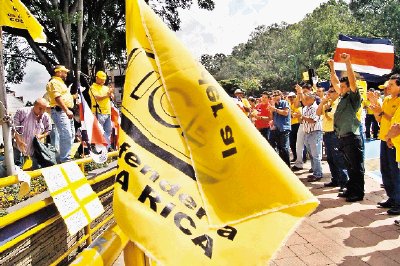
File photo
October 12th, 2015 (ICR News) What public sector union leaders are promising to be the largest series of union strikes in decades are expected to cripple Costa Rica in the coming days as talks between union leaders and the Solis administration continue to lead nowhere.
Despite talks between the Solis administration and union leaders on Wednesday and Friday last week – a last ditch effort by the administration to appease the unions – union blocs representing dozens of public sector unions are promising to take to the streets in the days ahead.
One of the two largest union blocs, known as Bussco and which represents some 60 public sector unions from nearly every government institution, says its unions will call a general strike and take to the streets beginning Friday, October 16th.
Meanwhile, the union bloc known as Patria Justa confirmed a general strike beginning 10 days later, on October 26th. The bloc consists of the unions of dockworkers, the Costa Rican Oil Refinery (RECOPE), the Costa Rican Electricity Institute (ICE), and some 55 municipal workers unions across the country.
Other unions allied with Patria Justa who have confirmed their participation include the National Assocation of Public and Private Employees (ANEP), the National Insurance Institute (INS) workers union (UPINS), the nurses’ union, and several others including unions representing health, education, and immigration workers.
Union leaders are protesting proposed legislation that aims to regulate wages and salaries paid to public sector employees.
The Solis administration has been under pressure this year to rein in excessively high salaries, benefits and pensions paid to public employees as the country’s fiscal deficit soars.
Union leaders also say the strikes will be in protest to the high cost of living and unemployment.
For their part, many lawmakers from across political aisles have described the looming strikes as “senseless” and unnecessary in recent weeks.
Lawmakers last month also condemned a threat made by ICE union boss, Fabio Chaves, that journalists could face violence during the demonstrations.
In announcing the looming strikes last month, Chaves threatened that reporters could face acts of reprisals in the streets if the media doesn’t end what he called a “campaign of demonization against public employees.”
The massive strikes could affect a wide range of public services, from public schools and hospitals to municipal services like garbage collection, amongst many others.

ATTENTION: If you are seeing this message,
- randy berg
- lazymainer
- Roberto
- costarick
- Ben
- Mark Nelson
- disgusted
- prdatki

