


Humpback whales find sanctuary for raising young in Costa Rica
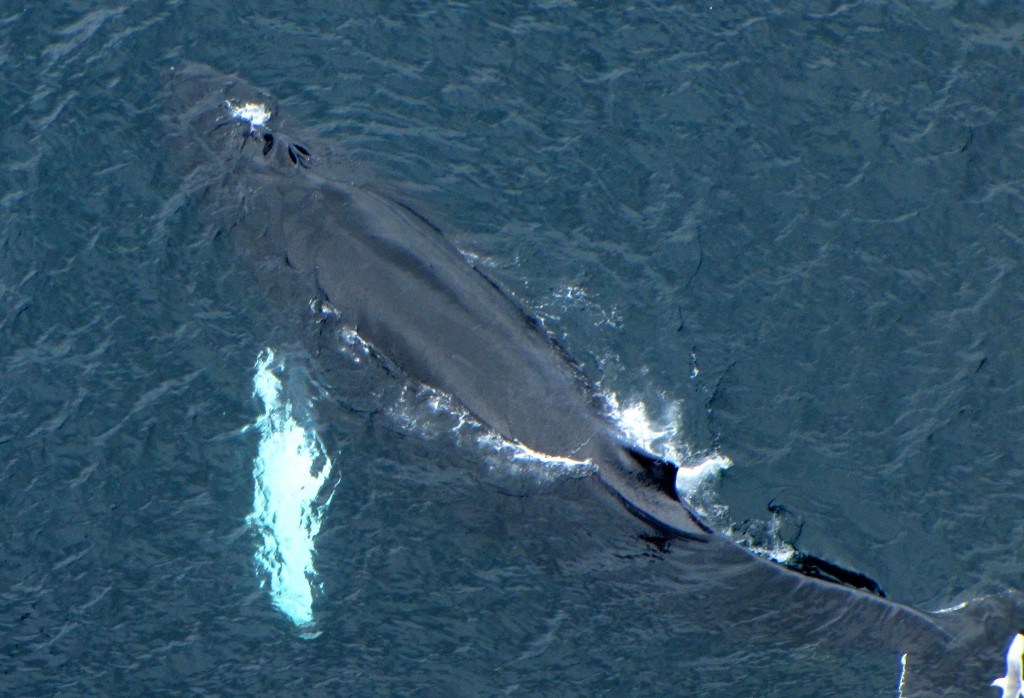
A Humpback Whale surfaces. (Wikimedia Commons)
September 7th, 2015 (EFE) Every year some 700 humpback whales from the Northern Hemisphere swim down to Marino Ballena National Park, located on the South Pacific side of Costa Rica, to mate and give birth to their young.
During four months of the year, the warm waters become a natural sanctuary where hundreds of humpback whales, one of the world’s largest animals, put on a spectacular show that draws crowds of tourists.
Their acrobatic leaps, the sound of their breathing and the height of their blows, their huge size and complex song are some of the attractions these cetaceans offer to whale watchers positioned just a few meters (yards) away.
Tropical Costa Rican seas keep them from wasting energy to maintain their body heat, since the water temperature ranges between 25 C (77 F) and 28 C (82 F), which makes it ideal for reproduction.
The whales also head for relatively shallow areas to distance themselves from their natural predators like sharks and orcas.
Marino Ballena National Park is where they gather, the place they were born and emigrated with a “Costa Rican passport” toward the polar regions, and where some return once every year.
That journey has given them the world record in migration for a sea mammal, with a total of 18,000 kilometers (11,200 miles) between the Arctic and Costa Rica’s Pacific coast.
Along the way, mother whales teach their calves to swim, hunt, breathe, breach and leap.
This species can soar completely out of the water, the reason for its fame as the most acrobatic in the world, and it also slaps the water with its tail as a form of communication and a way to exercise.
Sightings of these cetaceans in Costa Rica won the National Geographic’s rating as the 7th best place in the world for whale watching. Topping the list is a place in Norway.
Figures from the Costa Rican Tourism Institute show that the number of foreign tourists who went whale watching in Costa Rica has recently tripled, jumping from 43,302 in 2010 to 133,926 in 2014.
Adult humpback whales measure between 14 meters (46 feet) and 17 meters (56 feet) long and weigh up to 45 tons, and have a life span of some 70 years.
In addition to the whales, the park offers a great variety of other marine attractions including the pantropical spotted dolphin, the bottlenose dolphin, sea turtles and more.

ATTENTION: If you are seeing this message,
- Yeims

