


Construction of Nicaragua Canal to begin on December 22nd, officials say
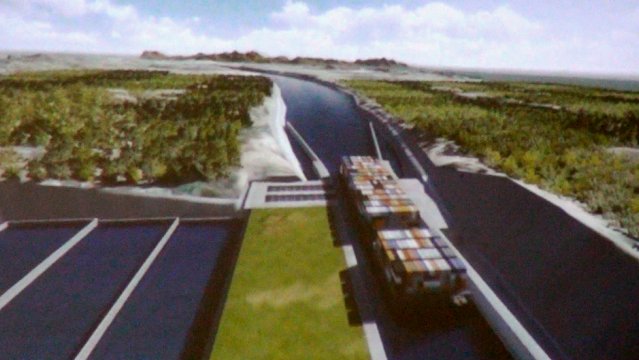
An artists rendering of a portion of the canal. (Courtesy / File)
November 21st, 2014 (InsideCostaRica.com) The construction of a $50 billion USD interoceanic canal through Nicaragua which would dwarf the Panama Canal is set to begin on December 22nd, Nicaragua officials confirmed yesterday.
Officials said that the first works would be the construction of ports and secondary roadways.
HKND, the Chinese concessionaire behind the project, said that saltwater intrusion into Lake Nicaragua (also known as Lake Cocibolca) would be “minimal” because of the design of the project’s locks, and that excess salt water would be drained into the San Juan River (Rio San Juan).
With an area of 8,264 square kilometers, the lake is the largest in Central America and an important source of fresh water. Environmentalists and others have expressed their concern this year that the canal would salinate the lake.
For its part, Costa Rica in July expressed its concerns over the project’s possible environmental impacts, demanding environmental impact studies and assurances that the canal would not affect the flow or navigability of the San Juan and Colorado rivers.
Costa Rica also expressed its concern over accidents such as spills from oil tankers traversing the canal.
Opposition in Nicaragua to the canal project has been growing in recent months, based both on environmental and socioeconomic concerns.
Those who live in the canal’s path will have to move, and there have been recent reports that HKND representatives, with Nicaraguan police officers and soldiers acting as guards, have appeared in peoples’ homes taking measurements and informing homeowners that their property will be purchased by the company.
Reports indicate that the company intends to only compensate property owners for the taxable, rather than market values of their homes and properties.
Numerous protests surrounding the likely evictions have ensued.
During one such protest in early October around La Unión, located in the Región Autónoma del Atlántico Sur, RAAS, in Eastern Nicaragua, some three thousand inhabitants marched with signs that read “The land is not for sale… Nicaragua will not give up!” as well as “Ortega: betrayer of the homeland!”
The people demanded that the construction of the Canal must not pass through their lands. In fact, an indigenous representative, Brooklyn Rivera Bryan, highlighted that the Canal’s current plan passes through a community of the Rama indigenous people, which the government should protect instead of evict.
Similarly, in late September some 250 inhabitants of a community in the department of Rivas carried out a peaceful march protesting the likely evictions that the Canal will cause. “We are fishermen and we have livestock, we cannot live in the city, we cannot take the lake and the livestock [when we move]” one local leader declared.
The famed Nicaraguan priest, poet, and politician Ernesto Cardenal went so far as describing the canal as a “monstrosity” in a column published earlier this month, and painted a bleak picture of the canal’s impact on Nicaragua’s environment and landscape.
Cardenal, a native of Granada, said that “the islets of Granada will disappear” as the locks would raise the level of the lake by two meters and that “with every passing ship, huge amounts of fresh water would go to sea.”
“With this canal the country will be divided into two, North Nicaragua and South Nicaragua, as there were two Germanys and as there are two Koreas. There will be two distinct populations of animals (except those that can fly) which will become more and more different with time, which will hurt our biodiversity,” Cardenal wrote.
HKND deputy construction manager Pang Kwok Wai, however, said that water levels, fishing activity and biodiversity in the lake “will not be affected.”
In total, the $50 billion project includes two ports, an airport, an artificial lake, two sets of locks, a free trade zone, tourist facilities, roadways and cement factories. The canal route will be three times longer than that of the Panama Canal and able to accommodate ships up to 400,000 tons.
The project is expected to create 50,000 direct jobs and 200,000 indirect jobs, according to officials.
The Chinese developers of the canal said last year that “Nicaragua will become by far the richest country in Central America [as a result of the canal] – and that will affect the entire region.”
HKND’s concession could last up to 100 years.

ATTENTION: If you are seeing this message,
- NorthendFool
- expatin paradise
- Mike Wise
- HONEST MAN
- Michael Clarkson

