


Two years after Nicoya Earthquake, a lot still to learn

A severely damaged house in Nosara after the 2012 Nicoya earthquake. (Photo: Giordano Ciampini / La Voz de Guanacaste)
By Henry Morales and Roberto Acuña / La Voz de Guanacaste
September 8th, 2014 (La Voz) September 5th marked the second anniversary of the Nicoya earthquake that had an epicenter off the coast of Playa Samara and shook the entire country, with a 7.6 magnitude on the Richter scale. Fortunately, the earthquake did not cause any deaths, but it did leave more than 100 homes damaged.
But experts say that Nicoya is an area of seismic activity and for that reason preparation for another earthquake is necessary. With that goal, the Nicoya Campus of the National University developed a tsunami prevention symposium to prepare the community and its student body. The event was held September 2-5 and brought together experts from diverse parts of the world.
According to the presenter Theofilos Toulkeridis, a Greek geochemical specialist, in Latin America there is still a lot to learn about prevention in light of this kind of natural phenomenon.
“I believe that in recent years we have advanced a lot. However, there is a lot to do in the area of prevention. On Costa Rica’s coasts prevention and risk management education has already been implemented in schools,” Toulkeridis said.
Juan Luis Porras, a geologist with the National Seismology Network at the University Costa Rica, thinks that although the Nicoya Peninsula is a region with a lot of seismic activity, the people don’t pay it the attention it deserves.
“Here it is thought that an earthquake will never happen, but with the experience of other countries such as Japan, Sumatra and the Philippines we [should] realize the importance of being educated on the subject. It’s incredible that first world countries such as Japan have suffered such devastation for not being prepared,” said Porras.
Preparation in Communities
With the goal of educating and organizing people for earthquakes and tsunamis, the University of Costa Rica, in collaboration with the Ministry of Public Education, has implemented a training program for coastal elementary schools.
According to Porras, the idea is that the children learn to react to an emergency from an early age and that it will not take them by surprise.
“Recently the subject has become more important. We have tried to reach coastal schools, to bring children the idea they can learn in a fun way, but above all, to raise awareness of the magnitude of this kind of disaster,” he explained.
In addition to the work in primary schools, the National Emergency Commission (CNE – Comision Nacional de Emergencias) has been supporting the development of Communal Emergency Committees.

Garza beach after the earthquake. (Contributed photo / La Voz de Guanacaste)

Super Nosara after the earthquake. (Contributed photo / La Voz de Guanacaste)
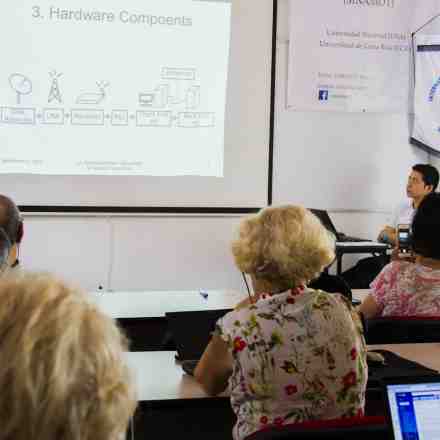
The Nicoya Campus of the National University developed a tsunami prevention symposium to prepare the community and its student body.
(Photo by Ariana Crespo / La Voz de Guanacaste)

ATTENTION: If you are seeing this message,

