


Specialists warn against excessive fungicide use in fight against coffee rust
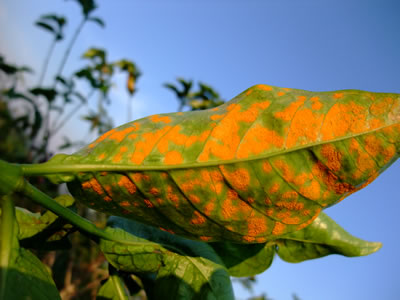
How coffee rust gets its name – this is a coffee leaf infected with the fungus. (ICR Archive)
May 28th, 2014 (InsideCostaRica.com) Over the past couple of years, coffee production in Central America has been hit by a deadly wave of coffee leaf rust (“roya” in Spanish), a type of fungus that has hurt the production of this valued commodity in the region. Costa Rica has lost at least $46 million as a result.
Now, experts from the University of Costa Rica (UCR) are warning farmers against the excessive use of fungicides to battle the epidemic, which they say can damage the environment as well as human and animal health.
As a result, a forum will be held by UCR agronomists on Friday, May 30th, on the current state of chemical use in the fight against coffee rust, aimed at educating producers about the proper use of fungicides and the dangers of excessive use.
The free activity will take place at the College of Agricultural Engineering in Moravia, aimed at educating producers on when and how to properly apply fungicides.
María del Milagro Montero Granados, president of the Association for Professionals in Plant Disease (APEP), said that agrochemical companies have launched marketing campaigns during the coffee rust outbreak, marketing supposedly “new” products which are in fact “based on the same molecules that have been in use for 20 years, which have harmful side effects on plant physiology,” according to Granados.
Some 50,000 families depend upon coffee production for their livelihoods in Costa Rica, 90% of which are small and medium producers.
Some 10,000 hectares of coffee have been affected by the epidemic in Costa Rica, resulting in a loss of 232,916 bushels during the 2012-2013 period.
Costa Rican authorities declared a national emergency over the epidemic in early 2013.
Read more about Costa Rica’s coffee rust problem.

ATTENTION: If you are seeing this message,
- expatin paradise

