


Skull discovery might rewrite human evolution
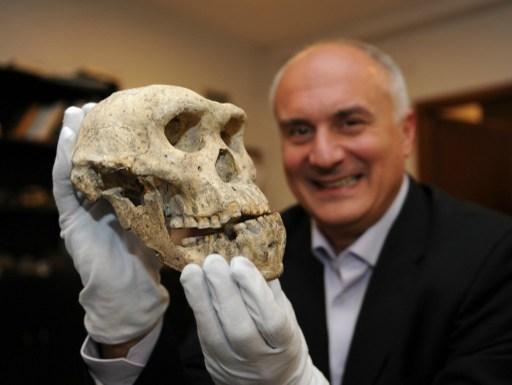
A picture taken in Georgia’s capital in Tbilisi on October 18, 2013, shows David Lordkipanidze, director of the Georgian National Museum, holding a well-preserved skull from 1.8 million years ago found found in the remains of a medieval hilltop city in Dmanisi. A stunningly well-preserved skull from 1.8 million years ago offers new evidence that early man was a single species with a vast array of different looks, researchers said yesterday. AFP PHOTO /VANO SHLAMOV
TBILISI, October 18, 2013 (AFP) – Georgian scientists on Friday presented a 1.8 million-year-old skull discovered in the Caucasus nation that researchers say could force a re-evaluation of current theories of human evolution.
The skull — unearthed in the medieval town of Dmanisi some 100 kilometres (62 miles) southwest of the capital Tbilisi — is the first completely preserved skull found from that period.
Along with four other skull samples uncovered at the site, it appears to show that early man was a single species with a wide range of looks rather than several distinct species.
“Today in this skull — and the other Dmanisi samples — we see all the features lumped together in one group that we previously thought identified different groups,” David Lordkipanidze, Georgia’s national museum director, told AFP after a presentation in Tbilisi on Friday.
“This is the most important thing — we are touching the earliest stages of genus homo and its lineage,” Lordkipanidze said.
The collection — which is housed in the vault of Georgia’s national museum — is “the richest collection of hominids in the world from that time”, according to Lordkipanidze, the lead researcher on the project.
“We wanted to share with the Georgian public here what we had found,” he said before allowing a small number of journalists into the vault to see the original skull.
The stunningly well-preserved find — known as Skull 5 — has an almost-complete set of teeth and seems more elongated than a normal human skull.
The fossil — which is about a third the size of a modern human head — is normally kept in a special padded box in the vault.
Wearing white gloves to avoid contaminating the sample, a beaming Lordkipanidze held up both the jaw and main section of the skull as photographers took pictures.
A replica of the skull was unveiled for display to visitors in the museum.
The conclusions — published in the US journal Science on Thursday — are the result of some eight years of research carried out by Georgian and international scientists since the discovery of the skull in 2005.
The skull was found lying a few metres from where its jawbone had been discovered earlier in 2000.
The scientists behind the discovery claim the different lineages some experts have described in Africa — such as Homo habilis and Homo rudolfensis — were all just ancient people of the species Homo erectus who looked different from each other.
They also suggest that early members of the modern man’s genus Homo, first found in Africa, soon expanded into Asia despite their small brain size.
But not all experts agree.
“I think that the conclusions that they draw are misguided,” said Bernard Wood, director of the hominid paleobiology doctoral program at George Washington University.
“What they have is a creature that we have not seen evidence of before,” he said, noting its small head but human-sized body.
“It could be something new and I don’t understand why they are reluctant to think it might be.”
Researchers did give the skull’s owner a new name, Homo erectus ergaster georgicus, in a nod to the skull as an early but novel form of Homo erectus found in Georgia.
The site of the discovery — thought to have been close to an important water source — also contained rudimentary stone tools hinting at early butchery techniques and the bones of large, sabre-toothed cats.

ATTENTION: If you are seeing this message,
- m_kelly84

