


Honduras: Authorities seek to reduce crime in Tegucigalpa
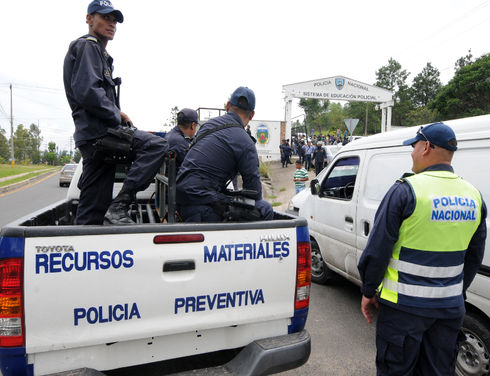
The United Nations’ “Safe and Friendly Cities for All” program has been operational in Tegucigalpa, Honduras, since Aug. 7. The initiative includes military and police operations to reduce crime in the nation’s capital. (Orlando Sierra/AFP)
Rene Novoa / ISH
TEGUCIGALPA, Honduras (ISH) – The “Safe and Friendly Cities for All” program seeks to eradicate crime in the 25 most dangerous neighborhoods in the Honduran capital.
The initiative is run by the United Nations Children’s Fund (UNICEF), UN Women and Tegucigalpa’s Municipality of the Central District (AMDC).
“The purpose [of the program] is to reduce femicide, homicide of children and youth and recover public spaces by cleaning and repairing streets, sports fields and schools, among others,” Tegucigalpa Mayor Ricardo Álvarez said.
“Transform Tegus,” which the Honduran version is called, forms local committees to monitor possible violations against women, children and adolescents’ rights.
AMDC’s staff has been implementing the program since Aug. 7 in the 25 neighborhoods, where the program also funds projects to improve streets and street lighting to reduce crime rates.
In October, UN Women will train community committees through workshops, where community leaders will be identified.
“We will focus on creating social awareness of the problems that cause crime and we also will work to recover public spaces,” Álvarez said. “We will be the links for community leaders and the government to find solutions to every sector’s problems.”
The 25 neighborhoods are: Cerro Grande, Villa Unión, Flor del Campo 1 and 2, La Laguna, 3 de Mayo, Las Mercedes, El Porvenir, Zapote Norte, Campo Cielo, Nueva Capital, Divino Paraíso, Ramón Amaya Amador, Villanueva, Los Pinos, Carrizal 1 and 2, José Ángel Ulloa, Nueva Danlí, Mary Flakes de Flores, Belén, Altos del Paraíso, Nueva Suyapa, Cruz Roja and 14 de Marzo, as the program will benefit about 240,000 of Tegucigalpa’s 1.4 million residents.
Between January and June, 725 homicides were reported in the capital. In 2012, the total number of homicides reached 1,035, according to the Violence Observatory of the National Autonomous University of Honduras (UNAH).
“We have registered a high incidence of crimes in these neighborhoods and districts, so we are conducting permanent patrols to provide security,” said Julián Hernández, a spokesperson for Ministry of Security.
Honduras has a homicide rate of 85.5 per 100,000 residents, which is one of the highest in the world, according to the Violence Observatory.
The program will be implemented over five years, according to Álvarez.
“Safe and Friendly Cities for All” has been implemented in seven other cities since 2011: Rio de Janeiro, Brazil; Beirut, Lebanon; Nairobi, Kenya; Marrakech, Morocco; Manila, Philippines; Dushanbe, Tajikistan; and San José, Costa Rica, according to Héctor Espinal, a UNICEF Honduras spokesperson.
Xavier Rodríguez, a 24-year-old psychology student who resides in the neighborhood of Las Mercedes, said an increased police presence and improvements to the community have raised residents’ optimism for the program.
“It’s great that authorities are concerned with providing security for us because prior to the operations people could not go out at night for fear of losing their lives,” he said.
Rodríguez also highlighted the recovery of public spaces.
“Recreation areas are an important issue for adolescents and minors,” he added. “It is fundamental to educate young people and children for a better future and to reduce the high crime rate.”
Jancy Salamanca, a 35-year-old systems analyst and mother of three who lives in the neighborhood of Cerro Grande, said children’s safety is a priority.
“I hope the results are immediate in terms of reducing homicides because I do not even let my children out in front of the house due to so much insecurity that overwhelms us,” she said.
Salamanca also is alarmed by the femicides registered nationwide in 2013.
From January to June, 225 femicides were reported after 606 women were murdered in all of 2012 and 512 were killed in 2011, according to the Center for Women’s Studies – Honduras (CEM-H), an NGO that focuses on gender issues.
“There must be a stop to killing women,” Salamanca said. “We no longer feel safe anywhere. I call on authorities to stop this wave of violence against us and punish the perpetrators.”
The United Nations’ program will strengthen efforts aimed at reducing crime, according to CEM-H Director Suyapa Martínez.
“The murder of women is alarming because it grows year after year, and until now, most of the perpetrators get away with this crime,” Martínez said. “Crime in general can be reduced by cleaning areas and street lighting, implementing a culture of peace and of course, strengthening the structures for investigating crimes.”
Last February, the National Congress amended Article 118 of the Penal Code to include a prison sentence between 30 and 40 years for those guilty of femicide.
Irma Grissel Amaya, the special prosecutor for women, said just 74 of the 1,343 cases of femicide her office has handled since 2008 have been prosecuted, resulting in 48 convictions. The remaining cases are under investigation.
“Unfortunately, we do not have a qualified investigation team, but we do everything in our power to combat these crimes,” Amaya said.
Espinal said the “Safe and Friendly Cities for All” program brings hope for Hondurans.
“I am sure there will be positive short-term results in the country because when Hondurans unite for a common cause, they achieve extraordinary goals,” he said.

ATTENTION: If you are seeing this message,

