


Communities, police fight narco-trafficking
By Mario Garita for Infosurhoy.com
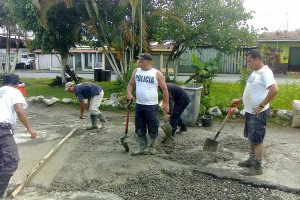
Every month, law enforcement agents celebrate “A Day for my Community” in different districts across the country. Above, police officers pave the streets in Turrialba, about 51 kilometers from the nation’s capital of San José. (Courtesy of the Ministry of Public Safety)
SAN JOSÉ, Costa Rica – The Costa Rican government’s National Drug Plan for 2013-2017 involves increasing citizens’ roles in the fight against narco-trafficking.
“An effective approach to the challenge of protecting society against the drug scourge cannot be carried out exclusively by government authorities,” Interior Ministry Drug Commissioner Mauricio Boraschi said. “That is why prevention – perhaps the main tool for tackling the drug problem – depends on families, neighborhoods, educators, churches, youth leaders and their principle partners to protect our children and adolescents.”
Authorities in the Central American nation have confiscated nearly 22.8 tons of cocaine, about 377,000 doses of crack, destroyed nearly four million marijuana plants and seized about US$10.5 million in cash proceeds from drug trafficking between 2010 and February 2013, according to Boraschi.
Iván Dumani, the director of Preventive Policing Programs who coordinates the 1,513 Community Safety Committees nationwide, is confident authorities can make even more seizures if communities become more involved in the counter-narcotics fight.
“The goal is for residents to get organized, so we provide free training,” Dumani said. “There are 12 modules with weekly meetings. At each police station, there is an officer responsible for addressing [their concerns].”
The modules teach residents how to act in risky scenarios.
“Police patrol the neighborhood, but it is the people in the neighborhood who are familiar with any strange activity,” Dumani said.
In 2013, police will focus on standardizing strategies for committees that have graduated instead of focusing on training more people.
“We’ve started to notice that committees graduated and the police continued to train new committees, [but] we have reduced this effort so we can put more emphasis on monitoring [those who have already graduated]. If you don’t meet with them, they tend to forget about the projects,” Dumani said.
Additionally, law enforcement is partnering with community associations, the Ministry of Culture, and the Institute on Alcoholism and Drug Dependence (IAFA) to restore public spaces that are hotbeds for drug dealers and addicts.
“There is more to it than just putting patrol cars in public areas,” Dumani said. “It also involves developing activities that make the traffickers leave.”
Every month law enforcement agents celebrate “A Day for my Community” in different districts nationwide, when they perform all sorts of community work, from talks on drug prevention, to playing sports to paving roads.
These efforts have been successful in engaging at-risk youth, according to David Aguilar, a resident of the city of Santa Ana who frequently is involved in prevention activities organized by law enforcement agents.
“The same young people who caused problems in the community in the past now participate in these activities,” Aguilar said. “They have managed to focus their energy on other things. You can bring them here to play sports and have fun in a healthy way.”
Commissioner Raúl Rivera, the regional director of the San José Police Force, emphasizes the importance of work between the community and police.
“This new partnership will lead us not only to join forces but create a safe and organized province in which citizens always will lead the way,” he said.
The National Drug Plan also focuses on combating narco-trafficking crime groups.
From 2006 to 2012, the Drug Enforcement Police (PCD) dismantled 640 narco-trafficking organizations, including 552 local, 88 international groups and 178 narco-families, according to Boraschi.
In addition, Drug Enforcement Police created the 1176 toll-free number so residents can report any narco-trafficking activity confidentially.
The National Drug Plan also aims to treat drug use as a public health problem through information and prevention.
“We can only make a difference with the support, commitment and involvement of each and every one of us,” Boraschi said.

ATTENTION: If you are seeing this message,
- http://www.facebook.com/mickey.atkinson.7 Mickey Atkinson
- http://www.facebook.com/fhuh.kew Fhuh Kew

