 Concept of Family in Costa Rica Is Changing
PAC Party Makes Political History Tomorrow
No New AH1N1 Flu Cases Reported in Costa
Rica For Three Consecutive Days
Driving In The
Rain Increases Chances Of An Accident
Jaguar Mums
Give Up Baby Secrets
Costa Rica
Increases Marketing Spending To Attract C&I
Business
Jaguar Mums
Give Up Baby Secrets
Ongoing
study in Costa Rica has revealed that
females in the wild give birth every 22 to
24 months
By Matt Walker, Earth News
Jaguars are one of the most elusive of large
animals, reluctant to be filmed or tracked
in their natural habitat. But now biologists
have finally managed to learn one of the big
cat's secrets; how often it gives birth.
An ongoing study in Costa Rica, one of the
last strongholds of the jaguar, has revealed
that females in the wild give birth every 22
to 24 months.
Knowing the reproductive behaviour of the
species will be vital information in helping
to protect the species.
Numbers of jaguars, the third largest of all
cat species and the largest in the New
World, are declining.
The big cat is occasionally sighted in
Arizona and New Mexico in the US, and
populations remain within Mexico and south
through Central America and into South
America, including much of Amazonian Brazil.
But the species is listed as Near Threatened
by the World Conservation Union.
If conservationists are to estimate how the
last remaining populations of jaguar might
grow, they need to know three things: how
many cubs females have in each litter, how
many of those cubs survive on average, and
how often females give birth to new litters.
But most information about the reproductive
habits of jaguars comes from observations in
zoos, which may not reflect how jaguars
reproduce in the wild. Even in captivity,
researchers have been rarely able to
document how often females give birth to new
litters.
So Eduardo Carrillo and Joel Saenz of the
National University in Heredia, Costa Rica
and Todd Fuller of the University of
Massachusetts, in Amherst, US embarked on an
ongoing study of jaguars living in the
Corcovado National Park in west Costa Rica.
The study began in 1990 after Carrillo saw a
female jaguar walking with a single cub
across a beach in the park during the day.
"At that time there were few jaguar studies
and the lack of information was an important
issue when making management decisions about
jaguar conservation," says Carrillo. "So in
1994 we decided to radio mark jaguars. In
2003 we began using camera traps."
During the study, they found that jaguars in
the park feed mainly on peccaries and marine
turtles.
The diet surprised the biologists because an
adult jaguar is capable of eating any animal
that crosses its path, including people,
though there is no record of a wild jaguar
ever having attacked a person in the wild.
They also managed to follow a single female
jaguar for three and a half years, by using
the radio collar to triangulate her position
and identifying her particular paw prints
left in the mud.
In March one year, they saw the female being
attended to by an adult male. By late May or
early June she gave birth, and was seen
accompanied by a single cub in July.
That cub remained with its mother for 19 to
20 months. Then some 22 months after she had
first given birth, Carrillo noticed she was
again pregnant, and was seen with a new cub
a month or two later.
That confirms that wild jaguars seem to give
birth once every 22 to 24 months, and that
juvenile jaguars leave the company of their
mother after 18 to 24 months, the team
report in the journal Mammalian Biology.
Jaguars are thought to give birth to more
than cub on average, though it is unclear
how many usually survive until adulthood.
"One of the main questions about jaguars is
their natural birthing habits," says
Carrillo. "We have little knowledge about
this until now."
However, despite the team's camera traps
recording pictures of adult jaguars, the
mothers are still proving protective of
their offspring.
"We have pictures of pregnant females, but
we have never taken a picture of a female
jaguar with its cubs."
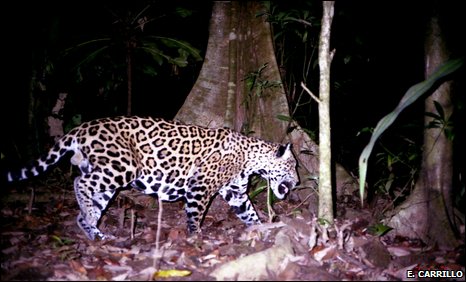
Camera trap shot of a jaguar in Corcovado
National Park |
|
|
|
|


