|
|
 Third Week of Panama
Health Strike
Third Week of Panama
Health Strike
Nicaragua to
Decriminalize Gay Sex
Colombia's Main Armed
Rebel Groups Meet in
Venezuela
Fidel Castro: The
Conversation with Chavez
Venezuela, Iran to Work
Against U.S.
Bolivian President
Accuses U.S. of
Conspiracy |
|
Venezuela, Iran to Work
Against U.S.
BEIJING - The
presidents of Venezuela
and Iran said Monday
that they will defeat
U.S. imperialism
together, noting that
the fall of the dollar
is a prelude to the end
of Washington's global
dominance.
Venezuelan President
Hugo Chavez (C)
gestures, as he shakes
hands with his Iranian
counterpart Mahmoud
Ahmadinejad, during an
official welcoming
ceremony for Chavez in
Tehran, Iran, Monday,
Nov. 19, 2007. (Photo:
China Daily/Agencies)
Photo Gallery>>>
Hugo Chavez's visit to
Mahmoud Ahmadinejad in
Tehran followed a failed
weekend attempt to push
the Organization of
Petroleum Exporting
States away from trading
in the slumping
greenback.
Their proposal at an
OPEC summit was
overruled by other
cartel members led by
Saudi Arabia, a strong
U.S. ally. But the
cartel agreed to have
OPEC finance ministers
discuss the idea, and
the two allies' move
showed their potential
for stirring up problems
for the U.S.
The alliance between
Chavez and Ahmadinejad
has blossomed with
several exchanged visits
-- Monday's was Chavez's
fourth time in Tehran in
two years -- a string of
technical agreements
were reached.
"Here are two brother
countries, united like a
single fist," Chavez
said upon his arrival in
Tehran, according to
Venezuela's Bolivarian
News Agency.
"God willing, with the
fall of the dollar, the
deviant US imperialism
will fall as soon as
possible, too," Chavez
said after a two-hour
closed meeting with
Ahmadinejad, the Iranian
state news agency IRNA
reported.
As the dollar weakens,
oil prices have soared
toward 100 dollars a
barrel. Chavez said over
the weekend at the OPEC
meeting in Riyadh, Saudi
Arabia, that prices
would more than double
to 200 dollars if the
U.S. attacked Iran or
Venezuela.
"The U.S. empire is
coming down," Chavez
told Venezuelan TV,
calling the European
Union's euro a better
option and saying Latin
American nations were
also considering a
common currency.
The Venezuelan president
is a fierce critic of US
President Bush, and
Iran's government is in
a bitter standoff with
Washington over Tehran's
nuclear program. The
U.S. accuses Iran of
seeking to develop
nuclear weapons, a claim
Tehran denies, and Iran
has been hit with two
rounds of UN sanctions
for refusing to suspend
uranium enrichment.
Ahmadinejad backed his
"dear brother" Chavez in
their joint fight with
the Bush administration.
"We have common
viewpoints and we will
stand by each other
until we capture the
high peaks. God is with
us and victory is
awaiting us,"
Ahmadinejad was quoted
as saying by IRNA. He
said he and Chavez would
stick together to defend
their "nations and
ideals to the end."
During the OPEC meeting,
Iran and Venezuela
proposed that the cartel
begins pricing its oil
in a basket of
currencies, rather than
just the dollar, and
wanted the summit to
specifically express
concern over the
dollar's slide in its
final statement.
Saudi Arabia blocked
those moves. Saudi
Arabia's foreign
minister cautioned that
even talking publicly
about the currency's
decline could further
hurt its value.
Chavez repeated his
warnings that attacking
Iran would further
increase oil prices.
"It's very important
that they leave us in
peace, the major
oil-producing
countries," he said.
"If it occurs to Bush to
invade Iran, I'm sure
the Iranians will
resist, and they aren't
going to allow them to
take away their oil,
just as we Venezuelans
wouldn't allow it," he
said.
In Tehran, the two
presidents signed four
memorandums of
understanding Monday to
create a joint bank, a
fund, an oil industry
technical training
program and an
industrial agreement,
Iranian state television
said. It said Chavez
then left after an
official farewell
ceremony.
On Chavez's previous
visit in July, the two
leaders broke ground for
construction of a
jointly owned
petrochemical complex in
Iran, with 51 percent of
it in Iranian ownership
and 49 percent to be
owned by Venezuela. The
two nations also began
construction of a second
petrochemical complex in
Venezuela, at a total
combined cost of 1.4
billion dollars.
Chavez and Ahmadinejad
believe their
petrochemical
partnership will help
Iran win markets in
Latin America and
Venezuela to gain access
to Asia's energy market,
especially India.
Since 2001, the two
countries have signed
more than 180 trade
agreements, worth more
than 20 billion dollars
in potential investment,
according to official
reports.
Iran has partnered with
Venezuela on several
industrial projects in
the South American
nation, including the
production of cars,
tractors and plastic
goods. |
|
|
|
|
|
|
|
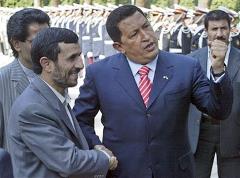
Venezuelan President
Hugo Chavez (C)
gestures, as he shakes
hands with his Iranian
counterpart Mahmoud
Ahmadinejad, during an
official welcoming
ceremony for Chavez in
Tehran, Iran, Monday,
Nov. 19, 2007. |
|
|
| |
|


