|
Eliminate Your Computer Viruses or Risk Being
Cut Off By Racsa
Tired of spam or unwanted emails? The
Radiográfica Costarricense (Racsa) says it is
doing something about it and each month, on
average, it disconnects 35 users from its
internet service because their computers
computers contain a virus that generates spam or
junk emails.
Racsa says that when it detects a problem, it
calls the customer and notifies them of the
disconnection until the virus is eliminated from
their computer.
The head of the Asistencia Técnica de Racsa,
Miguel Montero, explains that the measure is
strict because if, on an international level,
Costa Rica is labelled as a "spam" country, it
can be blocked from the world wide web.
"This means, that beyond our borders, no website
hosted in Costa Rica will be available to the
web, nor can emails be received or sent from
here. This occurred back in 2001", said Montero.
According to Racsa reports, so far this year,
106 customers were disconnected.
In all cases Racsa reports that the users became
part of a "botnet", a jargon term for a
collection of software robots, or bots, which
run autonomously.
In 2001, Costa Rica ranked number 5 of countries
generating the most spam. A number of countries
began to block Costa Rican servers and all
domains with the ".co.cr".
However, by 2004, Racsa was able to reduce the
amount of spam generated from Costa Rica mainly
due to measures and anti-spam regulations
adopted by the state agency .
According to Montero, the spam filters that were
put in place last March have effectively reduced
the number of e-mails with spam virus by 97%.
However, with all the controls, Montero, says
that the spam levels are still to high due to
the fact that most users don't take measures in
eliminating viruses from their computers.
What is Spam?
E-mail spam is a subset of spam that
involves sending nearly identical messages to
numerous recipients by e-mail.
Spam is e-mail that is both unsolicited by the
recipient and sent in substantively identical
form to many recipients. Thus, a common synonym
for spam is unsolicited bulk e-mail (UBE).
As the recipient directly bears the cost of
delivery, storage, and processing, one could
regard spam as the electronic equivalent of
"postage-due" junk mail. However, this does not
mean that all commercial email is spam; for
example, some recipients may have opted in
(i.e., willingly chosen) to receive the
marketer's email.
Spam is growing exponentially, with no signs of
abating. The amount of spam users see in their
mailboxes is just the tip of the iceberg, since
spammers' lists often contain a large percentage
of invalid addresses.
In absolute numbers, in 1978 an e-mail spam is
sent to 600 addresses. In 2007, the number of
spam e-mails daily are more than 90.000.000.000.
Sending spam violates the Acceptable Use Policy
(AUP) of almost all Internet Service Providers.
Providers vary in their willingness or ability
to enforce their AUP; some actively enforce
their terms, some lack adequate personnel or
technical skills for enforcement, while others
may be reluctant to enforce restrictive terms
against otherwise profitable customers.
Some popular methods for filtering and refusing
spam include e-mail filtering based on the
content of the e-mail, DNS-based blackhole lists
(DNSBL), greylisting, spamtraps, enforcing
technical requirements, checksumming systems to
detect bulk email, and by putting some sort of
cost on the sender via a Proof-of-work system or
a micropayment. Each method has strengths and
weaknesses and each is controversial due to its
weaknesses.
Detecting spam based on the content of the
e-mail, either by detecting keywords such as "viagra"
or by statistical means, is very popular. Such
methods can be very accurate when they are
correctly tuned to the types of legitimate email
that an individual gets, but they can also make
mistakes such as detecting the keyword "cialis"
in the word "specialist". The content also
doesn't determine whether the email was either
unsolicited or bulk, the two key features of
spam. So, if a friend sends you a joke that
mentions "viagra", content filters can easily
mark it as being spam even though it is both
solicited and not bulk.
|
|
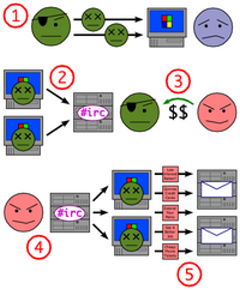
This example illustrates how a botnet is
created and used to send email spam.
1. A botnet operator sends out viruses
or worms, infecting ordinary users'
computers, whose payload is a trojan
application -- the bot.
2. The bot on the infected PC logs into
a particular IRC server (or in some
cases a web server). That server is
known as the command-and-control server
(C&C).
|
|
|
3. A
spammer purchases access to the botnet
from the operator.
4. The spammer sends instructions via
the IRC server to the infected PCs,
causing them to send out spam messages
to mail servers.
Botnets are exploited for various
purposes, including denial-of-service
attacks, creation or misuse of SMTP mail
relays for spam (see Spambot), click
fraud, and the theft of application
serial numbers, login IDs, and financial
information such as credit card numbers.
The botnet controller community features
a constant and continuous struggle over
who has the most bots, the highest
overall bandwidth, and the largest
amount of "high-quality" infected
machines, like university, corporate,
and even government machines. |
|
|


