|
Costa
Rica Breaks Relations with Taiwan
President Oscar Arias announced Wednesday that
Costa Rica has broken diplomatic ties with
Taiwan and established relations with China,
delivering a blow to Asian island's fragile
international standing.
Arias said Costa Rica needed to strengthen ties
with China to attract foreign investment.
Taiwanese Foreign Minister James Huang quickly
offered to resign to take responsibility for
Costa Rica's switch, which has left Taiwan with
relations with just two dozen nations.
"We are looking to strengthen the commercial
ties and attract investment," Arias said. "China
is the most successful emerging economy in the
world and soon it will be the second strongest
economy in the world after the United States."
Central America and Costa Rica in particular has been a
mainstay
of support for Taiwan, and Taiwan had expressed
fears that if Costa Rica were to shift its
recognition to Beijing, other nations such as
Nicaragua and Panama could soon follow suit.
China spends heavily to induce nations to change
diplomatic allegiances, offering investment,
loans and other incentives.
Arias said China is the Central American
nation's No. 1 trading partner, buying more than
us$1 billion worth of Costa Rican exports last
year.
"Taiwan has been very generous and I thank it
for the solidarity and co-operation it has shown
for nearly 60 years, but I have taken this
decision thinking of all the Costa Ricans,"
Arias said.
The change is just one more strike against
Taiwan in its campaign for international
legitimacy. Its high water mark came in the late
1960s when it had full relations with 67
countries, including the United States and much
of western Europe. But within a decade, the U.S.
pulled it embassy out of the Taiwanese capital.
And today, just 24 states recognize Taiwan.
The United States, Japan, Great Britain and
dozens of others maintain quasi-official ties
with Taiwan — part of a diplomatic sleight of
hand to honor Beijing's condition that full
diplomatic recognition be accorded to only one
of the rivals.
However, Beijing resents even the quasi-official
ties. Its main concern is the United States,
which remains Taiwan's most important foreign
connection, providing it weapons to defend
itself against a possible Chinese attack.
At a press briefing shortly after Costa Rica's
announcement, Huang, Taiwan's foreign minister,
offered to resign.
"I went to President Chen (Shui-bian) ... and
asked to resign to take political
responsibility," Huang told reporters.
Huang did not say if his offer was accepted.
Taiwan has been concerned about a deterioration
of its relations with Costa Rica since May 14,
when the Costa Rica voted at an
international health conference against holding
a discussion on proposed Taiwanese membership in
the World Health Organization.
On May 25, Huang met with officials from Costa
Rica and four other Latin American countries in
Belize City in an effort to shore up Taiwan's
diplomatic standing in the region.
Arias declined to comment on whether his
decision could encourage other Central American
nations to transfer their allegiance from Taipei
to Beijing.
"I won't speculate on the consequences of this
decision in the rest of Central American because
I made it thinking about Costa Rica," he said.
Salvadoran President Tony Saca said Wednesday
that his nation was interested in establishing
relations with China but did not want to sever
ties with Taiwan.
"Taiwan is an independent country that has won
its space and we will going maintaining
relations with Taiwan. If China accepts this we
will open relations with pleasure," Saca said.
|
|
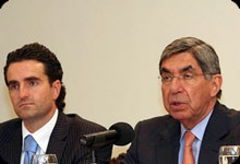
Costa
Rican's foreign minister, Bruno Stagno
(L) and president Oscar Arias (R)
yesterday announced the breaking of ties
with Taiwan.
|
|
|
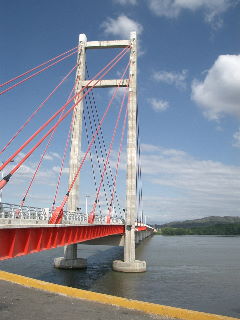
The bridge over the Tempisque river is
only of the many gifts Taiwan has made
to Costa Rica.
|
|
|


