|
Why Airplanes
Can't Land In Fog in San José
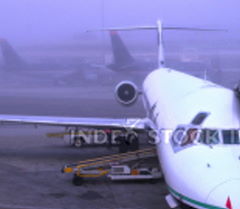
The foul weather and lack of proper equipment at
the Juan Santamaría (San José) international
airport has caused a headache and financial loss
for airlines and thousands of customers who saw
their trip to Costa Rica extended for hours, to
the next day in many cases.
Fog, a typical problem in the month of November,
has been the cause of additional costs to the
airlines and for travellers during the past
week, as more than 20 flights have been diverted
to other airports and a dozen or more cancelled.
The problem has been constant during the past
week as fog sets in at night, instead of the
usual rain, and the airport has had to be shut
down, with no flights taking off or landing, on
at least three nights, while on other nights
delays have been for more than 2 hours.
The economic loss to the airlines and the
inconvenience to passengers is incalculable.
Spent fuel to circle San José or land in an
unscheduled airport - Nicaragua and Panama are
the most common - add costs to airlines, not to
mention the problems with staff and the cost of
hotels rooms, meals to accommodate passengers
and the loss of an airplane from the regular
schedule.
A number of flights scheduled to arrive in San
José have ended up in Liberia and then off to
Panama or Nicaragua when it is definite that a
San José landing is impossible.
In some cases, flights have had to turn around
and head back to their point of destination.
Unfortunately there is no way of telling
ahead of time if the weather condition will
permit a landing at San José or if
the fog will clears before the flight is
diverted.
The stories of passengers losing their
connections and/or business meetings because of
the delays or having to spend hours on end in an
airplane while the pilot makes a final decision
to divert are endless.
One passenger who contacted Insidecostarica.com
told us of the tiring night of spending three
hours sitting in the cramped airplane on the
Liberia airport tarmac before the pilot made the
decision of one last attempt at San José,
only to end up in Panama.
In Panama, one of the passengers, of Middle
Easter descent, did not have a visa to enter
Panama and the inconvenience for this person to
endure for her trip to Costa Rica.
So why can't airplanes land in fog in San José?
The question is not simple to answer. It is a
combination of a number of things, according to
experts, which are partly due to the lack of
proper equipment at the airport and weather that
is so bad that it's "not safe" to rely on
instruments alone to make the landing.
In one answer found on a website, the statement
"do you completely trust a computer?" is the
best answer that pilots, especially on landings,
have to struggle with and end up preferring to
divert a flight rather than put their completed
trust in their computer Instrument Landing
System (ILS).
The ILS system as three categories: Category I -
a precision instrument approach and landing with
a decision height not lower than 60 m (200 ft)
above touchdown zone elevation and with either a
visibility not less than 800 m or a runway
visual range not less than 550m; Category II - A
precision instrument approach and landing with a
decision height lower than 60 m (200 ft) above
touchdown zone elevation but not lower than 30 m
(100 ft), and a runway visual range not less
than 350 m; and, Category III is further
subdivided.
Decision Height is determined by a preset
absolute altitude from within the Radio, or
Radar Altimiter (RADALT) which is usually around
200 feet but can be adjusted to any altitude
right down to the ground. When the plane reaches
decision height above the ground, the light
comes on, indicating as such, and if the pilot
CANNOT see the runway, they will go around and
try again or fly to another airport.
f a pilot does not go around at decision height,
he is usually commited to land.
Simply, 200 feet may seem like a lot, but when
you're flying at 135-140 knots just to keep your
plane from falling out of the air, 200 feet is
nothing.
Due to the complexity of ILS localizer and
glideslope systems, there are some limitations.
Localizer systems are sensitive to obstructions in the signal broadcast
and are also limited by the terrain in front of
the glideslope antennas. If terrain is sloping
or uneven, reflections can create an uneven
glidepath causing unwanted needle deflections.
Additionally, since the ILS signals are pointed
in one direction by the positioning of the
arrays, ILS only supports straight in
approaches. Installation of ILS can also be
costly due to the complexity of the antenna
system and siting criteria.
Though it has been difficult to ascertain
exactly what instruments the Consejo Técnico de
Aviación Civil (CETAC) in Costa Rica has
installed that Juan Santamaría, it can only be
concluded, by the number and frequency of
flights diverted or cancelled due to bad
weather, it is not enough.
|
|