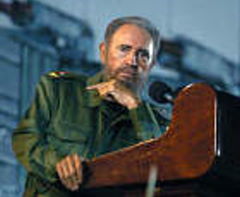
Fidel Castro: Bush,
Public Health and
Education
Havana, Jul 16 - Cuban
President Fidel Castro
criticized the policy of
the US government on
education, public health
and its projection
towards Latin America,
and highlighted the
progress and solidary
efforts of Cuba in these
fields.
In a new reflection
titled "Bush, Public
Health and Education"
published here Sunday,
the Cuban Revolution"s
leader expressed: "I
will not refer to Bush"s
health and education,
but to that of his
neighbors. It was not an
improvised declaration.
The AP agency tells us
what his opening words
were: "Tenemos corazones
grandes en este país"
(We have big hearts in
this country); he said
this in Spanish in front
of 250 representatives
of private and religious
groups, foundations and
NGOs who had come to
Washington with all
expenses paid by his
government. Of these,
some 100 came from the
United States.
"The meeting, called the
White House Conference
on the Americas, is part
of the ideas outlined by
Bush as he began a tour
of five Latin American
countries at the
beginning of March about
what his government was
hoping to do for the
region in the short time
still remaining of his
term in office." "Bush
called the conference in
order to discuss several
subjects, especially
education and health. "It"s
… in the interests of
the United States that
our neighborhood be
healthy and educated",
he said in improvised
declarations during a
chat with six of the
attendees, from
Guatemala, the United
States, Brazil, Haiti
and Mexico, who sat at
the table with him in a
colloquium", the press
agency added.
He said some incredible
things, like "the hard
work we"re doing in the
neighborhood".
Bush spoke, as did the
Secretary of the
Treasury, the Under
Secretary of State for
Western Hemisphere
Affairs and the Under
Secretary of State for
Public Affairs. Together
with them, several
members of the Cabinet
chaired the working
groups in which the
meeting was arranged.
They all talked until
they were blue in the
face.
They mentioned that Bush
had created a training
center in Panama that
graduated more than 100
doctors from six Central
American countries. They
very emphatically
referred to the Comfort,
"one of the best medical
ships in the world that
had just called on port
in Panama after visiting
Guatemala".
"Bush dedicated 55
minutes of his time to
this activity which took
place in a hotel in the
city of Arlington,
Virginia, on the
outskirts of Washington
D.C." Then, as bold as
you like, Secretary of
State Condolezza Rice,
joined the voices to
speak about Cuba.
According to another
news agency, when our
Council of State,
complying with
constitutional norms,
had just called the
elections, she declared
that "the United States
hopes that the Cubans
themselves will decide
their future", and she
added: "Washington will
not tolerate the
transition from one
dictator to another".
In his opening speech,
Bush addressed really
unusual concepts for the
head of a planetary
global empire, very
conscious of his power
and of his personal
role, reported in detail
by the Spanish press
agency EFE: "The
President of the United
States, George W. Bush,
today urged the
governments of Latin
America to be honest,
transparent and open."
(…) "The leader affirmed
that societies which are
open and transparent are
those which will lead to
hopeful tomorrows." "We
expect governments to be
honest and transparent
(…) We reject the notion
that it"s okay for there
to be corruption in
government…" "It is also
in our interest to help
a neighbor in need. It
renews our soul. It
lifts our collective
spirit. I believe to
whom much is given, much
is required. We"ve been
given a lot as a nation,
and therefore, I believe
we"re required to help,"
he insisted.
Bush knows that he is
lying and that his tall
tales are hard to
swallow, but he doesn"t
care. He is confident
that if he repeats it a
thousand times, many
will finally believe
him. Why so much
trickery? What
essentially torments
him? When did all this
rushing come up? Bush is
discovering that the
economic and political
system of his empire
cannot compete with Cuba
in vital services, such
as healthcare and
education, although this
country has been
attacked and blockaded
for almost 50 years.
Everyone knows that the
United States" specialty
concerning education is
the brain drain. The
International Labor
Organization has
indicated that "47
percent of people born
abroad that complete
their Doctorate in the
United States stay in
that country." Yet
another example of the
plunder: "There are more
Ethiopian physicians in
Chicago than in all of
Ethiopia." In Cuba,
where healthcare is not
a commodity, we can do
things that Bush cannot
even dream of.
Third World countries do
not have the resources
to set up scientific
research centers, while
Cuba has created these
even if her own
professionals have often
been enticed and
encouraged to defect.
Our Yes I Can method of
teaching people to read
and write is today
available to all Latin
American countries, free
of charge, and the
countries that choose to
use the program receive
support to adapt it to
their own
characteristics and to
produce the printed
materials and the
corresponding videos.
Countries such as
Bolivia are implementing
the program in Spanish,
Quechua and Aymara. The
numbers of those who
have learned to read and
write there in just one
year exceed the number
of those who have been
taught to read and write
by the empire in all of
Latin America, if indeed
there is anyone. And I
am not speaking about
other countries like
Venezuela which has
accomplished veritable
heroic deeds in
education in a very
short time.
Yes I Can is of benefit
to other societies
outside the Western
Hemisphere. Suffice it
to say that New Zealand
is using the program to
eradicate illiteracy in
their Maori population.
Instead of having one
training center for
medical professionals in
Central America, which
has trained about 100
-and we"re glad for
this-- our country today
has tens of thousands of
students from Latin
America and the
Caribbean on full
scholarships who spend
six years training as
doctors in Cuba, free of
charge. Of course, we do
not exclude any American
youth who take their
education very
seriously.
We cooperate with
Venezuela in the
education of more than
20,000 youths, who study
medicine and train in
clinics in the poor
neighborhoods, tutored
by Cuban specialists, so
that they can get
acquainted with their
future and difficult
job.
The Comfort, with over
800 people on board,
that is, medical staff
and crew, will not be
able to look after great
numbers of people. It is
impossible to carry out
medical programs
episodically. Physical
therapy, for example, in
many cases requires
months of work. Cuba
provides permanent
services to people in
polyclinics and
well-equipped hospitals,
and the patients can be
cared for any time of
day or night. We have
also trained the
necessary physical
therapy specialists.
The eye surgery also
requires special skills.
In our country
ophthalmologic centers
perform more than 50,000
eye surgeries on Cubans
each year and look after
27 kinds of diseases.
There are no waiting
lists for cornea
transplants which need
special arrangements.
Let an active
investigation be done in
the United States and
you will see how many
people really need to be
operated on there; since
they have never been
examined by an
ophthalmologist they
will attribute their eye
problems to other causes
and run the risk of
becoming blind or of
having their vision
seriously impaired. You
would find out that
there are millions.
In the abovementioned
figure I did not include
the hundreds of
thousands of Latin
Americans and Caribbean
people some of whom are
operated on in Cuba, but
most in their respective
countries, by Cuban
ophthalmologists. In
Bolivia alone, they are
more than 100,000 each
year. In this instance,
Bolivian doctors
educated in the Latin
American School of
Medicine (ELAM) take
part in the surgeries
alongside our Cuban
specialists.
Let"s just see how the
Comfort will make out in
Haiti, providing health
services for a week.
There, in 123 of the
country"s 134 communes
there are Cuban doctors
working alongside ELAM
graduates, or Haitian
students in the last
year of medical school,
fighting AIDS and
various tropical
diseases.
The problem is that the
United States cannot do
what Cuba is doing. On
the contrary, it
brutally pressures the
manufacturing companies
of the excellent medical
equipment that is
supplied to our country
to prevent them from
replacing certain
computer programs or
some spare parts that
are under United States
patents. I could cite
concrete cases and the
names of the companies.
It is disgusting, even
though we have solutions
that make us more
invulnerable in this
field.
Less than six months ago
Bush had not yet
invented the idea of
making fuel production
universal, from
foodstuff inside and
outside the United
States. Those of us who
are aware of the value
of fats and protein
foods for human
nutrition know what the
consequences are for
pregnant women,
children, teenagers,
adults and the elderly
if they lack these. The
brunt of the scarcity
will fall on the
shoulders of the least
developed countries, in
other words, on the
largest part of
humanity. It will
surprise no one that
this will be accompanied
by increased prices for
basic foodstuffs and
social instability.
Yesterday, Friday 13,
the price of oil was
79.18 US dollars a
barrel; another
consequence of the money
rush and the war in
Iraq.
Barely 48 hours ago, the
United States Secretary
of Homeland Security,
Michael Chertoff, said
that "he had the gut
feeling that a terrorist
attack could happen in
the country during the
summer". The Secretary
of State, and
subsequently the
President of the United
States himself, said
something similar. But
while they were giving
information about a
potential risk, they
were also taking great
pains to calm public
opinion.
The government of the
United States sees and
hears all, with or
without legal authority.
Furthermore, it
possesses numerous
intelligence and
counterintelligence
services that are
provided with copious
economic resources for
espionage. It can obtain
all the security
information it needs
without kidnapping,
torturing or murdering
persons in secret
prisons. Everybody knows
the real economic
purposes pursued through
world violence and
force. They can prevent
any attack on their
people, unless there is
some imperial need to
deliver a bang so that
they can carry on with
and justify the brutal
war which has been
declared against the
culture, religion,
economy and independence
of other peoples.
I must conclude.
Tomorrow, Sunday, is
Children"s Day. I think
of them as I write this
reflection. I dedicate
it to them. |
|