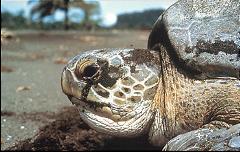
Green Sea Turtles
Reemerging
Endangered green sea
turtles are enjoying a
slow but steady recovery
at six major nesting
grounds, according to a
new analysis going back
30 years. The findings
suggest that
conservation efforts are
pulling the large
reptiles back from the
brink of extinction.
The majestic swimmers,
which grow to three feet
long and can weigh more
than 300 pounds, are
found in the Atlantic,
Pacific and Indian
oceans and are important
players in sea grass
ecosystems. For
centuries they have been
exploited for their
meat, decorative shells
and the eggs they lay on
beaches; and by mid-20th
century, several
populations were extinct
or nearly so.
Because the turtles
spend years foraging at
sea, it is difficult to
measure population sizes
and trends. So
scientists from six
major nesting sites in
Japan, Hawaii,
Australia, Costa Rica
and Florida collaborated
in an analysis of how
many females had
returned to lay eggs at
their respective sites
over the past 25 to 30
years.
Those numbers have
steadily increased, at 4
to 14 percent per year,
the team reports in the
December online issue of
the journal Global
Ecology and
Biogeography. Doing
particularly well are
the turtles that nest at
the Archie Carr National
Wildlife refuge on
Florida's east coast:
They were almost extinct
in 1980 but their
numbers have grown 14
percent per year since
1982.
At one rookery -- the
largest, on Australia's
Great Barrier Reef --
population increases
have recently flattened,
suggesting that problems
may be reemerging or
that the population has
achieved its natural
maximum.
ad_icon
Extrapolating from the
rookery counts, which
tally only the nesting
females in a population,
the team estimates that
the six areas account
for tens of millions of
green sea turtles
worldwide.
|
|