|
Can Frischy repeat at La Ruta?
A year ago Thomas Frischknecht
ended one of cycling's longest
streaks, becoming the first
foreign rider to triumph at
Costa Rica's famed La Ruta de
los Conquistadores mountain bike
race.
Fast forward 12 months, and the
Swiss legend will try to make it
two in a row in November when he
returns to defend his title at
one of the world's toughest
stage races.
Among the Swisspower rider's
chief challengers at La Ruta's
14th rendition will be Colombian
Leonardo Páez and American
Jeremiah Bishop
(Trek-Volkswagen).
Páez is currently No. 1 in the
UCI's marathon rankings, while
Bishop is coming off a stellar
performance at the world
championships, where he finished
8th in the men's cross-country.
Páez and Frischknecht were fifth
and sixth respectively in that
same race.
Famed mountain bike pioneer Tom
Ritchey has also registered for
the race.
The three-day trek across the
country commences November 3 at
the Best Western Jacó Beach
Hotel, a stones throw from the
Pacific Ocean. November 5's
finish is at the port of Moín
just a few blocks from Caribbean
Sea. In between a mix of
professionals and weekend
warriors will cover 176 miles
and approximately 30,000 feet of
climbing. The high point comes
beneath the looming shadow of
Volcan Irazu. Here the race tops
out nearly 9900 feet above sea
level -- and the starting line a
day earlier.
Despite these impressive
numbers, La Ruta is not solely
the realm of the world's top
mountain bikers. Each year a mix
of local of international
amateurs contest the event,
taking on a challenge that has
few equals in the world of
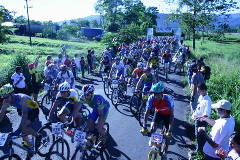
endurance sport. All told, 27
nations were represented at the
2005 event, which had nearly 400
riders lined up at the start.
"More than a race, La Ruta is a
personal growth journey,"
explained event founder and race
director Roman Urbina. "That's
the difference from the
traditional mountain bike
competitions. There are some
segments that cannot be traveled
even in 4X4 vehicles or
motorcycles. The competitors
will not always have access to
external support and must trust
in his their own tenacity."
Besides the distance and
elevation gain, La Ruta also
serves up a vast array of
climate and topography changes.
Searing tropical temperatures
will be most prominent, but
riders may also have to bust out
their winter wear as the race
heads up into the country's high
mountains.
The course is equally diverse,
with sections of serene paved
road interspersed with plenty of
off-road terrain that ranges
from smooth ox-cart path to
rock-strewn double track.
There's also an extended stay on
the old north-south railway
tracks on the Atlantic side,
taking riders down a bumpy and
bruising path as they head
toward the finish.
Among the changes on tap for
this year's race is a more
remote course. This has been
done in part to cut the local's
chances of getting illegal
support from relatives, friends
or team members. In the past
this has tipped the playing
field against foreign riders,
but now everyone will compete
under equal conditions.
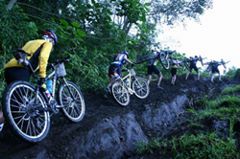
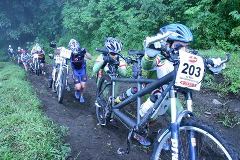
As in year's past, day one's
course will head through the
Carara National Park's thick
jungle. This humid, muddy and
breathtaking pass has been
traditionally one of the race's
toughest obstacles. After the
third checkpoint, located in San
Pedro de Turrubares, racers will
face the grueling Grifoalto
region with its muddy trail up
across the mountains. This
replaces last year's long
asphalt ascent.
The race got its start 14 years
ago, when Urbina first read
about Spanish conqueror Juan de
Caballón and his 20-year journey
up and over Costa Rica's
sky-scraping mountains.
Caballón's expedition started at
the Pacific Coast and finished
at the Caribbean Sea.
Urbina, a recognized Costa Rican
athlete and adventurer himself,
decided to emulate the harrowing
voyage. Captivated by the trek
of the Spanish general, he and
34 companions crossed nine of
Costa Rica's 12 microclimates
during an adventure that led
them through rain forests, up
majestic volcanoes, and across
shimmering rivers. It was then
that Urbina decided the trip
should be turned into an annual
competition, and La Ruta de los
Conquistadores was born.
Today La Ruta is considered one
of the most difficult mountain
bike races on the planet. It is
also the most important fat tire
race in Costa Rica, and the only
one that attracts top-flight
foreign riders and the attention
of the international media.
|
|