|
RACSA Has Constitutional Court
Support to Block Spammers
The Radiográfica Costarricense (Racsa)
- the nations provider of
internet service - has been
criticized for sanctioning mass
e-mailer or "spammers", mainly
by the spammers themselves, but
now has the backing of the
Constitutional Court following a
decision that an appeal
presented has not merits.
Racsa has been using filters to
block certain types of emails
based on their content, like
child pornography, but it has
also been stopping companies
from using its mail servers to
send out hundres of thousands to
millions of email in a single
batch by companies that have
been banned in other countries,
like the United States.
Articles 1, 2, 3, 4 and 6 of the
"Reglamento General" (general
regulations) that governs the
Regulación del Correo
Electrónico (rules on mass or
unwanted emails), dating back to
2002, gives the state
institution the power to block
accounts and emails it deems are
abusing its regulations.
An American company that offers
email accounts for commercial
purposes took Racsa to court
when it had it account
cancelled. The company, whose
name was not released by Racsa,
argued in-constitutionality as a
basis for Racsa's actions. The
Constitutional Court or Sala IV
did not agree and found the
argument without merit and
backed Racsa's position to
cancel, refuse or deny service
to any person or company that
violates its regulations.
Miguel Montero, a coordinator of
mass emails at Racsa, is pleased
with the court decision and
assures that the institution
will continue to sanction
violators.
"Before the (spamming) rules
were in place in 2002, we used
to get some 1.200 to 1.500
complaints daily from customers
who were receiving undesired
emails. Now, the complaints are
down to about 50 a day. Before
the regulations, Costa Rica was
a paradise for spammers. Casinos
and pornographic sites were the
major spammers", said Montero.
Montero added that none of its
local clients is involved in
spamming and is no long
considered a spamming country,
like as it was listed number 5
in the world for spamming,
producing between 7% and 10% of
all "junK" emails going through
the internet.
What is Spamming?
Spamming is the abuse of
electronic messaging systems to
send unsolicited, bulk messages.
While the most widely recognized
form of spam is e-mail spam, the
term is also applied to similar
abuses in other media: instant
messaging spam,
Spamming is economically viable
because advertisers have
effectively no operating costs
beyond the management of their
mailing lists.
Because the barrier to entry is
so low, the volume of
unsolicited mail has produced
other costs which are borne by
the public (in terms of lost
productivity and fraud) and by
Internet service providers,
which must add extra capacity to
cope with the deluge. Spamming
is widely reviled, and has been
the subject of legislation in a
number of jurisdictions.
The most common purpose for
spamming is advertising.
Goods commonly advertised in
spam include pornography,
unlicensed computer software,
medical products such as Viagra,
credit card accounts, and fad
products.
In part because of the bad
reputation (and dubious legal
status) which spamming carries,
it is chiefly used to carry
offers of an ill-reputed or
legally questionable nature.
Many of the products advertised
in spam are fraudulent in
nature, such as quack
medications and get-rich-quick
schemes.
Spam is frequently used to
advertise scams, such as diploma
mills, advance fee fraud,
pyramid schemes, stock
pump-and-dump schemes, and
phishing. It is also often used
to advertise pornography without
regard to the age of the
recipient, or the legality of
such material in the recipient's
location.
|
|
 |
|
|
Phishing?
In computing, phishing is a form
of criminal activity using
social engineering techniques.
It is characterized by attempts
to fraudulently acquire
sensitive information, such as
passwords and credit card
details, by masquerading as a
trustworthy person or business
in an apparently official
electronic communication.
Phishing is typically carried
out using email or an instant
message.
The term phishing derives from
password harvesting and the use
of increasingly sophisticated
lures to "fish" for users'
financial information and
passwords.
With the growing number of
reported phishing incidents,
additional methods of protection
are needed. Attempts include
legislation, user training, and
technical measures
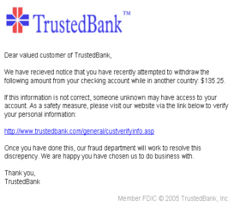
The above is an example of a
letter sent by spammers to bank
account holders, requesting that
they log in to their account, by
clicking on the link in the
email. In reality, the link
takes the user to a webpage that
looks and feels the same as the
bank's page, but it is not.
Filling out the information
requested on the page will allow
the creator to take your
information and then log in to
the real account.
Paypal.com users are a major
target of Phishing. |
|
|


