|
Franklin Chang Space Tech Lab in
Liberia Ready
Next Saturday, former NASA
astronaut Franklin Chang will be
inaugurating the Costa Rican
laboratory dedicated to
developing space technology.
The Daniel Oduber - La Flor de
la Universidad EARTH, in
Liberia, Guanacaste campus, will
be opening its doors to the AS
Astra Rocket that was founded by
Chang in 2005.
The company's mission is to
develop the Variable Specific
Impulse Magnetoplasma Rocket (VASIMR) plasma
engine technology that will
reduce space travel time.
In Liberia, seven Costa Rican
scientists will be be working on
the technology that will then be
exported and built in Houston,
Texas.
Slated to be at the inauguration
is Samuel. C. C. Ting, 1976
Nobel Prize winner for Physics
for his work with atomic
sub-particles. Also present will
be Roald Sagdeev, former space
director of the Soviet Union.
NASA scientists and
investigators from various
United States and European
universities will also be on
hand for the opening with what
Chang promises "a good entrance
for Costa Rica to space
technology".
The lab was built in six months
at a cost of us$1 million
dollars and financed by local
investors. Ad Astra Rocket plans
to have the VASIMR prototype by
2007 and the first tests to be
begin in 2010.
What is VASIMR?
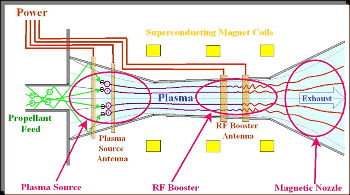
The Variable Specific Impulse
Magnetoplasma Rocket (VASIMR)
system encompasses three linked
magnetic cells, consisting of a
“plasma source,” an “RF
booster,” and a “magnetic
nozzle.” With this
configuration, plasma can be
guided and controlled over a
wide range of temperatures and
densities.
The plasma source cell involves
the main injection of neutral
gas (typically hydrogen, or
other light gases) to be turned
into plasma and the ionization
subsystem. The RF booster cell
acts as an amplifier to further
energize the plasma to the
desired temperature using
electromagnetic waves. The
magnetic nozzle cell converts
the energy of the plasma into
directed motion and ultimately
useful thrust.
Ad Astra Rocket Company -
Costa Rica
The AARC Costa Rica was
formed in 2005 and new building
facilities are under
construction. The facility is
being built approximately 10 km
west of the city of Liberia,
capital of the province of
Guanacaste, on the territory of
the Earth University.
The main tasks of AARC CR are:
Building a flexible apparatus to
explore optimization of a Plasma
Source for VASIMR technology;
Measure the waste heat load from
the source, and characterize its
distribution; Explore strategies
to minimize thermal load; Create
engineering designs to remove
the waste heat efficiently;
Ensure thermal engineering
solutions are compatible with
the rest of VASIMR subsystems.
|
|


