|
FISCHEL-CAJA:
Anonymous Calls Results in Raid
of Legal Offices of the Caja
Agents with the "Delitos
Económicos" (Financial Crimes)
section of the Organismo
Investigacion Judicial (OIJ)
raid the offices and car of the
Legal Director of the Caja
Costarricense del Seguro Social
(CCSS), Rodrigo Cordero.
Today's Stories:
 Anonymous
Calls Results in Raid of Legal
Offices of the Caja Anonymous
Calls Results in Raid of Legal
Offices of the Caja
Private
Sector Distancing Itself from
Fischel
Consulting
Firm Can't Account for $200K in
Aid for Costa Rica
Two
Elderly Women Murdered in their
Home
Kayaker
Set to Begin Journey for Peace
New
Los Angeles Auxiliary a Native
of Costa Rica
Did
You Know?
|
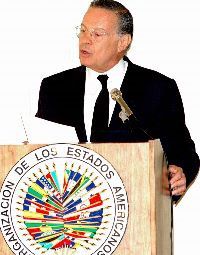
Former Costa Rican president and
now
Secretary General of the
Organization of American States
(OAS) Miguel Ángel Rodríguez
told reporters that he knows
nothing of the scandal
surrounding the Fischel, the
Caja Costarricense del Seguro
Social and the credit loan from
Finland.
He also told reporters from the
Spanish daily La Nación, that he
has not been following the news
on the subject and what is being
said in Costa Rica about the
matter.
The credit was approved in
December of 2001, during the
Rodríguez presidency.
When pressured by reporters to
give his opinion on the scandal,
Rodríguez, said that he has been
immersed in the restructuring of
the OAS for the last couple of
months.
|
|
|
Did you
Know?
Costa Rica is located at the
center of the American
Continent, with coasts on both
the Pacific and Caribbean, three
volcanic mountain ranges and 12
climactic zones.
Costa Rica harbors 5% of the
world's biodiversity. In these
diverse habitats and ecosystems,
13 thousand species of plants
can be found as well 163 species
of amphibians, 220 of reptiles,
1600 of fresh and salt-water
fishes and at least 850 species
of birds.
|
The Ministerio Público said it
received an anonymous phone call
that Cordero was removing
documents from the legal
department of the CCSS and
storing them in the trunk of his
car, with the intent to remove
them completely from the
building.
Authorities spent more than
three hours reviewing the
documents in the vehicle and
speaking with Cordero before
moving to the third floor
offices where the man worked.
No official news has been
released on the results of the
raid and the inspection of the
documents nor the results of the
conversation between Cordero and
the authorities.
Private Sector Distancing Itself
from Fischel
The
scandal that has surrounded the
Corporación Fischel, the Caja
Costarricense del Seguros Social
(CCSS) and the Finland credit
loan, had not only been a focus
of attention for the Ministerio
Público, but for the private
sector as well.
Several companies have already
place a distance between itself
and anything to do with the
Fischel and any of it's
officers.
Yesterday, Asesores de Servicios
en Salud (ASERSA) publicly made
the announcement that in the
following days the names of
Walter Reiche Fischel, Marvin
Barrantes and Randall Vargas,
will disappear from the board of
directors of ASERSA.
Fischel owns some 40% of the
stock of ASERSA. Another 40% of
ASERSA stock is held by ASEMECO,
the company that also owns the
Clínica Bíblica hospital, and
the rest of the stock in the
hands of various shareholders.
William Cubillo, manager of
ASERSA, says that the company is
in the process of purchasing the
stock held by Fischel.
The move by ASERSA to separate
itself from Fischel comes on the
heels of another company, ANVECO,
who built the new building
housing the new Clínica Bíblica
clinic.
More companies are expected to
distance themselves from any
relations with Fischel in the
coming weeks.
Consulting Firm Can't Account
for $200K in Aid for Costa Rica
About $200,000 linked to a
Japanese official development
project in Costa Rica remains
unaccounted for after it was
paid to a major Japanese
consulting company, the Yomiuri
Shimbun reported Saturday.
The fund is part of $230,000
(around 25 million yen) paid to
Pacific Consultants Co., based
in Tama, western Tokyo, which
was supposed to subcontract part
of a Japanese-financed project
to a Costa Rican government
agency, the major newspaper said
in a front-page article.
The irregularity was disclosed
through investigations by the
Japan International Cooperation
Agency (JICA), the government's
aid donor body, the Yomiuri
said.
On Sept. 15, JICA suspended the
company from bidding on aid
projects for two months, the
Yomiuri said.
Costa Rican law enforcement
authorities also appear to have
launched investigations into the
case, it said.
The project was for devising an
agricultural development plan in
Costa Rica's northwestern
region, the Yomiuri said. The
consulting company formed a
consortium with another firm in
October 2000 to bid on the 423
million yen project, entirely
financed by Japanese aid.
Pacific Consultants
subcontracted the surveying and
mapmaking related to the project
to the National Geographic
Institute of Costa Rica,
according to the paper.
The subcontract fee cited in the
contract submitted to JICA was
$230,000, but an audit by the
Costa Rican Ministry of Public
Works and Transport found only
several tens of thousands of
dollars in the institute's
account, the newspaper said.
Two Elderly Women Murdered in
their Home
Two elderly Costa Rican ladies
were murdered in their own homes
in Porvenir en la alameda N° 5
in Desamaparados yesterday, in
what police believe the motive
to have been robbery.
Seventy two year old, Susana
Medina and her sister, Yolanda,
who is 64 years old, where shot
at close range; Susana in the
heart and Yolanda in the neck
and head.
Missing from house where the two
women lived is a case that is
believed to contain jewelry the
women sold to the neighbourhood
with a value of between ¢500.000
and ¢1 million colones.
Nothing else was apparently
missing from the home and there
was no forced entry, leading
police to speculate that the
women knew the assailant.
Jorge Rojas, director of the
Organismo de Investigacion
Judicial (OIJ), believe that
person who attacked the two
women knew of the jewelry and
whose intent was to simply rob
the women, however, something
must have gone wrong.
Police are being tight lipped on
the potential identity of the
assailant.
Kayaker Set to Begin Journey for
Peace
After more than a year of
planning and training, Carlos de
la Fuente, a retired San Diego,
California, a lawman and lawyer,
will take to the sea today in a
daring mission to draw attention
to his concerns about
environmental degradation and
the ravages of war.
Alone on the ocean in his
18-foot kayak for six months, de
la Fuente will travel from Santa
Barbara to San José, Costa Rica,
on a 2,500-mile journey that to
his knowledge has not been
attempted.
He'll keep family members and
friends informed using a
satellite telephone, and his
thoughts, words and observations
will be posted on a Web site to
be updated weekly. The site,
www.kayakingforpeace.org,
will include a map or an aerial
photograph pinpointing de la
Fuente's location, said Web
master Philip Mally.
Supporters will be able to
follow his journey or post
messages that de la Fuente's
family will pass along to him,
Mally said.
A longtime peace activist, de la
Fuente, 66, hopes his mission
will bring attention to water
pollution and destruction of sea
life, particularly in his
beloved Sea of Cortez.
In a statement against war, he
intends to end his journey at
the University for Peace in San
José, Costa Rica. The school is
affiliated with the United
Nations and promotes conflict
resolution, human rights and
environmental security.
De la Fuente's route will take
him along the California coast
to the Mexican border, where
he'll cross over by truck to the
gulf side of Baja California.
From there, he will paddle down
the Gulf of California, take a
ferry to Mazatlan, then continue
south to Costa Rica.
Inside his kayak, named for his
wife, Mariana, de la Fuente will
carry water, dried food, several
changes of clothing, a tent and
a thin sleeping bag. He will
rest on ocean shores, in fishing
camps wherever possible.
De la Fuente, who has been
training with one of the world's
top sea kayakers, Roger Shuman,
has admitted some nervousness.
He could be facing 14-foot waves
in the ocean around Mexico and
Central America, which he said
"could be very nasty."
Paddling solo for long distances
is risky, so de la Fuente has
been practicing his "rolling"
technique, a means of righting a
kayak after it capsizes, and
schooling himself about the
potentially deadly effects of
hypothermia. "You can never be
completely prepared for
something like this," de la
Fuente said. "The sea is so
unpredictable.
New Los Angeles Auxiliary a
Native of Costa Rica
Pope
John Paul II has appointed
Monsignor Alexander Salazar, the
54-year-old vice chancellor of
the Los Angeles Archdiocese, as
auxiliary bishop.
Alexander Salazar was born in
San José, Costa Rica. His family
went to the United States in
1953 and settled in Los Angeles.
He became a U.S. citizen at the
age of 18.
Salazar studied at California
State University, Los Angeles,
and later at Immaculate Heart
College, Los Angeles, where in
1978 he received a bachelor's in
bilingual studies.
In 1977, he entered St. John's
Seminary in Camarillo. He was
ordained a priest in June 1984.
|


