|
Harris Admits to '15-Minute
Mistake'
Bruce Harris, former
head Caza Alianza - the Latin
American street kids' charity -
fired after being accused of
paying a Honduran teen-ager for
sex, acknowledged on Saturday
that he had made a "15-minute
mistake."
Today's Stories:
 Harris
Admits to '15-Minute Mistake' Harris
Admits to '15-Minute Mistake'
"Illegal"
Lotteries Popular
Standing
Ovation
A
Deal with Goodall
Americas
Free-Trade-Zone Efforts Stalled
Cup
by Cup, Coffee Fuels World
Market
Did
You Know?
|
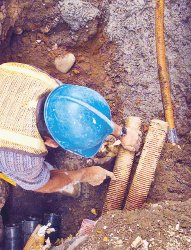
The
work by the Nacional de Fuerza y
Luz (CNFL) bury all electrical
electrical services in the
downtown core will continue into
January, well past the original
deadline of October. The CNFL
assures, however, that within
the next three weeks the work of
breaking up sidewalks and
streets to lay the underground
channels, that has caused many a
traffic congestion, will be
completed. Beginning next month
the job is to connect customers
to the underground system, which
will not interrupt traffic in
any way.
|
|
|
Did you
Know?
Costa Rica, considered a
developing nation, is the
political and economic star of
Central America. It has a
century-old democracy and the
region's highest per capita
gross domestic product, $8,300.
By comparison, the U.S. GDP is
$37,600.
|
Harris, who was awarded the
Order of the British Empire in
2000 for his work protecting
homeless children in Central
America, was dismissed Friday by
the international child welfare
group Covenant House.
The charity said it acted
against Harris, because he
recently paid a 18-year-old
Honduran boy for sexual favors.
While prostitution is not
illegal in Honduras and the age
of consent is 18, Harris has
fought for the rights of
homeless youths in the region
and campaigned against sex
tourists.
"I have never been someone that
hides behind lies, and so I take
responsibility, as I always
have, for my actions, correct or
incorrect. I don't want the
children that Casa Alianza
serves to pay for my private
life," Harris said in an e-mail
to Reuters.
"I am being judged on my 15
years of service to children for
a specific, 15-minute mistake. I
do not deny that it was my
mistake in my time and my
personal life," he wrote. He
said he would place himself "at
the orders" of the authorities.
Harris sent a note to colleagues
on Sept. 16 saying he had
decided to resign "and take some
time for myself and my family."
He said he had submitted his
resignation to Casa Alianza two
days earlier.
Honduran Security Minister Oscar
Alvarez said Saturday that
Honduras, Guatemala and Costa
Rica were opening probes into
Harris's activities.
"We are talking to the security
ministers of Guatemala and Costa
Rica and we are going to
investigate whether this man had
improper, deviant relations with
other youths," Alvarez said.
Documentaries in many countries
in Europe, the U.S. and Canada,
have shown Harris' efforts to
combat child prostitution in
Costa Rica, including working
undercover as a customer in a
child brothel to gather
evidence.
Honduran authorities are saying
that they will want to see
Harris in jail in their country
if their investigation shows
that Harris committed a crime.
For the time being Harris is
free man.
Harris, who has been a thorn in
many governments in Central
America with his outspoken and
controversial ways, is now a
target of criticism, including
from those he worked with it.
"Illegal" Lotteries Popular
A recent report shows
that "illegal" lotteries in
Costa Rica monopolized 37% of
the ¢110.000 Million colones
spent on lotteries last year.
The Junta de Protección Social
de San José (JPS), the
government organization that
runs lotteries (save lotteries
run by the Red Cross) says that
in 2003 more than ¢40.000
million colones are lost to the
"illegals" and Panamanian
lotteries that can be purchased
in Costa Rica.
An inquiry by the JPS revealed
that last year more than 50% of
lottery purchasers purchases
"illegal" lotteries at some
point.
One of the most popular time of
lottery is the "numbers".
Purchasers can bet any sum they
choose and can earn anywhere
from 5 to 70 times their wager.
However, with the legal
lotteries, the price of the
ticket is fixed and the prizes
are established.
Illegal lotteries, according to
JPS officials, is supported by
the "rich" who have the ability
to pay out any large winnings,
who also can make fat profits.
There are many intermediaries
who sell or offer the "illegal"
lotteries.
A typical intermediary can be a
simple person who will visit a
person's place or work, hangout
or even one's home to take your
bet. If the better is well
known, a simple telephone call
can place the wager.
Authorities say these types of
lotteries are usually run out of
downtown area retail stores that
are really fronts for the
illegal lotteries.
Operators of the illegal
lotteries use the results of the
JPS lotteries, that is to day,
the results of the JPS numbers
drawn are used to set the
winning prize of the illegal
lotteries.
Standing Ovation
The
Youth Symphony Orchestra of
Costa Rica was accorded a
standing ovation at one of the
world's top music venues, the
St. Cecile Academy in Rome,
Italy.
In acknowledgement of an
extraordinary performance, the
full house stood up to cheer
conductor Marvin Araya and his
68 boys and girls, ages 16 to
23, who played in Rome a message
of peace and harmony to the
world, in commemoration of the
140th anniversary of relations
between Italy and Costa Rica.
A Deal with Goodall
Jane
Goodall visited Costa Rica, not
only to share her ideas but also
to plant a root of her
environmental awareness in Tico
soil.
The British scientist, world
renowned for her work with
chimpanzees in Tanzania, signed
an agreement with the local
National Biodiversity Institute
(INBio) to establish the first
Central American office of her
environmental education program
Roots and Shoots.
New York State University, in
Buffalo, and the Jane Goodall
Institute will support INBio
with the program, which already
takes in more than 225,000
people in 7,500 groups
distributed in 87 countries.
Americas Free-Trade-Zone Efforts
Stalled
Efforts to create a
hemisphere wide free-trade zone
are stalled, and trade officials
have all but abandoned an
end-of-month deadline for an
agreement to open markets.
The Western Hemisphere's
democracies last November agreed
to an outline for the Free Trade
Area of the Americas, a
far-ranging pact that would
cover 34 nations with 800
million people and $13 trillion
in economic output.
One of the few concrete goals
set in November was a Sept. 30
deadline to conclude
negotiations on "market access,"
which includes elimination of
trade barriers.
"We have said for some time that
this deadline was challenging
and since it's only two weeks
away, it does not look
achievable," said a U.S. trade
official, who asked not to be
named.
FTAA talks also have an
end-of-year deadline for the
entire pact. The trade official
would not dismiss the deadline
but acknowledged that meeting it
would be "a challenge."
Since the November meeting in
Miami, the 34 countries have
failed to significantly advance
the FTAA, a centerpiece of U.S.
economic policy for the
hemisphere.
The United States and Brazil
especially are at loggerheads.
The two nations are co-chairmen
of the current phase of
negotiations and met several
times earlier this year to try
and break the impasse but did
not succeed.
The Bush administration is
linking lower trade barriers to
a commitment from other nations
to protect products from piracy
and create rules that help
investors. Brazil is hesitant to
change its laws governing piracy
and investment, but still wants
lower trade barriers, especially
for its agricultural products.
But the two nations still have
fundamental differences on the
FTAA and different
interpretations of the November
agreement. The outline, while
allowing leaders to declare
success at a regional summit,
purposely left vague "a common
and balanced set of rights and
obligations applicable to all
countries."
The United States, meanwhile,
has set its sights on a series
of bilateral free-trade
agreements that cover much of
the hemisphere.
"This is a validation of our
strategy to not put all of our
eggs in one basket. We have been
opening markets throughout the
hemisphere with our bilateral
agenda," said Richard Mills, Mr.
Zoellick's spokesman.
Within the hemisphere, the
United States has free-trade
agreements with Canada, Mexico
and Chile, and the Bush
administration completed
free-trade negotiations with
Costa Rica, El Salvador,
Guatemala, Honduras, Nicaragua
and the Dominican Republic.
The administration also has
started talks with Panama,
Colombia, Ecuador and Peru.
Cup by Cup, Coffee Fuels World
Market
As morning breaks in Tres Rios,
scores of pickers dash into lush
rows of 7-foot trees and begin
tugging at branches laden with
ripe, crimson berries.
José María Solano, along with
his wife, daughter and three
grandchildren, starts picking on
a sultry Saturday in late
January. The 66-year-old quickly
strips the slender branches of
their berries, filling the
wicker basket strapped around
his waist.
Those strong, weathered hands
may well have picked the beans
that flavor your morning jolt of
caffeine, a cup of coffee
brought to you by a global
economy that links 25 million
coffee farmers and legions of
consumers.
Farmers, pickers, processors,
importers, shippers, roasters,
grocery clerks and baristas on
six continents all have a hand
in $70 billion of world coffee
sales. Many of those who pick
and process the beans have never
tasted espresso, and their daily
earnings amount to the cost of a
few double-tall lattes.
The beans Solano picks on Bella
Vista Tres Rios farm make their
way through an elaborate
international chain of commerce
that begins in the fields of
Costa Rica, continues on
container ships bound for
Seattle and ends in more than
4,000 company-run Starbucks
stores in the U.S
Coffee is the world's No. 2
commodity, after oil. The most
recent annual harvest produced
6.7 million tons of beans.
Arabica beans - the
higher-quality ones preferred by
specialty coffeehouses - require
higher altitudes, temperate
climates and nutrient-rich soil.
They grow well on the fertile
slopes of volcanoes in tropical
Costa Rica. In the U.S., Hawaii
and Puerto Rico grow the only
coffee sold commercially.
The coffee market is dominated
by lower-grade unwashed arabica
and robusta beans, which are
combined to make some canned
blends and instant coffees.
Robustas grow in hotter, wetter,
lower-altitude regions and yield
more beans than arabica plants.
In Central America, it costs
between 60 cents and 90 cents to
produce enough beans for a pound
of specialty coffee, according
to the Specialty Coffee
Association of America. In Costa
Rica, costs can top $1 a pound,
some farmers say.
Coffee is a tradition in Tres
Rios, where generations have
grown up picking beans at Bella
Vista, one of Costa Rica's
oldest coffee farms. About
30,000 of the country's 4
million people are coffee
farmers, and about 500,000 or so
- many from neighboring
countries - pick and process
beans.
Coffee has long been Costa
Rica's most famous export, once
accounting for nearly one-third
of the nation's gross domestic
product. While it now claims
less than 5 percent of the
national GDP - giving way to
microchips, textiles and medical
devices - coffee remains central
to the country's identity.
Most of Costa Rica's presidents
have been descendants of the
coffee elite. When the
seven-month picking season peaks
- from December through February
- an economic ripple effect
swiftly spreads through the
region.
|


