|
President's Independence Day
Speech Reassures Costa Ricans
President Abel Pacheco told
Costa Ricans gathered in the
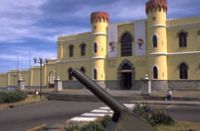
'Plaza del primer presidente
costarricense, José María Castro
Madriz' that "the future this
country is not built by a the
President or his Cabinet of
Ministers. The future of this
country, is being built by four
million people. No one can feel
indifferent about their native
land, we all have to work for
her."
Pacheco's comments were made
before a crowd in front of the
Banco de Costa Rica, marking
Costa Rica's 183rd anniversary
of independence.
Beside the president stood
members of the Supreme Court,
Diplomats, the Comptroller
General, Alex Solís, students
and other invited guests.
The President talked about Costa
Rica's strengths and reiterated
his commitments and his actions
to include Costa Rica as one of
the developed nations.
For Pacheco, one of the first
virtues is "ethical order". He
touched on the current scandals
that has been absorbing the
nation, which he said "will not
be tolerated".
The president told his audience
of Costa Rica's achievements in
economic policies and social
challenges.
He reiterated his commitment to
work for the country, among
other things, govern with
humanity, honour, speak the
truth, decide calmly, act with
transparency, and provide an
example of a life dedicated to
serving the country.
"The Seguro Social (Social
Security) is sacred, we are
defending it and will continue
to defend it against looters and
privatization...", Pacheco told
his listeners.
Fischel-Caja Saga Continues
Now that the patriotic duties
are over, the country the get
back to the business at hand -
the "Fischel-Caja" scandal.
It's been almost two weeks since
it was discovered that former
president Rafael Angel Calderón
had received $440.500 dollars
from Fischel as a commission for
his alleged role in the credit
by government of Finland to the
Caja Costarricense de Seguro
Social (CCSS) or commonly known
as the 'Caja'.
More than a week ago, a San José
court ordered that Calderón
could not leave the country.
This week, authorities raided
the offices of the former
president and interviewed his
law firm partner, Gerardo
Bolaños, for his role in
receiving $90.000 of the
Fischel-Caja money.
Bolaños was placed under house
arrest and restricted from
leaving the country. Yesterday,
police chief Walter Navarrro
said that photos of Bolaños have
been issued to officers of the
Fuerza Publica so that he can be
easily recognized by his
officers.
Notwitstanding, the Procuraduría
General de la República - the
Attorney Generals office - has
not ordered any embargo against
the assets of any of the
suspected, assuring any recovery
of the of the losses by the
state.
The Ministerio Público fears
that as the days pass those
involved will have time to move
assets out of reach of the
authorities. A transfer to other
persons or corporations will
protect those assets from being
either discovered or recovered.
The saga has not left ICE
untouched. Yesterday, in a press
release, the Instituto
Costarricense de Electricidad
(ICE) announced that one of it's
engineers had received $77.746
dollars from Walter Reiche
Fischel, who is currently in
preventive detention.
The press release said that "IcE
will act immediately to apply
administrative procedures and
legal precedents to determine
the involvement of one of our
employees, Rodrigo Méndez Soto,
by requesting a complete
explanation with respect to this
economic gain, while Méndez is
still an employee of the
Institution."
Méndez is expected to make his
declarations today.
The question on the mind of
authorities is if there are
other politicians tied to the
Fischel-Caja case. The
prosecutor's office is still
reviewing banking documents
received by Panamanian
officials.
Dalai Lama To Visit Costa Rica
His
Holiness the Dalai Lama has left
on a six-nation visit to the
United States and Latin America.
His Holiness is scheduled to
visit Florida, USA, Puerto Rico,
Costa Rica, El Salvador,
Guatemala and Mexico.
On September 26 September, the
Dalai Lama, will be in Costa
Rica for three days during which
he is scheduled to speak at two
public events.
The Dalai Lama will then head
towards El Salvador where two
lectures on Introduction to
Buddhism and Outer Peace Through
Inner Peace.
Costa Rica Opens Region's First
Lab for Nanotechnology
Nanotechnology research in Latin
America has received a boost
with the inauguration of the
National Laboratory for
Nanotechnology, Microsensors and
Advanced Materials (Lanotec) in
Costa Rica.
Although small nanotechnology
projects are underway in various
Central American universities,
there is no specialist centre
for this field of research.
Lanotec will be the first such
centre in Central America and
one of only a few in Latin
America, and is intended to
become a centre of excellence in
advanced materials science.
Sources at the Costa Rican
National Centre of High
Technology (Cenat), the
institution that hosts the
laboratory, told that Lanotec's
main activities will be advanced
research and establishment of
strategic alliances with the
high technology industry, both
nationally and overseas.
These collaborations will focus
on the research and development
of products and specialist
services.
Lanotec will also have a
teaching laboratory that will
collaborate with other
institutions on their academic
programmes.
"Lanotec will be the focal point
for major national and
international projects," said
physicist Jorge Andrés Diaz,
leader of the initiative, during
its inauguration ceremony on 31
August.
The laboratory will begin
working on two projects. One
will research, design and
construct microsensors, a field
of research in which Diaz was
awarded Costa Rica's national
science prize in 1999.
The other project will research
and construct carbon nanotubules,
small cylindrical structures
used in the manufacture of
advanced electronics materials.
On this project, Lanotec will
collaborate with the Costa Rican
chemist Jeannette Benavides, who
is director of the carbon
nanotubules project at the NASA
Goddard Space Flight Centre
based in Maryland, United
States.
"The development of
nanotechnology is very important
for the technological
development of Costa Rica," says
Benavides, who devised a method
of nanotubule manufacture that
reduced production costs from
US$300 per gram to US$1 per
gram.
The method will begin to be
implemented at Lanotec shortly,
and Benavides will also make
joint investigations with the
Costa Rican laboratory.
The 300 square metre Lanotec
facility was built with an
initial investment of about
$50,000, and includes a 'clean
room' featuring special
conditions required for high
tech materials research. These
include a total absence of dust
particles, minimal vibration and
an environment free of negative
charges, all of which could
disrupt experiments.
The building is now being
equipped, at an additional cost
of several hundreds of thousands
of dollars, and electron,
magnetic and atomic force
microscopes have already been
bought. Authorities from Lanotec
and Cenat expect the laboratory
to be fully equipped soon.
The construction of Lanotec and
the purchase of necessary
equipment were funded by the
Costa Rica - United States of
America Foundation for
Cooperation, the Costa Rican
Ministry of Science and
Technology's 'incentive fund',
and the Pro-Cenat Foundation.
|