|
Two Former Presidents in Jail At
The Same Time
Costa Rica is making
history. Never in the history of
Costa Rica, from
the days of the Great Navigator
himself, Christopher Columbus,
in 1502, have Costa Ricans had
to face such a situation and
international humiliation.
|
Today's Stories:
 Two
Former Presidents in Jail At The
Same Time Two
Former Presidents in Jail At The
Same Time
Taiwan
Admits Donating to Ex-President
Rodríguez, report says
United
Nation's Head Opposes Human
Cloning Ban, U.S. and Costa Rica
Firm
Shortage
of Hotel Rooms
CNFL
To Change More Than 7.000 Street
Lamps
|
|
|
Fallen
Angels!
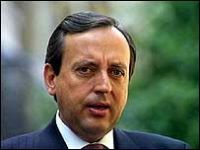
Former president Rafael
Angel Calderón Fournier
(1990-1994)

Former president Miguel
Angel Rodríguez Echavarria
(1998-2004)
See Scandals Scorecard
for the latest of who's how
and where!
The Image of Costa Rica at
Stake
While reacting angered at
the disclosure of corruption
scandals involving two
former Presidents government
officials and private
companies are worried about
the damage to the image of
their nation as a land of
peace, law, and order
brought upon it by the
scandals.
However, some agree that at
the end the current crisis
will be for the good,
because it is a confirmation
that corruption won’t go
unpunished here, it doesn’t
matter how high the persons
involved.
|

Banco Elca
will be dissolved!
That is the news from the
Consejo Nacional de
Supervisión del Sistema
Financiero (CONASSIF) who
intervened the bank's
operations on June 29, 2004.
The head of the
Superintendencia General de
Entidades Financieras (SUGEF),
Óscar Rodríguez, says the
bank is not a viable
operation and it is best to
liquidate it completely.
The president of Banco ELCA,
Carlos Alvarado Moya, along
with former manaher, Hernán
González Peña, and advisor
Javier Filloy Esna, are
still in jail on three
month's preventive
detention.
A complete report will be
available tomorrow,
Saturday. |
The detention yesterday of
former president Rafael Angel
Calderón Fournier on corruption
charges with respect to the
government of Finland loan to
the Caja Costarricense de Seguro
Social, put Costa Rica on the
world stage for a second time in
less than a week.
Last Friday, former Costa Rican
president, Miguel Angel
Rodríguez, stepped off a Grupo
TACA flight from Washington,
D.C. where he had just left his
post of less than a month as
Secretary General of the
Organization of American States
(OAS) to waiting judicial
officials, who handcuffed the
man in view of television and
newspaper cameras and wisked him
off as common criminal to
waiting prosecutors.
Rodríguez was placed under
"house arrest" for six months
and ordered to pay a
¢250.000.000 colones bond.
Rodríguez is appealing the bond
payment, while the Fiscalía is
appealing the house arrest,
wanting nine months of jail time
for the former president.
Calderón is this morning waiting
on a judge's decision. It is
expected the former president
will also get "house arrest"
though the Fiscalía is asking
for six months in jail.
Calderón's lawyer has been
making appeals to the news media
following reports that
Calderón's health was being
placed at risk, since jailers
did not attend to his needs of
delivering specially prepared
food at his jail cell, the same
cell reportedly used to hold
Rodríguez and others involved in
the various scandals surrounding
the country.
Calderón apparently suffers from
"gastritis" and his lawyer was
emphatic that it could lead to
cancer if his clients special
needs were not attended to.
Taiwan Admits
Donating to Ex-President
Rodríguez, report says
The Taiwan Embassy in Costa Rica
has admitted donating $400,000
to a foundation related to
scandal-hit former Costa Rican
President Miguel Angel Rodríguez.
According to the report, the
embassy said it donated $200,000
in 2001 and the same amount in
2002 to a foundation called
Liberty and Human Development of
Costa Rica, to help it hold some
seminars and meetings to promote
liberty and human development,
but the money was eventually
transferred to Inversiones
Denisse, a private company
believed owned by Rodríguez.
Costa Rican authorities are
investigating allegations.
Media reports said Taiwan made
the donations against the
backdrop of its hope to regain a
seat in the United Nations.
Costa Rica recognizes the
sovereignty of the government of
Taiwan, which China regards as a
breakaway province.
The Associated Press reported
Sunday that Taiwan Foreign
Minister Mark Chen denied the
allegations, saying, "Taiwan has
never given political donations
to any individuals."
United
Nation's Head Opposes Human
Cloning Ban, U.S. and Costa Rica
Firm
The head of the
United Nations says he opposes a
proposal to draft a treaty
banning all forms of human
cloning. Meanwhile, the United
States and Costa Rica are
standing firm in their resolve
to fight for a complete ban
rather than delay a vote for
another year or allow a partial
ban to pass.
U.N. Secretary-General Kofi
Annan on Thursday endorsed
embryonic stem cell research and
said he opposes efforts by the
61 nation coalition, headed by
the U.S. and Costa Rica, to
draft a treaty opposing both
reproductive and research
cloning.
"Obviously it is an issue for
the member-states to decide, but
as an individual and in my
personal view, I think I would
go for therapeutic cloning,"
Annan told reporters Thursday.
Meanwhile, a U.S. diplomatic
official told the French Press
Agency that its position in
favor of banning all human
cloning has not changed.
"A partial ban that prohibits
cloning for reproductive purpose
but permits the destruction of
cloned human embryos for
experimental purposes is
unacceptable," the State
Department official said.
"Our position on cloning has not
changed. We believe all cloning
is wrong and should be banned,"
the official said.
A Costa Rican representative
said that his country isn't
changing its mind either.
However, Costa Rica's U.N.
Ambassador Bruno Stagno Ugarte
also said he was concerned that
pressure is building to delay a
vote another year.
"We are convinced that we enjoy
a clear majority. However, and I
think we must be realistic here,
we still face the specter of
some type of procedural vote as
a way of avoiding our
responsibilities to address an
urgent and important matter,"
Stagno told Associated Press.
The UN's legal committee opened
debate on Thursday on guidelines
for drafting a human cloning ban
treaty.
On Monday, Moroccan U.N.
Ambassador Mohamed Bennouna, who
chairs the legal committee, said
he would do everything in his
power to delay a vote for
another year, claiming the
international community is not
ready to vote on the
controversial issue.
"This has become such an
emotional issue that I hope to
avoid a vote this year,"
Bennouna told Reuters.
The U.S. and Costa Rica want
nations to sign on to a treaty
saying "human cloning, for any
purpose whatsoever, is
unethical, morally reproachable
and contrary to due respect for
the human person and that it
cannot be justified or
accepted."
Belgium and other European
nations are rallying a smaller
group of countries in
opposition.
The Belgian group of nations,
with twenty-one supporters, have
drafted a competing proposal
that bans human cloning for
reproduction but allows it for
research.
In a September speech, President
Bush endorsed the complete ban
on human cloning.
"In this session, the U.N. will
consider a resolution sponsored
by Costa Rica calling for a
comprehensive ban on human
cloning. I support that
resolution and urge all
governments to affirm a basic
ethical principle: No human life
should ever be produced or
destroyed for the benefit of
another," he said.
The issue has divided the U.S.
presidential candidates with
Senator John Kerry co-sponsoring
a Senate bill, SB 303, that
allows scientists to clone and
kill human beings for research.
Related web sites: United
Nations -
http://www.un.org
Shortage of Hotel Rooms
The joy resulting from an
increasing arrival of tourists
in Costa Rica is marred by the
threat of shortage in hotel
rooms, both private and official
sources agreed.
According to the National
Chamber of Tourism and the
Association of Tourism
Professionals, the increase in
the arrival of tourists who
travel by air has averaged 8.26
percent in the last seven years,
while the number of new hotel
rooms has averaged only 3.26
percent.
The Minister of Tourism, Rodrigo
Castro, explained that he has
had recent meetings with both
local and international
investors to promote new
investments and expand the
existing facilities, in order to
properly address the lodging
needs of visitors.
CNFL To Change More Than 7.000
Street Lamps
In an ambitious
project, the Compañía Nacional
de Fuerza y Luz (CNFL),
announced that it will replace
some 7.580 light bulbs in street
lamps during the period of
2005-2006, at a cost of
¢320.000.000 colones per year.
Fourteen districts in the
Metropolitan San José area will
be affected with the better
lighting on their streets.
The areas most affected with the
improved lighting are Aserrí,
Desamparados, Montes de Oca, La
Unión, Tibás and Curridabat. The
areas of Alajuelita, Escazú,
Santa Ana, Alajuela, Belén,
Flores, Barva and Santa Bárbara
in Heredia will also see
lighting improvements.
Henry Chinchilla Mora, a
director at CNFL, says that the
improvements will hopefully
reduce the number of complaints
about street lights and street
lighting in general. |


