|
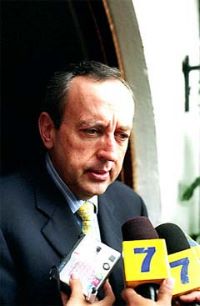
FISCHEL-CAJA SCANDAL:
Eliseo Vargas Fingers Calderón
The Fischel-Caja
scandal took on a new twist as
former president of the Caja
Costarricense de Seguro Social (CCSS),
Eliso Vargas, talked to
prosecutors on Tuesday to make a
deal for a change in his housing
arrangements and charges dropped
against his daughter, in
exchange for more incriminating
information.
Vargas is preventive detention
in the Cocorí jail in Cartago,
but soon could be home under
house arrest and all
investigations will be dropped
against his daughter for
receiving a Toyota Rav4, paid by
the Corporación Fischel from
funds received in connection the
the us$39 Million dollar loan
from Finland.
Vargas told prosecutors that
former president Rafael Ángel
Calderón tried to hide the
deposit of us$520.000 dollars in
Panama paid form the Finnish
loan.
In an interview that took some
12 hours, Vargas, detailed to
prosecutors how Calderón
attempted to mask the movement
of the funds as part of a sale
of stock in a Miami hotel.
Vargas also told prosecutors
that it was Calderón who showed
him how to funnel funds to U.S.
accounts and that an aide to
former Panamanian president,
Mireya Moscoso, helped in
opening the Panamanian accounts.
The statement by Vargas also
indicated that Calderón was very
worried about covering up the
payments made through the
Sultana company in Panama and
had dealings with Fischel
president, Walter Reiche Fischel,
over the movement of the funds.
According to Vargas, it was
Calderón who decided how the
"commission" would be split up
and who got what. Calderón paid
out us$300.000 to himself,
another us$300.000 to Gerardo
Bolaños (Calderon's law firm
partner) and another us$300.000
to Juan Carlos Sánchez.
Vargas got us$600.000 for his
part, being told by the former
president that he deserved
double the amount of the others,
since he had been a deputy in
the Legislature and then
president of the CCSS.
Vargas, who has been in
preventive detention since
September 7 and who may soon see
more liberty, also told
prosecutors that he received a
payment from Alcatel. Through
his friendship with Rodrigo
Méndez, an engineer at the
Instituto Costarricense de
Electricidad (ICE), he met Edgar
Valverde, the them president of
Alcatel Costa Rica.
Vargas said that he was promised
a "good" commission if Alcatel
was able to get the ICE contract
to install 400.000 GSM cellular
telephones lines in Costa Rica,
a contract that Alcatel did get
and was worth us$149 million
dollars.
Former president Rafael Ángel
Calderón is to appear before the
Fiscalía this morning (Thursday)
to answer questions over the new
allegations by Vargas and could
see the investigation place
preventive measures against the
former president, as the case
with former president Miguel
Angel Rodríguez who is under
house arrest in the ICE-Alcatel
scandal.
Calderón told the press that his
is hurt by the allegations by
Vargas, a man he had helped with
his career and personally.
Gonzalo Castellón, Calderón's
lawyer, says that the
possibility exists that his
client (Calderón) may face
stiffer measures against him
following the meeting this
morning with prosecutors. He
told the press that his client
will walk in the main doors of
the 'Tribunales' in San José
like any other citizen,
referring to the way former
president Rodríguez was escorted
in handcuffs, as a common
criminal, following his arrival
to Costa Rica last Friday.
Internal court house security
has been intensified for this
mornings appearance by the
former president and additional
security measures are in place
to avoid the disorder around and
inside the court buildings last
week with the arrival of
Rodríguez.
PRESIDENTIAL SCANDAL:
Taiwan's
Impact of Costa Rica Scandal
Widens
The Taiwan legislative foreign
affairs committee yesterday
temporarily froze an annual
secret budget to South and
Central America nations,
demanding that the Ministry of
Foreign Affairs (MOFA) provide a
clear explanation of Taiwan's
donations to former Costa Rican
president Miguel Angel Rodríguez.
KMT legislator Bill Sun, who
initiated the freeze, argued
that MOFA has failed to provide
an explanation of the situation,
which might lead to more damage
to Taiwan and its ties with
Costa Rica.
Costa Rican prosecutors
confirmed that they are
investigating alleged payments
by the government of Taiwan into
accounts controlled by former
president Miguel Angel Rodríguez,
who allegedly received
US$200,000 in 2001 from the
Foreign Ministry and another
US$200,000 in 2002 from the
Taiwanese Embassy in San Jose.
Furthermore, there are reports
that a Panamanian company
controlled by Rodriguez
allegedly accepted two separate
donations of US$500,000 each and
that Taiwan had provided a total
of US$1.4 million in political
donations to Rodríguez over
three years.
The MOFA, which submitted an
explanation of Taiwan's
contributions to its Costa Rican
counterpart Tuesday, has denied
making any political donations
to former president Rodríguez,
but has not made proper
disclosure of such.
The MOFA also said that it had
allocated US$200,000 for a
personnel-training project and
international conferences in
2001 and 2002, after the
Foundation for Liberty and Human
Development in Costa Rica sent a
letter to Taiwan's embassy
seeking a donation of US$1.2
million, to defray the cost of
seminars and training."
The MOFA, however, claimed that
it was unaware of the source of
the remaining US$1 million that
was supposedly donated to
Rodríguez's Panamanian company.
Rodríguez's lawyers, however,
said that the amount of
US$200,000 dollars sent in 2001
and 2002 to the foundation was a
personal loan to the then
president.
Taiwanese banks arranged to loan
Rodríguez the money through the
government in Taipei, lawyer
Rafael Gairod said.
The MOFA yesterday declined to
comments on the statement by
Rodríguez's lawyers.
Sun emphasized that the
Legislature is seeking to
exercise damage control to
ensure that Taiwan's image would
not be further tarnished as the
case continues through the legal
process.
To protect Taiwan's image, Sun
said, a special committee was
needed to investigate the case.
He said yesterday that he was
not satisfied with the MOFA's
explanation, which left many
uncertainties concerning the
secret budget, which would be
again reviewed by the
Legislature's foreign affairs
committee today.
Abengoa Loses
Costa Rican Contract
Spain's
Abengoa SA 's Inabensa SA unit
has lost a €162.4 Million Euro
contract in Costa Rica due to
bribery charges facing
ex-president of the country
Miguel Angel Rodríguez, El Mundo
reported, without citing a
source.
According to El Mundo, Abengoa's
alledged involvement in the
bribery allegations facing the
ex-president has led the
Instituto Costarricense de
Electricidad (ICE) to cancel a
contract to build the Miramar de
Puntarenas power plant.
Inabensa has been accused of
making a us$100,000 payment to
Rodríguez for awarding the
company a contract to lay
underground power cables in
downtown San José, a project
that is coming to the end of
it's two construction phase.
The contract was awarded to
Inabensa when Rodríguez was
president.
Inabensa said it 'has never made
payments to public servants in
order to improve chances of
winning a contract,' denying any
involvement in a bribery scandal
surrounding the ex-president of
Costa Rica.
Four e-mails published in the
Spanish daily Al Día
newspaper is incriminating
Inabensa in paying Rodriguez for
awarding the company the
contract. Al Día
cited unnamed judicial sources
on Sunday, however, as saying
that the judge has refused to
accept the e-mails as evidence,
calling them 'spurious.'
The Abengoa unit said it was
awarded the power line contract
because 'the second bidder
offered a substantially higher
price than Inabensa.'
Amid the allegations contractor
Inabensa, as well as telecoms
firms Alcatel and Ericsson have
been removed from the list of
government suppliers.
The awarding of telecoms
contracts in Costa Rica has
always been somewhat mysterious,
with a number having been won
and then subsequently lost
again. However, the mounting
publicity surrounding this
scandal could have serious
consequences for Ericsson and
Alcatel throughout the region.
For example, the president of
Honduras, Ricardo Maduro, has
said that the country will begin
an investigation into the
conduct of Alcatel in relation
to contracts awarded to it by
state-owned, fixed-line
incumbent Hondutel. Any more
allegations against the company
could see it blacklisted in one
of the fastest-growing telecoms
regions in the world.
More Protected
Areas and Planted Forests in
Latin America and the Caribbean
Less natural forest cover, but
more protected areas and forest
plantations, and an increased
share of international trade in
forest products are expected by
2020 in Latin America and the
Caribbean.
This is the conclusion of an
outlook study to be published at
the end of the year by the UN
Food and Agriculture
Organization (FAO).
The forecasts were presented for
discussion to country
representatives at the Latin
American and Caribbean Forestry
Commission this week in San
José, Costa Rica.
"The challenges and
opportunities of the expected
changes call for greater
participation of communities and
local government in forest
management, better property
rights regulations, improved
intraregional trade and
development of systems for a
better flow of information,"
said Mr. Merilio Morell, an FAO
forestry expert, at the meeting.
Country representatives at the
meeting recognized the need for
coordinated follow up actions
and programs in response to the
outlook forecasts.
"The future of forests in the
region in the coming decades
depends on how countries react
to, and what kinds of actions
they take in view of these
expected changes," Morell said.
Natural forest cover is expected
to continue decreasing between
now and 2020, according to the
study. It is expected to shrink
from 964 million hectares in
2002 to 887 million hectares in
2020 or 47 percent of the total
land area of the region.
Planted forests are forecast to
increase from 12 million to over
16 million hectares. Protected
areas are also likely to expand.
Already between 1950 and 2003,
protected areas increased from
17.5 to 397 million hectares,
reaching 19 percent of the
region's total area and 23
percent of the world's protected
areas. Between now and 2020, new
protected areas are expected to
be created in the region,
including mega parks and
biological corridors.
Participating countries shared
success stories on this topic at
the meeting in San José.
Costa Rica reported how forest
cover in the country increased
from less than 30 percent to 47
percent in a little more than a
decade thanks to its National
Fund for Forest Financing. The
Fund spends a 3.5 percent in tax
charged for the use of fossil
fuels to support land owners and
local communities to maintain
protected areas, plant trees and
manage their natural resources.
Uruguay and Cuba also described
how their policies helped slow
down and reverse the
deforestation rate.
"To guarantee protection and
sustainable use of forests the
multiple benefits and services
provided by forests have to be
valuated in monetary terms by
those who benefit," Mr. Morell
said.
"Forests not only offer timber
and non-wood forest products
such as fruits and natural
medicines, but also contribute
to ecotourism, the conservation
of watersheds and biodiversity,
and to the mitigation of climate
change. All this should be
valuated to raise funds needed
to pay for conservation of
forests," he said.
|