|
|
|
News
 Home
Page Home
Page
National
Latin
America
Sections
Special
Reports
Travel/Tourism
Real
Estate
Business
Health
The
Internet
Letters
Opinion
Columnists
Leisure
EroTica
Entertainment
The
Take!
Learn
Spanish
Photos
Editorial
Letters
Opinion
Columnists
Public
Forum
Who We Are
About
Us
Contact Us
Advertise
with us
Subscribe
to our
Newsletter
Links
Page
|
 |
|
<
Back
Send this Page To a Friend |
Violent Awakening as Strong
Quake Shakes Costa Rica
The strong earthquake that shook
Costa Rica in the early hours of
Saturday morning resulted in
eight deaths and lots of
property damage from the Pacific
Coast to the Central Valley.
The quake occurred at 2:07am
local time. It shook people from
their beds, with a magnitude of
6.2 on the Richter scale. The
epicenter. according to
Observatorio Vulcanológico y
Sismológico (Ovsicori) was
located about 10km Northeast of
Quepos, with a depths of 30 km,
lasting 25 seconds.
Quepos and Damas was the hardest
affected by the quake as
property damage to more than 500
homes were recorded and more
than 100 shocks were registered
during the day yesterday,
following the main tremor.
Eight people were reported dead
as result of the earthquake,
seven of them from heart
problems and one man from a
traffic accident.
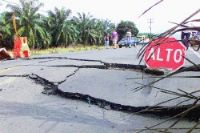
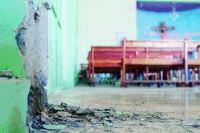
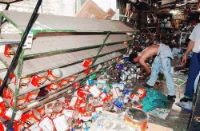
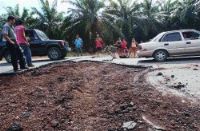
Property damage, from cracked
walls, to roofs caving in and
foundations giving way, were
reported all to the way to
Cartago, about 25 kim east of
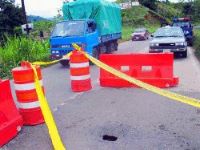
San José. The Braulio Carrillo
highway - the main road that
connects Límon to San José - was
closed for hours as work crews
worked to remove fallen rock
from the roadway.
In the Parrita to Quepos stretch
of the only road that connects
the two communities, engineers
were concerned about the state
of the bridges that are along
the roadway. Cracks in asphalt
were the only reported damage
and the roadway was re-opened
within hours of sunrise as
inspectors gave the green light
to no structural damage.
"We heard a big bang and then
the whole house started to
shake", were the words of many
we talked to yesterday morning,
as the talk of the earthquake
overtook any other conversation.
"Did you feel it", was the
common greeting, replacing hello
and good morning.
The Comisión Nacional de
Prevención de Riesgos y Atención
de Emergencias (CNE)
declared a yellow alert for the
area of Quepos and Parrita and
Cruz Roja Costarricense (Red
Cross) workers have been
responding to many calls for
assistance from residence shook
up by the strong earthquake.
The quake forced the suspension
of electrical, telephone and
water services to Quepos and
Parrita for hours, being
restored in the early afternoon
as work crews assessed damages.
Some reports of power failures
were also reported in San José,
though power was restored almost
immediately.
The last earthquake to shake
Costa Rica with a similar force
was
a little after 1 a.m. Christmas Day,
when the Northern Pacific coast
of of Panama and the Southern
Pacific coast of Costa Rica
were rocked and shaken by a 6.4 earthquake, which
killed at least one person and injured hundreds
others.
The epicenter of that quake was established in the
vicinity of Puerto Armuelles, Panama, not far from
the Costa Rican border.
Summit leaders out of their
beds
The strong earthquake also
forced leaders at an Ibero-American
summit in the capital out of
their beds. "There was not a
single president who didn't get
up. We all did," said Ecuador's
President Lucio Gutierrez.
The head receptionist for Hotel
Herradura, where the
summit leaders are staying, said
the chiefs of states had not
left their rooms even though the
quake was felt "quite strongly"
at the site.
"They didn't come out, no one
did, all the normal security
measures went into effect," he
said, adding that the quake had
merely shattered a few kitchen
plates.
The Iberoamerican summit was
inaugurated late Friday, before
the heads of state and of
government sat down for a day of
formal talks Saturday.
For more information about
the earthquake in English click
here!
|
|
|
In the
market for a change? Click
here! |
Leaders of Spain, Portugal,
Latin America Gather for Annual
Summit
The Iberoamerican summit was
inaugurated late Friday, before
the heads of state and of
government sat down for a day of
formal talks at a San Jose hotel
Saturday.
The gathering was largely
overshadowed by the Asia Pacific
Economic Cooperation (APEC)
summit in Santiago, also held
over the weekend.
And it was marked by the absence
of presidents Luiz Inacio Lula
da Silva of Brazil, Ricardo
Lagos of Chile, Fidel Castro of
Cuba, Alejandro Toledo of Peru,
Jorge Fernando Brando de Sampaio
of Portugal and Hugo Chavez of
Venezuela.
Education topped the agenda, and
a draft of the final declaration
calls for "creative" new
approaches to tackle the lack of
funding in that sector.
The leaders will also discussed
a host of other issues, and the
participation of Spanish Prime
Minister Jose Luis Rodriguez
Zapatero was expected to be a
highlight as it will be his
first visit to Latin America.
In past Iberoamerican summits,
Castro has faced criticism of
his government's human rights
record.
Preparations for this year's
gathering were marked by
Havana's request for the leaders
to condemn Panama for pardoning
four Cubans convicted in a plot
to assassinate Castro during the
2000 Iberoamerican summit.
The Cuban delegation has agreed
to tone down the language in the
resolution to be formally
adopted at the end of the
summit.
Havana cut ties with Panama City
in August over the pardon, but
the two sides announced Friday
they had restored consular
relations.
The announcement came after
Panama's President Martin
Torrijos and Cuban Vice
President Carlos Lage held talks
on the sidelines of the Costa
Rica gathering.
Meanwhile, a senior UN official
urged international financial
institutions to ease their
conditions for aid to Haiti.
"We strongly urge them to ease
some norms," said Juan Gabriel
Valdes, the UN special envoy to
Haiti.
"There are 1.3 billion dollars
pledged in Washington from
various governments and
international organizations for
projects in Haiti, but internal
rules by organizations like the
World Bank, as well as the
delicate situation of the
Haitian government, are delaying
their utilization," Valdes told
the AFP news agency.
Central America’ Candidate for
OAS Secretariat
Presidents of Central American
countries chose this Satuday in
San José former Salvadoran head
of state Francisco Flores as the
region's candidate to head the
Organization of American States.
Mr. Flores candidacy was
sponsored by Salvadoran
President Tony Saca and his
Guatemalan counterpart, Oscar
Berger.
"Central America and the
Dominican Republic have chosen a
candidate. Mr. Flores is the
region's only candidate for the
post with the backing of all
countries," said President Saca
after leaving the Costa Rican
presidential palace where the
decision was made.
"Some countries voted for their
own candidates, but in the end
Central America has chosen and
the decision is that we're all
going to support a single
candidate," added Mr. Saca.
President Berger said that
Central American leaders will
now have to seek votes from the
rest of the hemisphere, noting
that Mr. Flores already has the
support of Mexico, Colombia and
the Caribbean countries.
The post has been vacant since
early October when former Costa
Rican President Miguel Angel
Rodríguez stepped down one month
as OAS secretary-general, to
face corruption charges in Costa
Rica. Rodriguez now sits in La
Reforma prison, less than 10
miles from the
Iberoamerican summit leaders,
waiting for the Fiscalía to
complete its investigation
against the former president.
Central American leaders also
insisted that the position,
which generally rotates among
the three Americas, must remain
within the region in spite of
the frustrating experience with
the Costa Rican candidate. But
it’s not certain how the other
influential countries of the
region, Brazil, Argentina,
Venezuela will react.
North Zone Hotels
Almost at Full Capacity
Notwithstanding the bad roads,
hotels in the Guanacaste region
and La Fortuna de San Carlos say
they have few rooms available.
In Guanacaste hotels are already
at 80% capacity.
Managers of Tamarindo hotels say
their season began in November.
The Cámara de Turismo (CANATUR)
officials for the Northern areas
were caught by surprise by the
number of tourists to visit the
area at this time of year,
almost one month in advance of
the normal season.
CANATUR said in a press
statement that in La Fortuna
there was a definite shortage of
hotel rooms. La Fortuna includes
the Volcano Arenal and other
tourist attractions. Many
visitors go to La Fortuna for
the thermal waters. |
|
|
|
|
|
|