Cuban US dollar ban takes effect
Cuba
has ended circulation of the US
dollar in an attempt to resist a
tightening US blockade.
Dollar transactions that have
been allowed for the last 11
years were replaced by
convertible Cuban pesos, which
are worthless outside Cuba.
Cubans will have to pay a 10%
surcharge to exchange US
currency.
Cubans can still keep dollars at
home and hold dollar bank
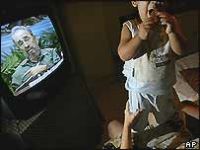
accounts, but President Fidel
Castro has banned the use of
dollars in transactions.
The Cuban leader announced the
change of policy accusing
Washington of "mafia-like" moves
limiting cash and people flows
to the island.
Cubans have seen their economy
deteriorate in recent years
because of the embargo and the
loss of European communist
allies.
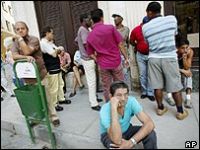
They have been queuing at
special exchange counters to
swap dollars for convertible
pesos, which will be worth $1 in
Cuba but will be worthless
abroad.
The change will be felt by
everyone in Cuba, where many
everyday transactions were
carried out in dollars.
In a sign that authorities had
underestimated how many dollars
were being horded, the deadline
for converting the currency was
extended until 14 November.
After that, the 10% surcharge
will apply.
Colombia president approves
extraditing drug lord to US
Colombian President
Alvaro Uribe on Tuesday approved
the extradition of one of the
country's most notorious drug
lords, former Cali cocaine
cartel boss Gilberto Rodriguez
Orejuela, to the United States
for trial.
Led by Rodriguez Orejuela and
his brother Miguel, the Cali
group had grown into the world's
top drug cartel in the late
1980safter the downfall of its
rival Medellin.
In the 1990s, Cali once
controlled 80 percent of cocaine
trade in the world, which
brought them 8 billion US
dollars in profit every year.
Rodriguez Orejuela, a
63-year-old former banker, was
known for his shrewdness. He
earned the nickname of "The
Chess Player" for his ability to
outwit the police.
The Colombian government once
mobilized some 20,000 troops and
policemen in a nation-wide hunt
for the Rodriguez Orejuela
brothers.
Rodriguez Orejuela was first
arrested in June 1995 in his
house at his hometown Cali, the
country's third largest city
where the cartel was based. His
brother was captured later.
The brothers received a sentence
of 15 years in prison, which was
shortened to 7 years in November
2002 due to their "good
behavior" during the term. They
were released shortly
afterwards.
However, several months later,
Gilberto Rodriguez Orejuela was
once again put into prison for
"other crimes pending sentences"
in March 2003.
US anti-narcotic organizations
believe the Cali, responsible
for 80 percent of cocaine and
the large amount of Heroin in
the US, has been the most
powerful drug cartel ever
existed.
The US had been striving to
extradite the two brothers and
havethem tried in the US.
Chilean court decides to
continue proceedings against
Pinochet
The Chilean Supreme Court said
on Tuesday that it had decided
to continue the proceedings
against former dictator Augusto
Pinochet.
As part of the decision, Monica
Maldonado, prosecutor of the
court, suggested that judge
Sergio Munoz attend the petition
of Spanish judge Baltasar Garzon
to confiscate Pinochet's assets
found in Riggs Bank of the
United States.
Maldonado indicated that her
suggestion conforms to Article
76 of the Civil Proceedings
Code.
It is also based on the norms of
the Inter-American convention on
the transaction of rogatory
letters, and the Treaty of
Extradition and Criminal
Judicial Assistance signed
between Chile and Spain, she
added.
Meanwhile, the Criminal Tribunal
of the Court sent the plenum of
the Court of Appeals of Santiago
a petition of Argentine judge
Maria Servini to interrogate
Pinochet for his involvement in
a murder case.
Servini's petition was focused
on the investigation of the
murder for Carlos Prats in
Buenos Aires, when he was a
former commander of the Chilean
army.
Pinochet, who took control of
Chile by ousting constitutional
President Salvador Allende in
1973, was arrested in London on
Oct.16, 1998, after Garzon
issued an arrest warrant to have
him extradited to Spain on
charges of torture, terrorism
and genocide. He was later
released because of his poor
health conditions.
The former ruler and his
security agents face hundreds of
charges of homicide, kidnapping
and torture in Chile.
In late October, Garzon sent the
Chilean tribunals an
international rogatory letter in
which he asked for information
about Pinochet's assets
deposited in other countries.
Argentine VP says Hu's upcoming
visit is "a historic event"
Argentine
Vice-President Daniel Scioli has
said Chinese President Hu
Jintao's upcoming visit is "a
historic event" and relations
between Argentina and China are
of "great importance" to the
future of the Latin American
country.
"In the same year when President
Nestor Kirchner visited
China,President Hu's visit to
our country is a historic
event," Scioli said Monday.
President Kirchner paid a
six-day state visit to China in
June.
Scioli said the economic and
trade ties between Argentina and
China are complementary, and
both sides will strengthen
exchanges in the field.
State Secretary of Information
Enrique Alberstur also welcome
Hu's visit with high praise.
"The Argentine government and
people are looking forward to
President Hu's upcoming visit,"
he said in an interview with
Xinhua.
"The visit not only is an
important event for Argentina
and China, but has far-reaching
impact on the whole Latin
American region," Alberstur
said.
Alberstur dismissed the
so-called "China threat," adding
that Argentinians see "China
hope" instead.
"China's rapid development has
brought us new hope," he said.
Alberstur said Hu's visit will
definitely further boost the
development of bilateral ties.
The Argentine government and its
people welcome investment from
Chinese enterprises, hope to
expand trade and economic
cooperation with China and to
enhance mutual understanding
between the peoples of the two
countries through more cultural
exchanges, he added.
Argentina's business circle
welcomes Hu's visit and sees it
as an opportunity.
Julio Werthein, chairman of the
Argentina-China Chamber of
Commerce, said on Tuesday that
Hu's visit will be an important
opportunity for Argentine
enterprises. "China is a very
good, reliable and serious
partner," he said.
Cooperation projects between
enterprises of the two countries
will play a positive role in
Argentina's economic
development, Werthein said.
Jorge Aguello, chairman of
foreign affairs commission of
Argentina's lower house, said
the consensus reached by the two
countries can be understood as
South-South cooperation, which
willhelp the development of the
Mercosur (Common Market of the
South) and other Latin American
countries.
Hu is scheduled to visit Brazil,
Argentina, Chile and Cuba on
Nov. 11-23 and attend the 12th
Informal Leadership Meeting of
the Asia-Pacific Economic
Cooperation to be held on Nov.
20-21 in Santiago, capital of
Chile.
|