|
Jailed Ex-Presidents Unhappy
With Their Current Living
Arrangements
Former
president, Rafael Angel Calderón,
did not like his current living
arrangements. He made his appeal
to the courts for a change,
asking to be placed under house
arrest, in exchange for a jail
cell in La Reforma prison, for
the next 8 1/2 months.
|
Today's Stories:
 Jailed
Ex-Presidents Unhappy With Their
Current Living Arrangements Jailed
Ex-Presidents Unhappy With Their
Current Living Arrangements
President
Pacheco's Rating Up
Unions
To Show Their Discontent With
Corruption
Brazil,
Costa Rica, Mexico to Serve on
U.N. Economic Council
Alcatel
Faces Informal SEC Inquiry
Daniel
Oduber Airport Getting Relief
|
|
|
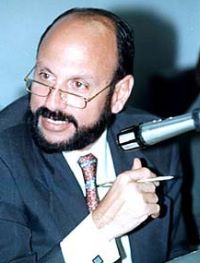
The La Reforma prison is getting
overcrowded with former
politicians. Yesterday, former
Labour Minister, Farid Ayales,
joined former presidents
Calderón and Rodríguez in the
largest prison in Costa Rica.
Ayales, a minister in the
Figueres Olsen administration,
was convicted in 2000 for fraud
and given 8 years in prison. In
2003 an appeals court lowered
the sentence to 4 years and
given house arrest following
three years in prison. However,
he broke that condition and
yesterday judicial officials
waited for him when he returned
home to take him back to prison.
|
Hello, this is
COSEVI calling.
Your traffic fine is overdue for
payment!
That is one option the
Consejo de Seguridad Vial (Cosevi)
is considering calling drivers
to remind them of their
outstanding traffic tickets and
to pay up and the easiest way to
do so.
Collecting unpaid traffic
tickets is a headache for the
Cosevi as it has to, in
most cases, wait until license
renewal to get paid, which can
be from 2 - 5 years. An
estimated ¢30 million colones is
due on traffic fines each year
or 45% of all outstanding
traffic tickets.
|
Calderón made his appeal before a judge and then
was taken to the Clínica Católica, in Goicoechea, suffering from
high blood pressure and an increase in his heart rate, according to
the doctors.
Doctors at the hospital say the former president is stable, arriving
at the hospital a little after 5pm yesterday.
Calderón has now completed 13 days of his nine months of preventive
detention and is appealing the decision by judge Carmen María Peraza,
set on October 22.
Across the hallway in the La Reforma cell block is former president
Miguel Angel Rodríguez, who is also unhappy with is living
arrangements.
Rodríguez was ordered under house arrest following his return to
Costa Rica last October 15. The Fiscalía appealed the judge's
ordered and a Superior Court overturned the decision and ordered
Rodríguez to preventive detention in La Reforma for six months.
Rodríguez cannot appeal the latest decision, and must wait for the
mandatory three months before a review, so he has taken to the media
to express his feelings.
By way of his lawyer, Rafael Gairaud, Rodríguez issued a statement
that said he has been victim of a lynching since his return to Costa
Rica.
In the statement he criticized the media for having access to
restricted areas of the airport and filming his arrest, being led
off the arriving airplane in handcuffs by judicial agents.
He questioned the "right to be heard". He said "he has been
condemned and sent to prison".
Rodríguez also criticized the Fiscalía for leaking reports and
information to the press. He said that there exists in Costa Rica
regulations that prohibit the publication of information in files,
however, in his case, moments after any decision, the information
was in the news.
Rodríguez also questioned the flip-flop of last Friday afternoon.
What happened between 2pm and 4pm? when the media was telling that
the house arrest would certainly be continued, then by the end of
the day, the judge made the ruling for preventive detention.
Rodríguez, in the statement written in his own hand writing, asked
several questions: "Is it the Fiscalía and the press that now
convict in Costa Rica? Are we going to put aside the courts and
replace them with lynching? Where are we going?"
Rodríguez concluded his statement with "the answer is with each of
us, just remember what history has taught us, today me, tomorrow
you."
President Pacheco's Rating Up
President Abel Pacheco is regaining public backing, according to a
poll by CID-Gallup published in the Spanish language daily,
La República.
49 per cent of respondents say the president’s performance has been
good, a 12 per cent increase since December 2003.
Pacheco, of the Partido Unidad Social Cristiana (PUSC) was elected
in a run-off in April 2002 with 58 per cent of the vote.
Issues such as alleged contributions by foreign entities into his
campaign fund, as well as his moral support for the war in Iraq, had
affected his approval rating.
The poll results reveal that the corruption allegations linking
former presidents Rafael Angel Calderón (1990-1994) and Miguel Angel
Rodríguez (1998 to 2002), who are both from the PUSC party and both
in La Reform prison in preventive detention has helped Pacheco in
his popularity.
The Costa Rican congress opted to bring back presidential
re-election last year. Óscar Arias Sánchez of the National
Liberation Party (PLN)—who headed the government from 1986 to 1990,
and is still regarded for his democratic proposals and actions on
how to deal with violence in Central America—is considered the
frontrunner in the race to replace Pacheco. The election is
scheduled for April 2006.
Polling
Data
How would you rate the
performance of Abel Pacheco
as president of Costa Rica?
|
| |
Dec. 2003 |
Oct. 2004 |
|
Good |
49% |
37% |
|
Average |
36% |
34% |
|
Bad |
15% |
29% |
Source: CID-Gallup / La
República
Methodology: Interviews to
1,238 Costa Rican adults,
conducted from Oct. 16 to
Oct. 25, 2004. Margin of
error is 2.8 per cent. |
Unions To Show Their Discontent
With Corruption
Members of the
Movimiento Cívico Nacional and
the ANEP will travel today in a
caravan that will include
automobiles, buses and trucks,
from San Ramón through downtown
San José to presidential house
in Zapote to present Minister
for the Presidency, Lineth
Saborio, a letter stating their
unhappiness with corruption in
Costa Rica, the Riteve and the
TLC (Free Trade Agreement)
situation that everyone seems to
have forgotten over the scandals
of late.
Brazil, Costa Rica, Mexico to Serve on U.N. Economic Council
Brazil, Costa Rica and Mexico are three of 18 countries recently
elected as new members of the U.N. Economic and Social Council (ECOSOC),
a panel that coordinates development work for the world body.
In an October 29 statement, the U.N. said the Latin American nations
will begin three-year terms on the council on January 1, 2005.
The United Nations said that every year its General Assembly elects
a third of ECOSOC's 54-nation roster of members, choosing candidates
according to a pre-arranged formula of geographic distribution. At
any one time, 14 members must be from Africa, 11 from Asia, six from
Eastern Europe, 10 from Latin America and the Caribbean, and 13 from
the category called "Western Europe and other States."
The United States, Belize, Canada, Colombia and Panama are some of
the nations that will complete their three-year terms on the council
at the end of 2006, the United Nations said.
ECOSOC is responsible for promoting higher standards of living, full
employment and economic and social progress; identifying solutions
to international economic, social and health problems; helping in
international cultural and educational cooperation; and encouraging
universal respect for human rights and fundamental freedoms.
ECOSOC's purview extends to over 70 percent of the human and
financial resources of the entire U.N. system.
The United Nations said ECOSOC also is regularly given additional
tasks, including supervising and promoting the U.N. Millennium
Development Goals, which are a set of eight time-bound targets that
include the halving of extreme poverty in the world by 2015.
Alcatel Faces Informal SEC
Inquiry
Alcatel's troubles in Costa Rica
could lead to a United States
Security Exchange Commission
(SEC) investigation, according
to documents filed with the
Commission.
For now, the SEC is only
launching an "informal inquiry,"
according to a form F-3 filed by
Alcatel on Wednesday. The form
also says Alcatel has told the
SEC and the U.S. Department of
Justice that it would cooperate
with any investigation, although
it's unclear whether either
organization will formally look
into the matter.
The troubles stem from a bribery
scandal where payments were
allegedly made to "various state
and local officials in Costa
Rica," two political parties in
Costa Rica, and representatives
of Grupo ICE, the state-owned
telephone company, on behalf of
Alcatel, according to the SEC
filing.
The accusations led Alcatel to
launch an internal
investigation.
An Oct. 27 press release from
Alcatel noted the termination of
"two senior employees" and an
intent to pursue criminal
charges. One of the officials
apparently was Edgar Valverde,
president of Alcatel's Costa
Rican operations, who was
detained by officials last
month. The other employee is
described by the filing as "a
vice president-Latin America of
a French subsidiary."
Alcatel is terminating its
contracts with the local
consultants involved in the
scandal and is "in the process
of pursuing criminal actions"
against them as well.
Costa Rican officials have
investigations of their own
going on, and the F-3 form notes
that if they find Alcatel
violated the law, it's possible
the company could be barred from
bidding for contracts for a
time.
This would be a public relations
blow to the company but would
have relatively little financial
impact. Alcatel was expecting
$26 million from Costa Rican
contracts in 2004, according to
the filing.
Daniel Oduber Airport Getting
Relief
The Instituto
Costarricense de Turismo (ICT)
has announced a plan, that will
include more personnel and added
security and efficiency at the
Daniel Oduber airport in
Liberia, where more than 180.000
visitors are expected to arrive
for the season starting next
month.
The Cámara Nacional de Turismo (Canatur)
and the Cámara de Turismo de
Guanacaste, had asked the ICT
for help following a report last
September that the airport would
not be able to handle the
increased traffic this summer
season.
The Daniel Oduber airport has
grown exponentially over the
last nine years. From a small
airport that handled only
regional flights, now will be
handling 14 flights a week, with
addition of the newest flights
by TACA from San José, Air
Canada that will be flying
directly from Toronto and US
Airways who will add a third
flight a week in February.
A commission that was set up to
study and make recommendations
to deal with the increased
traffic at the airport
recommended that the airport
increase it's hours of
operation, that will now be from
6am to 8pm, add more immigration
and security personnel.
The announcement also said that
"Eco Desarrollo Papagayo" is
donating two quadracycles and an
automobile to add security to
the airport surroundings.
The airport, unlike the Juan
Santamaria airport in San José,
lays dormant between flights. It
springs to life as a flight is
about to arrive and goes back to
sleep after it leaves. The
airport is minutes from the town
of Liberia, but more important,
within less than one hour of
most of the Guancaste beaches,
including Papagayo, Tamarindo
and Flamingo.
In the past, visitors had to
land in San José and then either
make a connecting flight on a
regional airline or make the 4-5
hour bus or car ride and the
additional cost.
With flights now coming directly
into the Daniel Oduber airport,
visitors can now be on the beach
in less than an hour from the
airplane touching down. |


