Air Traffic in Crisis
Ninety five air traffic controllers walked off the job yesterday morning
following a general meeting the evening before where it was decided to
force the government to negotiate and called an indefinite strike
action.
By 6:30am, officers of the Fuerza Publica (police)
removed all the striking air traffic controllers from the main control
tower building in Alajuela. The same occurred later at the Pavas and
Liberia airports.
No airplanes left or landed from Costa Rica Saturday morning.
Air traffic controllers had kept their promise, however, by 9:00am the
government gave the control to foreign air traffic controllers and "tico"
pilots.
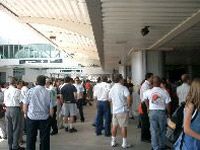
Flights were delayed, but did finally take off. The waiting area at Juan
Santamaria airport was crowded waiting the arrival of flight that were
up to one hour late in some cases.
Early morning flights were being diverted to Mexico and Panama as they
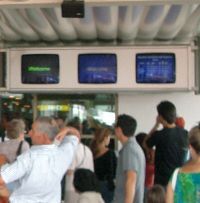
could not land here. The arrivals screen at noon time showed one flight
cancelled, from Toronto, Canada.
Most of the people waiting to board flights or those waiting on arrival
of flights were not even aware of the strike. ICR spoke to several
people waiting a flight to arrive and none had any idea of any strike.
Leonardo Leonardo Guillén, spokesperson for the
air traffic controllers union called the government's action to place
foreign controllers and pilots at the controls, irresponsible and a
danger to air safety.
Guillén reconfirmed that the strike is not about a salary
increase, but rather that the government keeps to it's agreement when in
1994 the government signed a pact with the air traffic controllers union
that air traffic controllers would earn 35% more in salary that civil
aviation inspectors.
The government's refusal to honour the agreement
was the cause for calling the strike.
Transport Minister Javier Chaves will be petitioning the courts tomorrow
morning to call the strike illegal and force the air traffic controllers
back to work.
Thousands have been affected so far by the strike.
The question on the minds of many is how can only 20 controllers take
the place of 95 and how long will the strike last?
Costa Rica and Panama in a "Chicken" War
It all started when Costa Rica refused to allow a
shipment of chickens from Panama, fearing it was tainted with
Salmonella.
The Panamanians reacted by closing off the border to all Tico products,
stopping much of the cross border traffic of merchandise that occurs
daily at Paso Canoas.
Salmonellosis is an infection with a bacteria called Salmonella. Most
persons infected with Salmonella develop diarrhea, fever, and abdominal
cramps 12 to 72 hours after infection. The illness usually lasts 4 to 7
days, and most persons recover without treatment.
However, in some persons the diarrhea may be so severe that the patient
needs to be hospitalized. In these patients, the Salmonella infection
may spread from the intestines to the blood stream, and then to other
body sites and can cause death unless the person is treated promptly
with antibiotics.
The elderly, infants, and those with impaired immune systems are more
likely to have a severe illness.
Salmonella live in the intestinal tracts of humans and other
animals, including chickens.
Salmonella are usually transmitted to humans by eating foods
contaminated with animal feces. Many raw foods of animal origin are
frequently contaminated, but fortunately, thorough cooking kills
Salmonella.
A study is being done to determine if the chicken was really
contaminated or just an unjust action on the part of the Costa Ricans
against the Panamanians.
Non-stop to
Europe
European airlines are displaying an interest in
expanding their services to Central America, as
confirmed by the Spanish Air Madrid, which started
non-stop flights between Madrid and Costa Rica.
Another Spanish carrier, Iberia, which now operates
its flights to Central America via Miami, will soon
start a non-stop service linking Madrid with
Guatemala, Panama, and Costa Rica.
To point out the meaning of these services for the
tourist sector, a source said that Air Madrid's
flights mean the arrival in Costa Rica of an
additional 50,000 tourists a year.
Intel
Recommends Extra Effort
Intel Costa
Rica launched the production of a new device for
computers - the Chipset - and recommended that the
country make extra efforts in order to become more
competitive and thus attract more firms from abroad
to settle here.
The Costa Rican plant of Intel competed with its
peers in Malaysia and China to produce the Chipset,
a regulator that enables to process information
faster when several applications are being used at
the same time in a computer.
Intel Costa Rica general manager Bill Abraham
pointed out that their plant here enjoys the best
supply of electricity among their facilities
throughout the world, but pointed out that there are
other areas - such as communications- that need
improvement to make the country more attractive to
other companies.
 News
Briefs News
Briefs
-
Five members of the a street
gang in La Carpio, west of San
José, were sent to hospital for
treatment of gunshot wounds,
following a fight between rival
gang members. Police say the
disturbance was isolated between
two rival groups and the armed
conflict ended quickly. La
Carpio was the scene of "mob"
rule last month when residents
decided to pressure the
government into making good on
it's commitment for the area and
staged a protest that turned
into violence.
-
Marco Badilla, Immigration
Director, confirmed that during
an operative in San José Friday
night, immigration officials
detained seven Chinese nationals
without documentation of being
legally in Costa Rica, where
part of a traffic ring that
brought them here.
|