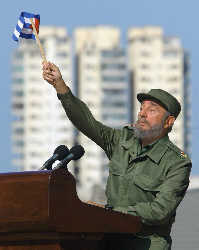
Castro
warns US against war on Cuba
Cuban leader Fidel Castro on Monday warned US President
George W. Bush not to make a war on the island country.
"You would not win that war... You will not find glory in military
action against Cuba," because "your march on Cuba would not be easy,"
Castro warned Bush while addressing a crowd of 200,000 in Havana. The
rally was held to condemn the new anti-Cuban measures adopted by the
Bush administration.
Wearing his olive-green military uniform, 77-year-old Castro spoke
before a 12-meter likeness of Bush, also in a military uniform and
daubed with a Hitler-style mustache.
Below the photo, hung near the US Interests Section in Havana, was the
text: "Bush, Fascist: There Is No Aggression Cuba Cannot Resist."
An aggression would cause an overall war between the US and theCuban
people, "something that would be very sad," Castro said in what he
called an open letter to Bush.
"An incursion into Cuba, my physical absence or other reasons would not
cause any damage to our capacity to fight and resist," Castro said in
his 35-minute speech.
He said that a "surgical operation" on the island will destroy bilateral
migration accord and lead to massive and uncontrollable serious
outcomes.
The two countries hold no diplomatic relations, although they signed an
agreement in 1994 to specify Cuban emigration to the United States.
Castro noted that the Cuban army has more than 200,000 well-trained
soldiers who know how to use weapons and a large number ofcombatants
"who know very well the strong and week points of thosewho threaten us."
It will be impossible for the United States to take power in Cuba after
his death, he said.
"They will not have one day, one hour, one minute, even one second to
prevent the military and political leadership of the country from being
immediately taken by my successors," he stated."The orders of what is to
be done have already been given. I willbe the first in line to die for
my country."
Castro stressed that with or without him, Cuba's socialist revolution
will go on.
He said that the invaders will not find divided people, opposite ethnic
groups, deep religious differences or army traitors in the country.
Bush recently announced plans to tighten US residents' remittances to
relatives in Cuba, as well as to crack down on US citizens who visit
Cuba, with a purpose to accelerate the fall of the Cuban regime.
Castro said Bush should not count on Cuban emigrants' support in the
Nov. 2 presidential election. "Your dependence on those groups will lose
you many votes, not only in Florida but in the entire country," he said.
During his speech, Castro also announced that Cuba would offer free
health care to 3,000 Americans, the same number of Americans who died in
Sept. 11 attacks.
Mexico's leatherback still endangered
Despite nearly two decades of conservation efforts, the world's biggest
sea turtle species continues to disappear from Mexican waters and is
sliding toward extinction around the globe, Tuesday's China Daily quoted
federal officials as saying.
The leatherback can grow to 6 to 8 feet (1.8 to 2.4 meters) long and
weigh between 1,200 and 1,500 pounds (545 to 680 kilograms). The species
is included on red-alert extinction lists worldwide.
Leatherback hatchlings are protected in Puerto Rico. Despite
conservation efforts, the turtles' numbers continue to decline.
In Mexico, an adult population of 115,000 in 1982 dwindled to between
20,000 and 30,000 by 1996, officials said at a news conference.
"If we don't do something, we could lose the species in a very short
time," said Oscar Ramirez, director of field operations for the wildlife
division of the federal environmental prosecutor's office, Profepa.
Efforts to protect the leatherback have slowed its rate of
disappearance, but the species likely won't begin recovering for at
least 15 years, said Luis Fueyo, Profepa's director of inspections.
Laws designed to protect sea turtles in Mexico were first approved in
1988 and they were tightened last year.
Those caught trafficking turtles now can face up to nine years in
prison.
During 139 sting operations in 2003, federal agents confiscated 231,975
turtle eggs and 101 products made using turtles and arrested 59 people.
Through April of this year, federal laws had been used to prosecute nine
people, Fueyo said.
Federal agents now patrol 23 beaches and keep an eye on nearby highways,
looking to nab smugglers transporting turtle goods, Fueyo said.
The sale of turtle eggs and meat to restaurants is common in nearly all
of southern and western Mexico and the practice stretches as far inland
as Mexico City, according to Profepa.
In the north, the sale of shells, boots and other clothing made from
turtle skin is popular, as is the illegal capture and sale of the
reptiles as pets, according to Profepa.
Conservation efforts include the creation of 23 sea-turtle sanctuaries
in 12 Mexican states as well as agreements with people in beachfront
communities nationwide to police their communities for illegal sea
turtle hunting, Fueyo said.
Mammoth nets used for commercial fishing -- especially aboard those
vessels trolling Mexican waters for shrimp and sharks -- often
inadvertently trap turtles, further threatening their fragile
populations.
New guidelines require fisherman to abstain from spreading nets in
turtle-rich areas. Also, last month, Profepa signed an agreement with
Mexico's largest fishing organization to better protect turtles, Fueyo
said.
Mexican waters are home to seven of the world's eight major species of
sea turtle.
Despite setbacks for leatherbacks, conservation efforts have been more
successful for other species. In Mexico, the adult population of Olive
Ridley sea turtles went from fewer than 3,000 in 1992 to nearly three
times that six years later. Its population fell back to just under 5,000
by the year 2001, however.
The Kemp's Ridley species, the smallest variety of sea turtle, saw its
population rise from 702 Mexican nests in 1985 to more than 6,400
between 2002 and 2003.
Public
watch naked art performance
Members of the public have been able to watch a performance art project
involving 30 topless models in the Argentinian capital, Buenos Aires.
The women, aged from 16 to 24, posed half-naked in the gardens of the
Bellas Artes Museum in front of hundreds of photographers.
The public weren't stopped from watching as the models stripped off for
the photoshoot.
The performance, aimed at promoting world peace, was directed by artists
Luizo Vega and Fabian Pereyra.
Pereyra told Las Ultimas Noticias: "It was impressive, photographers
from all over the world and cameras showing the performance live to many
countries. We are thrilled!"
Chilean
president defends UN mission in Haiti
Chilean President Ricardo Lagos on Monday defended his country's
military mission in Haiti as part of the peace operation launched by the
United Nations.
Chile sent troops to Haiti as it felt necessary to maintain order and
stability in the Caribbean state, said Lagos, admitting that the UN-led
involvement in Haiti should help improve local living conditions.
The Amnesty International accused foreign troops in Haiti of failing to
deal effectively with the local armed groups. "Though the troops led by
the United States were in a unique situation to contribute to disarming,
they did not seriously try to cooperate with the Haitian police to
establish a nationwide disarming program," said a report by the
London-based human rights watch-dog.
The non-governmental group admitted, however, that it is a challenge to
disarm a country of 8 million people with just less than 4,000 policemen
and women. The US-led multinational force of3,600 troops should have
moved as much as possible in the task of disarming, said Eric Olson,
Amnesty International Director for the Americas and the United States.
The Chilean president said that the conception of the UN mission is
fully understood and he would reiterate its significance when he visits
Haiti in July.
He said he will be dissatisfied if the Chilean troops just stick to
their military mission in Haiti.
|