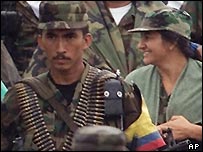
Farc
admits coca farmers massacre
Colombia's largest left-wing rebel group, Farc, has admitted
that it carried out the killings of 34 coca farmers earlier this week.
A Farc statement said the farmers supported right-wing paramilitaries
and accused the government of shedding "crocodile tears over the
deaths".
Tuesday's attack in Norte de Santander was the worst since President
Alvaro Uribe took office two years ago.
The United Nations has condemned the massacre as a "war crime".
The UN High Commissioner for Human Rights in Colombia described the
attack as "the premeditated murder of unarmed and totally defenceless
civilians".
The farmers - who had been working at the farm for the past fortnight -
were sleeping in hammocks, when the gunmen arrived at dawn on Tuesday in
the village of Rio Chiquita.
They were bound hand and foot with ropes and shot with automatic
weapons.
"We saved ourselves by running toward the mountain," Jesus Bayona, 45,
who survived after being shot in the foot, told the AP news agency.
A regional police commander Lt Col William Montezuma later told the BBC
that 50 gunmen took part in the attack.
A government official said the farm appeared to belong to right-wing
paramilitaries.
Landless peasants often pick coca leaves and sell them to both left-wing
guerrillas and their right-wing opponents, which can leave the farmers
targets of reprisals.
Other villagers and farmers have been fleeing the area, fearful of
further attacks, according to a human rights monitor.
President Uribe pledged to curb the violence which has plagued Colombia
for decades, and increased military spending.
Annan calls for truce at Olympic torch first ever visit to UN
United Nations Secretary-General Kofi Annan Saturday called all those
engaged in armed conflict of any kind to observe the Olympic Truce and
to use the opportunity to promote peace, dialogue and reconciliation.
Sddressing the Olympic Truce Ceremony, which is part of the 2004 Olympic
Torch Relay in New York, the UN chief said it is "wonderfully fitting
that this flame, symbolizing friendship among nations, should shed its
light and grace on the United Nations" during its first ever visit to
the world body.
He noted that the past few years have been difficult and troubling ones
for the family of nations, and that makes it all the more important for
all nations to join force to give life to the most fundamental and
universal ideas, ideal shared by the Olympic movement and the United
Nations.
The Secretary-General described Olympic Truce as a "unique concept,"
noting that this ancient Greek tradition has been revised by the General
Assembly as a call to all member countries to stop fighting while the
entire community of nations meet under the noble flames of this torch.
Annan stressed that the Truce should be understood as more than a
symbol. "While limited in duration and scope, it can offer a point of
consensus to open a dialogue and provide relief for a sovereign nation
and it can offer a window of hope," he said.
"During the 2004 Olympics may the serenity of the Olympic flame silence
the sound of warfare, may all heed message of hope of thisOlympic torch
is taking around the world, a message that carries within it all our
aspirations for a better, more peaceful world," he added.
The Olympic torch was carried in and out of the United Nations complex
by two young people whose lives have been deeply affected by conflict.
Jones, 18, was forced to flee her home in Monrovia, Liberia, in 1990
because of political conflict and spent three years in a refugee camp
before moving to New York. Mejia, 17, was born in New York three years
after his parents immigrated from Colombia, where one of his uncles was
the victim of a political assassination a decade ago.
Annan took over the torch and lit a cauldron at the ceremony.
The UN General Assembly adopted a resolution last November calling for a
worldwide truce during the Athens Olympics. The resolution was sponsored
by Greece, and all 190 other nations in the world body signed as
cosponsors.
The roots of both the truce and the Olympics itself go back to the 8th
century BC The truce idea was revived in 1993 to allow athletes from
Yugoslavia to participate in the 1994 games, and thelatest General
Assembly resolution was the seventh adopted since then.
After the relay through New York, the flame will tour Montreal on Sunday
before heading overseas again. The 75,300 kilometer journey began June 4
and passed through Africa and South America for the first time.
Jimmy Carter brokers encounter between Chavez Frias and Cisneros
Former US President Jimmy Carter has been brokering a meeting between
Venezuelan President Hugo Chavez Frias and Venezuelan media tycoon,
Gustavo Cisneros ... the meeting took place in Caracas last Friday (June
18).
Carter says the result of the meeting is a "mutual commitment to honor
constitutional processes and to back future conversations between the
National Executive and Venezuela's private print & broadcast media to
secure a more adequate climate for the recall referendum."
According to President Carter, whose Carter Center has been in Venezuela
for a year as political observer, the two men also talked about the need
for national dialog after August 15.
Although the meeting has been kept secret, Carter flew in from Atlanta
to moderate the session of the two leaders who have been at each other's
throat.
President Chavez Frias has accused Cisneros of attempting to topple his
government, while Cisneros has made no secret of his opposition towards
Chavism and has used his contacts in Washington to make things
unpleasant for the Venezuelan President.
Cisneros' Venezuelan TV channel, Venevision has been in the forefront of
a constant barrage of anti-government programs and PR spots and last
month, the government ordered a raid on a Venevision country club,
allegedly discovering arms.
President Chavez Frias is expected to elaborate on the encounter in
today's Sunday radio address, which will no doubt leave many of his
followers unsettled and confused.
Political observers are skeptical about Carter's mediation and the
commitment being adhered to.
|