Sex Tourism: Lessons Learned in Costa Rica
By Philip Wright, BBC News, World Edition
Ordinary Costa Ricans, from taxi drivers to hoteliers, are taking
official tourism classes as part of the country's latest attempt to stop
the abuse of children by international sex tourists.
The world tourism industry has been accused of benefiting from the child
sex trade.
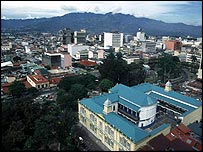
"If a tourist comes here looking
for under-age sex and we say
'no', but someone behind us says
'yes', then they will get that
service" - Costa Rican taxi
driver.
|
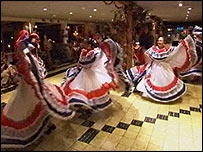
Costa Rica would like tourists
to enjoy the traditional
entertainment
|
The Central American holiday destination is sending thousands of
tourism workers, from hotel receptionists to tour guides, on training
courses to get the message across that it is not a good idea to help
tourists find under-age girls for sex. It is part of the Code of Conduct
drawn up by the industry and children's rights campaigners.
Costa Rica is the only country so far to adopt it throughout its tourism
industry.
Taxi drivers are key to the strategy because they are under fire for
helping tourists find under-age girls for sex.
In the capital San Jose, there are hundreds of self-employed taxi
drivers desperate for any business they can find. Some will take
tourists on tours to find under-age girls on the streets or even deliver
them to hotels.
Re-education
Erick Vargas works for a large firm ferrying tourists from San Jose. He
is keen to stop children being sexually exploited but he says child sex
tourists expect taxi drivers to help them.
He said: "When tourists arrive from other countries and get into my
taxi, the first question they ask is, 'Where are the girls? Where are
the little girls?'"
His company sent him and his colleagues back to the classroom to learn
about the harm child sexual exploitation can do, and how to discourage
and even report child sex tourists.
It is run by Paniamor, a local children's charity, and teacher Teresita
Ramellini summed up the approach: "We want the tourist to come to our
country to invest and spend money, we want them to come with their
families. But we want to make clear that our children are not part of
what tourists can buy."
But many of Erick's colleagues on the course are skeptical.
One said: "If a tourist comes here looking for under-age sex and we say
'no', but someone behind us says 'yes', then they will get that service.
Then the tourist will tell his friends he got it. That is why the
service will always exist."
Teresita added: "They are worried they may lose clients. They say: 'Why
must I put all the effort in? What are other people doing?' The taxi
sector is tough because they are very near to the problem and therefore
do not always want to acknowledge it.
Costa Rica wants to use tourism - now its biggest industry - to help
lift itself out of poverty. but not by boosting the international child
sex trade.
It has introduced tough new laws making sex with anyone under 18
illegal. However, the child sex tourists continue to arrive from America
and increasingly, Western Europe.
'Pimping waiter'
We stayed in San Jose while making the film Child Rescuers, and found it
hard to escape the seedy nightlife - which includes touting children for
sex.
We hoped we could find sanctuary once inside our hotel, but during
breakfast with the film's cameraman, one of the waiters sidled up with a
coffee jug and a strange glint in his eye.
Yes, he did want to top up our coffee cups, but he also had another
agenda.
"You guys having a good time?" he said.
He did not know we were a BBC film crew. To him we were just another
couple of blokes out to sample the delights of Costa Rica.
"Of course", we assured him, "Costa Rica's a great place."
Hotel restaurant waiter
"Have you tried the nightlife here?" he ventured."If you want
anything, you should come to me," he said, as he walked away to get more
coffee.
When he returned he was a little more upfront. "I can get you girls", he
said.
"What sort of girls?" we asked, wondering if he meant under-age girls.
"Any sort you want. Nice young girls, but experienced. They'll do
anything you want. Just let me know and I'll arrange it for you."
He was openly pimping to us in the middle of a plush hotel that is part
of an international chain.
He did not want his boss to hear him, but he was not bothered about the
poor American family at the next table who were innocently discussing
their visit to the rainforest later in the day.
"Just let me know", our waiter concluded with a dirty wink before
running off to take new orders from another American couple with young
teenage daughters of their own.
Future choices
But what about the Code of Conduct? The message did not seem to be
getting through to the likes of our waiter.
We went to meet the Director of the Costa Rican Chamber of Hotels, Ana
Gabriela Alfaro, and told her about our pimping waiter.
She said training of hotel staff was just beginning.
She added: "With this training, if you were to come back here in a year
from now, most probably things like this will be minimized."
We felt sorry for the unsuspecting families who would book a few days in
San Jose, only to find themselves marooned in the middle of the seedy
sex industry.
The hotels need to decide just what sort of business they really want.
Is it the families flocking to Costa Rica for its eco-tourism and
easy-going culture, or the fat, middle-aged sex tourists - some looking
for children to exploit?
The Code of Conduct does not allow them both. If they do not deter the
sex tourists, they could frighten off the lucrative family trade in the
meantime.
Child Rescuers is broadcast in the UK on Sunday, 20
June, 2004.
|


