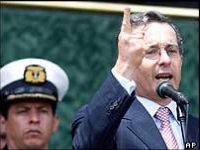
Victory
for Uribe re-election bid
Uribe says he needs a second term to complete
his programme
A bill to allow Colombia's President Alvaro Uribe to stand for a second
term has passed another hurdle in Congress.
The bill was approved by 92 to six, in the fourth of
eight votes in the House of Representatives.
The bill would amend the constitution to allow President Uribe to stand
for a second consecutive four-year term.
Polls suggest the move is supported by most Colombians but it is opposed
by some lawmakers, who say it would encourage corruption.
They taped their mouths shut to protest Thursday's vote.
The victory "reflects the majority of Congress, and the majority of
public opinion," said interior and justice minister Sabas Pretelt de la
Vega, according to Efe news agency.
Protests
The bill - which was approved by the Senate on 14 May - has now been
approved by the lower House of Representatives.
It faces another round of four votes when Congress reconvenes on 20 July
after recess.
Its passage through the lower house was interrupted on Thursday when
about 60 lawmakers stormed out of the chamber, only to return with their
mouths taped shut.
They were complaining about a decision not to broadcast the vote on
television or allow further debate on the bill.
"We have taped our mouths shut to symbolise that we don't feel the rules
of the debate over this bill have been clean and clear," said a
spokesman for the bill's opponents, Joaquin Jose Vives.
Mr Uribe's perceived hardline stance against left-wing rebel groups and
right-wing paramilitary groups is popular among Colombians weary of the
country's four-decade civil war, says BBC regional analyst Robert
Plummer.
Polls suggest some 80% of Colombians support changing the constitution
to allow him to stand for a second four-year term.
But our correspondent adds that concerns over the bill reflect the
traditional reluctance of Latin American societies to give too much
power to individual leaders, given the continent's historical experience
of dictatorships.
6 dead, 8 trapped
in Argentie coal mine fire
Search crews scoured a fire-ravaged Patagonian
coal mine Wednesday while reports indicated they had found two more
victims of an accident that already had claimed four lives.
With the toll rising to six dead, authorities told the local news agency
Diarios y Noticias that hopes were dwindling that eight other miners
still missing could have survived the blaze two days earlier.
The mining accident that began with a fire deep in the tunnels late
Monday at the remote mine in southern Argentina prompted search teams to
rush night scopes and other high-tech equipment to the scene.
The Diarios y Noticias dispatch said searchers advanced several
kilometers (miles) underground before they spotted two more victims on
Wednesday afternoon.
Authorities said the search group was advancing to the underground
chamber where the fire began in the vast coal deposits of Rio Turbio, a
mining complex 3,100 kilometers (1,920 miles) southwest of Buenos Aires.
Rescue workers said they hoped the remaining miners had managed to reach
several ventilated areas deep in the mine where officials believe the
miners may have tried to seek refuge.
President Nestor Kirchner, a three-term governor of remote Santa Cruz
province where the Rio Turbio mine is located, traveled Wednesday to the
state-run mine.
He had personally monitored rescue reports since Monday's accident.
His public works chief, Julio de Vido, was already at the scene and
pledged an exhaustive investigation once the rescue and recovery
operations are completed.
While de Vido acknowledged that local reports had cast suspicion on a
faulty mechanical belt, he cautioned that it was too early to venture
any finding.
An army helicopter clattered above the mine on an overcast, frigid day
as army troops helped transport rescue brigades on all-terrain vehicles
to the different mine entrances and set up communications equipment for
searchers.
"We have provided night vision equipment and the rescue crews are using
those now," said army Col. Federico Anschutz, speaking with the Telefe
television network.
He also said army experts had set up a better communications network
after radios malfunctioned underground.
Authorities said they found a total of four bodies late Tuesday not far
inside the entry to the vast underground mine complex.
Still holding out hope, worried family and friends maintained a vigil
nearby.
At least two air force planes equipped with emergency medical equipment
were ordered on standby by military authorities. Two regional hospitals
also were put on alert.
AIDS Treatment: Striving for Universal Access in the Americas
Today Latin America and the Caribbean lead the developing world in
providing HIV/AIDS treatment, accounting for more than half of all
people on antiretrovirals in developing countries, according to the Pan
American Health Organization (PAHO).
These life-saving drugs have changed the face of AIDS, and the region is
striving to provide universal access to them, according to "Casting the
AIDS Lifeline," an article in the latest issue of PAHO's magazine,
Perspectives in Health.
Additional Information:
Perspectives in Health Magazine
Volume 9, Number 1, 2004.
Click here to read the magazine
In Latin America and the Caribbean there are an estimated 210,000
HIV/AIDS patients receiving antiretroviral treatment, 55 percent of the
total number of people believed to be in need of treatment in the
region. In Africa, by comparison, only 100,000 or 2 percent of some 4.4
million people who need them are receiving these drugs.
Public health advocates acknowledge that there remain frustrating delays
in getting treatment to those who need it, but they say the achievements
so far reflect a growing commitment to providing universal access to
antiretroviral therapy.
"Today every country in our region has HIV/AIDS patients on
antiretroviral treatment," says Carol Vlassoff, head of the HIV/AIDS
program at the Pan American Health Organization. "There's a new
consensus that everyone in our region who needs AIDS therapy should have
access."
To support this process, PAHO is spearheading a regional initiative over
the next year and a half to increase the number of people receiving AIDS
therapy in Latin America and the Caribbean by 174,000—the number
currently believed to need treatment but who still lack access. The
effort falls within the framework of the "3 by 5" initiative, launched
by the World Health Organization (WHO) in late 2003 with the goal of
providing antiretroviral treatment to 3 million people in the developing
world by the end of 2005. It also supports the Millennium Development
Goals and answers the call by heads of state at the recent Summit of the
Americas to treat 600,000 HIV/AIDS patients throughout the Americas by
2005.
Since combination antiretroviral therapy became available in the
mid-1990s, death rates from AIDS have declined 90 percent in the United
States and Europe. Middle income countries including Argentina, the
Bahamas, and Brazil have seen as much as a 50 percent drop in death
rates from AIDS after only a few years of treatment. But in the world's
poorest countries, especially in Africa, AIDS deaths have continued to
climb along with new infections.
Most Latin American and Caribbean countries focused their early
anti-AIDS efforts on prevention, viewing antiretrovirals as largely out
of reach.
A notable exception to this rule was Brazil, which responded to its
spreading AIDS epidemic with a comprehensive strategy that incorporated
both prevention and treatment, including universal access to free
antiretroviral treatment.
To lower drug costs, Brazil began producing generic versions of
antiretrovirals in 1993 and has also negotiated lower prices with
brand-name manufacturers. While Brazil is one of the few countries in
the region with the technical and manufacturing base necessary to
produce its own drugs, other countries have followed its lead in
negotiating with drug makers to lower antiretroviral prices with support
from PAHO/WHO and the Joint United Nations Program on HIV/AIDS (UNAIDS).
Still the estimated cost per year of treating HIV/AIDS patients can be
staggering. A number of countries have been absorbing these costs
through their national health budgets and World Bank loans, but smaller
and lower-income countries have had to seek other external sources of
funding.
One of the most important of these is the $4.7 billion Global Fund for
Aids, Tuberculosis and Malaria, launched in 2002 to channel public and
private donations to combat these diseases. The United States'$15
billion President's Emergency Plan for AIDS Relief (PEPFAR), has also
financed AIDS treatment in Haiti and Guyana and pledged $1 billion in
general funds to the Global Fund for Aids, Tuberculosis and Malaria.
Despite these positive developments, activists complain that the process
of expanding treatment has moved too slowly. Carol Vlassoff, head of
PAHO's AIDS program, observes that, following the success of drug price
negotiations, technical, bureaucratic and medical hurdles still need to
be overcome and are top priorities for PAHO.
Vlassoff and others involved in the "3 by 5" initiative acknowledge that
universal access to antiretrovirals is an ambitious goal. "But this is a
goal we have to strive for," says Vlassoff. "Of all the developing
regions, the Americas have real potential to achieve universal access.
It is a challenge, but it needs to be done."
Other articles in this issue of Perspectives in Health include: "Latino
Health in the USA," "Aging in the Americas," and "A Question of Human
Rights," on rights violations of the mentally ill in the Americas.
The Pan American Health Organization, founded in 1902, works with all
the countries of the Americas to improve the health and quality of life
of their peoples. It also serves as the regional office of the World
Health Organization.
|