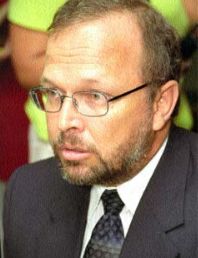
Another Arrest in the Parmenio Medina Murder
A surprising development in the murder investigation of
journalist, Parmenio Medina, saw agents from the Organismo de
investigación Judicial (OIJ) arrest a journalist from the daily Spanish
newspaper Diario Extra on Wednesday.
Adrián Marrero, joined the list of those detained, along with the priest
Minor Calvo and several others, who are all being held awaiting trial in
San José's San Sebastain jail.
Yesterday's arrest was made at the offices of the newspaper in the early
afternoon, when investigators felt they had enough evidence to link
Marrero who is accused of participating in the threatening of a witness
who is willing to testify in the murder case.
The strongest piece of evidence investigators linked to the journalist
is a cellular telephone that was made to place the threatening calls and
found hidden in a television set in the in the jail cell of Luis Alberto
Aguirre Jaime, better known as "El Indio", who is suspected of
being one of the principal authors of the crime.
Marrero is being being held on two charges: impeding an active
investigation and taking part in making threats. Marrero is being held
in the OIJ holding cells while a judge makes a decision on the
prosecutor's request to preventative detention.
The deadline is quickly approaching. The Municipality of San José had
orginally set tomorrow, Friday the 18th, and extended to Monday the
21st, as the deadline for the street vendors to clear the streets or be
forcibly removed in the ongoing battle between the street vendors and
the Municipality.
Vendors Threaten to Take the Boulevard
The street vendors announced yesterday that they will move
their stalls and sell their products on the "boulevard" - Avenida
Central - if they are removed from their present location.
Gerardo Chacón, president of the Vendor's association - Acovea - told
the press last night that between 800 and 1.000 vendors will occupy the
length of the boulevard, from the Mundo Gloria at the west, to the old
Cine Capri to the east.
Chacón said that the vendors have families to support and cannot stop
selling their products. "We will invade the boulevard and hide our goods
when the Municipal police approach".
This practice of hide and seek has been ongoing between some street
vendors and police for years. Anyone walking the boulevard can see
vendors setting up their portable shops and quickly hide their
merchandise and stand idle as Municipal police make their sweep of the
pedestrian walkway.
The street vendors affected have their permanent stands located in the
areas bounded by: Avenida 1, between Calles 6 and 16; Avenida 3, between
Calles 6 and 10; Avenida 4, between Calles 6 adn 10; Avenida 6, between
calles 1 and 14; and Calle 8, between Avenida 2 and 10 and Calle 14,
between Avenida 0 and 1.
Chacón said that the Municipality has to respect the "recurso amparo" or
appeal before the Constitutional Court, Sala IV and the Tribunal
Contencioso Administrativo de Hacienda. If the Municipality continues
ahead with it's plan to remove us, they will be doing it illegally, he
said.
Johnny Araya, Mayor of San José, is standing firm that the vendors need
to vacate the streets of be forcibly removed. He maintains that the
Municipality has given them lots of time to find alternative locations,
including a recent proposal for vendors to hold weekend fairs on
Municipal lands.
The Mayor added that there are plenty of parking lots in the area
affected and vendors who want to continue can make arrangements with
owners of the parking lots. The important thing for the Municipality now
is to have the streets cleared.
Costa
Rica Continues To Wait On Fiscal Reform Package
by Mike Godfrey, Tax-News.com
The Costa Rican government’s two top economic officials have warned that
further delay in the approval of a permanent package of fiscal reforms
will undermine the country’s capacity to absorb external economic
shocks.
The Permanent Fiscal Reform Plan was first conceived two years ago to
bolster the government’s tax revenues, pay off the country’s growing
foreign debt, and reduce the deficit to 2.65% of GDP through a series of
tax hikes and improved collection methods.
However, the implementation of the reform package has been dogged by
delays, as Deputies in the Legislative Assembly fail to meet successive
deadlines for approving the legislation. After the latest deadline in
May was missed, it has now been extended indefinitely.
Finance Minister Alberto Dent has said that the new measures are much
needed as they will better insulate Costa Rica from external economic
factors such as US interest rate movements and soaring oil prices.
Meanwhile, Central Bank president Francisco de Paula Gutiérrez has
expressed the belief that the reforms will also help strengthen the
economy by allowing Costa Rica to take more advantage of the benefits
offered by the CAFTA free trade deal with the United States.
The large fiscal deficit in Costa Rica has in recent times fuelled
doubts over the country's ability to service its debt. However,
austerity measures at public institutions and an Emergency Tax Plan
approved by Congress in December 2002 have helped to reduce the deficit
from 5.4% of the country's gross domestic product to 4.3% last year.
Economic growth generally appears to be on a sounder footing and
Gutiérrez has reported that growth rates are steady at the 4% mark.
Whilst international institutions such as the IMF and ratings agencies
have recognized this, they continue to warn on the pressing need for the
tax reforms to be put into action.
“Going forward, a stabilization of Costa Rica's sovereign
creditworthiness will depend on the ability of the government to tackle
fiscal deficits and implement structural reform," ratings agency Fitch
observed in its January report.
Riteve to Charge for Re-Inspection
Riteve SyA will celebrate two years of operating in the
vehicle inspection program in the country next month and to mark this
event, as of July 16, it has announced it will start charging for
re-inspections of vehicles who failed the first time around.
Every vehicle has to submit to an annual inspection. If the vehicle
fails the inspection, the owner has 30 days in which to make the
necessary repairs and re-submit for a re-inspection. Riteve has not been
charging for the subsequent re-inspections.
According to Vilma Ibarra, a spokesperson for Riteve, she says that
Riteve is within it's rights to charge for re-inspection according to
the contract the firm has with the Ministerio de Obras Públicas y
Transportes (MOPT), thus beginning next month, the fee for re-inspection
will be 1/2 of the original fee paid.
If the vehicle is presented for re-inspection after the 30 days period,
the fee charged will be 100%.
According to Riteve their operating costs have greatly increased and the
government has refused to increase it's rates, which it claims are
clearly spelled out in the contract.
Figures show that seven out of every 10 cars presented to the inspection
process fail the first time around. Exaust emission, brakes, suspension
and body condition are the principal causes of failure during the
inspection.
The inspection firm also announced that it will not charge for
re-inspection those vehicles whose registation is not finalized. The
company is concerned that there will be an avalanche of demand for
re-inspection prior to the July 16 date.
Casa Alianza Opportunities for Swedish Volunteers
University students and professionals interested in social work and
helping homeless Latin American children could have the opportunity to
make the difference in Central America.
Casa Alianza, a non-profit private organization dedicated to defend,
protect and promote the rights of street children in Latin America,
currently has volunteer opportunities for Swedish students and
professionals through its programs.
The Olof Palme Fundation is offering scholarships to send them to one of
Casa Alianza’s programs in Mexico, Honduras, Guatemala, Nicaragua or
Costa Rica.
The scholarships will cover part of the living expenses in any of the
programs. Volunteers will have the opportunity to work in crisis center,
family reintegration services, on the streets educators and in
administrative posts. They will provide invaluable support to the
organization.
Volunteers will benefit by learning new skills and experiences and
enriching their understanding of our culture and the lives of children.
All the candidates must send their resume to Casa Alianza ([email protected]
) and the process of selecting volunteers will begin in the regional
office in Costa Rica.
Volunteers are required that to be fluent in Spanish, in order to permit
an adequate interaction with boys and girls and the Casa Alianza work
team; have study or work experience related to children or teenagers,
(Education, Psychology, leader of child groups etc.); to be in agreement
with the principles of urgency, sanctuary, communication of values, and
structure which are the basis of Casa Alianza's model of attention.
To learn more about Casa Alianza, please visit
Volunteering with Casa Alianza.
 News
Briefs News
Briefs
-
Newly elected President of the
Organization of American States Miguel Angel Rodriguez and
former President of Costa Rica,
is
scheduled to give testimony before the Legislative Assembly on his
presidential campaign funding.
- The Catholic church has
proposed a new sexual guide for high school students. A month ago, the
church presented it's new text to the Consejo Superior de Educación,
the government body that approves all school programs. Monseñor Hugo
Barrantes, Archbishop of San José, said that the contents of the
new guide are in line with the beliefs of the church.
|