Chile may probe ex-dictator's possible secret accounts
Chilean President Ricardo Lagos warned Thursday that Chile might
investigate possible secret bank accounts of former dictator Augusto
Pinochet should the existence of these bank accounts be proved.
Today's Stories:
 Chile
may probe ex-dictator's possible
secret accounts Chile
may probe ex-dictator's possible
secret accounts
Mexico
ranks 53rd place in UNDP list
US
backs dialogue between govt,
paramilitaries in Colombia
Colombian
ex-senator defends paying ransom
|
US Senate: American bank helped
Pinochet hide millions
A US Senate committee has accused Riggs Bank of helping former Chilean
leader August Pinochet hide
money away. The bank have done
this even after Pinochet was
arrested.
The American bank is said to
have done this even after
Pinochet was arrested in London
in 1998 for crimes against
humanity. At the time, a court
ordered the freezing of his bank
accounts. Friday's CRI online
reported.
According to the senate
committee, Riggs Bank helped
Pinochet move between four and
eight million dollars from the
United Kingdom to the United
States over an eight-year
period.
As a cover, the accounts were
put in the name of two
businesses set up for that
purpose.
Riggs Bank said it was looking
into the matter. Pinochet's sons
dismissed the accusations as
lies
|
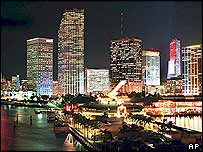
Miami tops 'foreign-born' cities
Miami has a big Cuban contingent
Miami has the largest
foreign-born population of any
city in the world, a United
Nations report says.
Some 59% of people in the city
were not born in the US, the UN
Development Program report said.
The city is home to many Cubans,
as well as migrants from the
Caribbean and South America.
The report said Canada's Toronto
had the second-highest
proportion of foreign-born
citizens (44%), while Los
Angeles was a close third with
41%.
|
Lagos's statement
came as a response to a US Senate report thatsaid a Washington-based
bank, Riggs, helped Pinochet hide millionsof dollars when he was
detained in United Kingdom in 1998.
According to The Washington Post, the US Senate investigators, who
for more than one year examined the activities of Riggs Bank, said
in a report on Wednesday that Riggs Bank sought business from
Pinochet and set up multiple personal and corporate accounts to hide
between 4 and 8 million dollars, violating US anti-money-laundering
safeguards.
According to this report, the bank referred to Pinochet as a
"retired pensioner" and with a "high-ranking position in the public
sector for many years."
"We are all equal in the eye of the law," said Lagos to the press
and affirmed that the only thing he knew about the accounts came
from the version of The Washington Post, the principal newspaper of
the United States, which was cited as a source of the report of the
US Senate commission to investigate the activities of the Riggs
bank.
"What I would really like to mention is that I am informed through
the Embassy of Chile at the US capital of Washington that a Chilean
official's participation has been requested in the inquires of the
US Congress," he said.
Pinochet, 88, who took control of Chile by ousting constitutional
president Salvador Allende in 1973, was arrested in London on Oct.
16, 1998 after Spanish judge Baltasar Garzon issued an arrest
warrant to have him extradited to Spain for charges of torture,
terrorism and genocide. He was later released on grounds of poor
health.
He and his security agents face hundreds of charges of
homicide,kidnapping and torture in Chile but none of corruption,
despite Pinochet's owning a mansion in Santiago and at least four
other properties in the country.
There have been several failed attempts to probe his finances by
journalists or lawmakers since the 1980s.
Mexico ranks 53rd
place in UNDP list
Mexico
was ranked in the 53rd place in a UN Development Program (UNDP) list
of the 55 countries with the highest human development.
For the second year in a row, Mexico appears in the UNDP list, in
which Norway, Sweden and Australia, Canada and the Netherlands
ranked as the best five countries to live, according to the UNDP
Human Development Report 2004 released on Thursday.
The Human Development Index, prepared by the UNDP, is issued
annually and includes every country for which statistics are
available.
The UN report describes human development as both economic and
political issue, including human rights and the strength of
democracy.
Coordinator of the report Luis F. Lopez said although Mexico
improved, the marked inequalities in the country still exist.
Rodolfo Stavenhagen and Lourdes Arizpe, who participated as
consultants in the report, highlighted that Mexico remains one of
the nations with greater internal socioeconomic inequalities.
US backs dialogue between govt, paramilitaries in Colombia
The United States on Thursday voiced support for dialogues between
the Colombian government and the right-wing armed organization
United Self-Defense Forces of Colombia (AUC) but insisted on the
extradition of the chiefs of this group.
US Ambassador to Colombia William Wood said Washington's support in
the process is based on the AUC's definite abandonment of its
drug-trafficking activities and attacks on civilians.
The US embassy would send a mission of four to meet with
Presidential Peace Commissioner Luis Restrepo, in Monteria, capital
of Cordoba state, in north Colombia to monitor the talks, he said.
Local authorities and the bishop of Monteria, Julio C. Vidal, would
also take part in the meeting, he added.
Some Colombians expressed their concerns over the US calls for the
extradition of AUC leaders, which they believe might block the way
for its demobilization.
The AUC, mainly funded by landowners and drug dealers, was founded
in April 1997 to fight left-wing guerrillas who also tried to
control plantations and sales of coca leaves, the raw material for
cocaine.
The group is responsible for the killing of hundreds of peasants,
syndicate leaders and presumed guerrilla sympathizers.
The efforts to demobilize it started on July 1. If the peace talks
end successfully, the AUC will turn into a political movement and
its 20,000 members will be demobilized by 2005.
Colombia's four-decade-old civil war among government troops,
leftist rebels, and right-wing paramilitaries claims about 3,500
lives every year, most of them civilians.
Colombian
ex-senator defends paying ransom
A former Colombian senator defended his decision to pay a
ransom to kidnappers holding his sons for three years, saying
Thursday he could not bear to see them "slowly die in the jungle."
Jaime Lozada said he felt humiliated for giving in to the Marxist
rebels who abducted his two sons and their mother from their luxury
apartment three years ago. He also denounced the government for
failing to ensure his family's safety.
"Paying a ransom is one of the most shameful things to do, but I
have to put the unity of my family before ethical considerations,"
Lozada told The Associated Press from his home in the southern city
of Neiva.
Lozada's sons, Juan Sebastian, 19, and Jaime Felipe, 20, were freed
Tuesday at an undisclosed location in southern Colombia. His wife,
Gloria Polanco, remains in captivity.
Lozada declined to say how much ransom he paid. Details on how the
payment was made have not been disclosed.
A visibly shaken Juan Sebastian said on the steps of his former
school in Neiva that being held for so long was "simply
indescribable."
"It's the most treacherous, most inhumane, worst thing that could
happen to a human being," he told reporters Wednesday.
Government and army leaders warned Thursday that paying ransoms to
illegal groups would encourage them to kidnap more people and would
provide them with funds to continue their armed struggle.
"If one day we want to put an end to kidnapping, society and the
state must agree to a policy of never paying," Vice President
Francisco Santos, who kidnapped by late drug kingpin Pablo Escobar
in the 1980s, said Thursday.
But Lozada said the Colombian government "has no right to say,
'Don't pay.' The state has a duty to protect its citizens. They took
my wife and children from their beds."
Rebels pretending to be police officers kidnapped the Lozada
brothers, their mother and 13 others after storming a high-security
apartment building in Neiva, 150 miles southwest of the capital,
Bogota, on July 28, 2001.
It was the first time the Revolutionary Armed Forces of Colombia, or
FARC, took over an apartment building, breaking down doors and
dragging away residents, shocking urban Colombians as a conflict
fought mainly in the countryside suddenly made it to their doorstep.
Four of the people taken that night, including Lozada's wife, still
are held.
The FARC separated Polanco from her sons six months after the
kidnapping. In a video released by rebels last year, she tearfully
pleaded to be reunited with them.
In 2002, Polanco was elected to congress and since has been included
on a FARC list of dozens of "political prisoners" it says it will
free in exchange for hundreds of jailed rebels.
That list also includes U.S. military contractors captured by rebels
in February 2003 when their single-engine plane crashed in the
south.
"There are only two ways for my wife and the Americans to be free: a
prisoner exchange or a military rescue operation, which would be
much too risky," Lozada said. "The government has to negotiate a
deal."
However, Santos reiterated that the administration of hardline
President Alvaro Uribe will not consider a prisoner swap unless any
freed rebels agree to go abroad to ensure they cannot commit more
crimes. The FARC has denounced such a move as unacceptable.
"It is not an impossible condition to meet and the truth is that we
don't understand why the FARC has not showed a positive response,"
Santos said.
The FARC and a smaller rebel group have been battling to topple the
government and establish a Marxist-style state in Colombia for 40
years in a conflict that claims an estimated 3,500 lives every year |


