Peru
hit by major workers' strike
At least 76 people have been arrested in Peru during a 24-hour
strike against the free market economic policies of President
Alejandro Toledo.
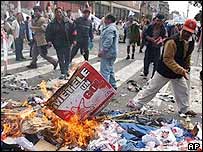
Many of the arrests were made in the capital, Lima, where police
used tear-gas to disperse protesters who tried to block roads with
tires and logs.
The strike was declared a success by Peru's largest union, the CGTP.
But the government said the protest had failed because people were
working and public transport was functioning.
Peruvian Interior Minister Javier Reategui claimed only half of all
transport services in Lima had been affected by the strike.
He said police had confiscated a large number of rubber tires to
stop protesters from setting fire to them.
In central Lima, one union leader told a cheering crowd that reports
from around Peru suggested 90% of workers supported the strike.
Peru's former President, Alan Garcia, the country's main opposition
party leader, suggested that Prime Minister Carlos Ferrero and his
cabinet should consider resigning.
The BBC's Hannah Hennessy in Lima reports that for many the protest
has become less about economics and more about trying to undermine
the authority of Mr Toledo - the region's least popular president,
with the support of less than 7% of Peruvians, according to recent
polls.
Although Peru has one of the fastest growing economies in Latin
America, half the population lives on $1.25 a day.
People are angry at the president's failure to fulfil his election
promises to create more jobs and stamp out poverty, our
correspondent adds.
Many said could not afford to strike - if they took to the streets,
they would have no money to feed their families.
More than 150 unions - from teachers to construction workers - had
signed up for the protest.
The communist-led General Workers' Union of Peru estimated that some
300,000 people would take part in protests.
But that the numbers seems to have been overestimated, our
correspondent says.
The strike comes as Peru tries to cope with hundreds of visitors to
an international football event - the Copa America - stranded by the
grounding of a local airline.
The Aero Continente airline was banned from flying on Monday after
the government alleged its planes were not insured and the US
announced it was investigating the firm for ties to the drug
trafficking trade.
Some 93,000 police were deployed across Peru to deal with any
unrest.
Peru's government said army and riot police units had been enlisted
because of fears that the demonstrations might be infiltrated by
guerrillas from the outlawed Marxist rebel army, the Shining Path.
Colombian
rebels release two kidnapped brothers
The Revolutionary Armed Forces of Colombia (FARC) released the two
sons of a former Colombian senator after they were abducted three
years ago, the authorities said Wednesday.
The freed brothers, Juan Sebastian, 18, and Jaime Felipe, 20, were
expected by their father at the city of Neiva, capital of Huila
province in southwestern Colombian, where they were kidnapped along
with their mother three years ago.
In a telephone interview, the youngsters expressed sadness overthe
fact their mother, who were separated from her sons six months after
kidnapping, still remains in captivity.
The ex-senator, Jamie Lozada, told the local press Wednesday heis
"not completely happy" and he will continue "fighting to obtain the
freedom of his wife Gloria and thousands of other kidnapped victims
in Colombia."
A large ransom has been paid to obtain the release of his sons,
Lozada said.
The kidnapping of the Lozada family took place in the early hours of
July 26, 2001, when the rebels broke into an apartment building in
Neiva, taking several other people with them.
The mother, a former Liberal Party congresswoman, is one of the
FARC's 60 hostages, including policemen, soldiers and three
Americans. The rebels wanted to exchange them for 500 imprisoned
guerrillas.
The 17,000-member FARC, which has been fighting to topple the
government for 40 years, kidnaps hundreds of people every year,
either for ransoms or political purposes.
US
rebuked for banning citizens from studies in Cuba
Cuban Foreign Minister Felipe Perez said on Wednesday that it was
injustice that Washington had banned its citizens from continuing
their studies in the Central American country.
Asked at a press conference about US citizens studying medicine
here, who may interrupt their studies due to the ban, Perez said,
"It is a total injustice, something unheard of, yet I expect this
issue will be solved."
"I have seen signs indicating this situation could be sorted out and
the students be authorized to continue with their medicine studies
in Cuba," he added.
Lucius Walker, leader of Shepherds for Peace, recently indicated
that they had initiated a campaign urging the White House to lift
the ban on young US citizens.
"US Secretary of State Colin Powell is personally intervening to
make an exception in this case," said Walker, who arrived here last
week, heading the Caravan for the Friendship Between the United
States and Cuba with humanitarian supplies for the country.
He said there are already signs that the US administration will try
to set down new rules to guarantee that the students will continue
with their studies without any obstacle.
Some 80 young US citizens are studying for free at the Latin
American School of Medical Sciences of Havana, as part of a program
of scholarships offered by Cuban President Fidel Castro in2000 to
Third World countries and the poor communities of the United States.
In May, Washington announced new regulations to squeeze Cuba's
economy. Under the new regulations, limits will be imposed on family
visits between the United States and Cuba.
On June 30, the regulations were put into effect to restrict trips
and academic exchanges of US citizens to the country.
|