Mexican president
starts South American tour
Mexican President Vicente Fox started a South American tour
Tuesday, during which he will formalize Mexico's intention to become an
associate member of the area's most active trade bloc, the Common Market
of the South (Mercosur).
During his four-day tour of Brazil, Argentina and Paraguay, Fox
will attend a Mercosur Summit in Puerto Iguazu, in Argentina's
northern province of Misiones, at which Mercosur leaders will
consider Mexico's application to join the trade bloc. Mercosur
groups Argentina, Brazil, Paraguay and Uruguay, with Bolivia, Chile
and Peru as associate members.
In an interview with Brazilian daily Folha de Sao Paulo published on
Tuesday, the Mexican president said his country's entry into the
Mercosur will give "vitality" and "new energy" to the bloc.
Mexico has signed free trade agreements with 42 countries, according
to Fox.
"Nobody like Mexico could talk about the advantages of free trade,"
Fox was quoted as saying, adding that "it is in our interest to have
an agreement with Argentina and Brazil as well."
Mexico's main trade partner is the United States, which is the
destination of 90 percent of its exports.
Fox said Mexico has already had free trade agreements with Uruguay
and Chile, and it is a natural step to join the Mercosur as an
associate member. "Then we would consider the possibility of having
a Mercosur-Mexico agreement," he added.
In Puerto Iguazu, Fox will hold separate meetings with his Chilean
counterpart Ricardo Lagos, Venezuelan President Hugo Chavez, and
President of the Commission of Mercosur Representatives and former
Argentine president, Eduardo Duhalde.
He will also attend the Forum of Political Consultation and
Negotiation of Mercosur, which will focus on issues such as social
development, justice and technology.
Fox's Argentina stop will be sandwiched between talks in Brasilia
with Brazilian President Luiz Inacio Lula da Silva on bilateral ties
on Wednesday morning and meetings in Paraguay with his counterpart
Nicanor Duarte on Thursday, according to the Mexican Foreign
Ministry.
The Mexico president was scheduled to arrive on Tuesday night in
Brasilia and will be back in Mexico on Friday night.
Brazilian defense minister to visit troops in Haiti
Brazilian Defense Minister Jose Viegas will visit Haiti on
Wednesday, where Brazilian troops are expected to take part in the
United Nations Mission for the Stabilization of Haiti (MINUSTAH).
Viegas will be accompanied by his counterparts from Argentina, Chile
and Uruguay, who will arrive in Brazil on Tuesday, the pressoffice
of the Defense Ministry said.
His visit was aimed at showing the military personnel the
government's support and solving some of the problems faced by the
troops, including the precariousness of their lodgings.
During the visit, Augusto H. Ribeiro, commander of the MINUSTAH,
will brief the delegation on the soldiers' performance in Haiti.
Brazil has 1,200 troops in Haiti, where they have the tasks of
patrolling, safeguarding authorities and buildings, escorting
convoys and providing logistic support in dismantling explosive
devices.
The MINUSTHA, which is expected eventually to have 6,700 soldiers,
1,622 police officers and 900 civil servants, was sent by the UN
after the turmoil resulted in the resignation of Haitian President
Jean-Bertrand Aristide earlier this year.
The UN forces, composed of soldiers from several South American
countries, replaced the troops from the United States, Canada and
France that arrived in Haiti in February.
The goal of the mission is to help the country recover from the
crisis, which became worse when rebel armed groups took to the
streets after Aristide's exile.
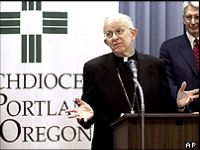
Sex claims 'bankrupt US archdiocese'
A Roman Catholic archdiocese in the US is to declare bankruptcy
because it cannot meet the cost of claims by people allegedly abused
by its priests.
The Archdiocese of Portland, Oregon, will be the first in the US to
do so.
The action will suspend the start of a civil trial of a priest
accused of molesting more than 50 boys.
Other US Roman Catholic dioceses are also facing bankruptcy, or have
had to sell property, to meet the cost of abuse claims brought
against priests.
Chapter 11 bankruptcy - the legal term for the action taken by the
Portland Archdiocese - gives an organisation freedom from legal
action by creditors while it reorganises, but cedes some control
over finances to the courts.
I think this is just another corrupt tactic of the Roman Catholic
Church archdiocese of Portland
In February 2004, a report commissioned by the Church said more than
4,000 Roman Catholic priests in the US had faced sexual abuse
allegations in the last 50 years.
It said more than 10,000 children - a large majority boys - were
allegedly abused, but victims' representatives said this was an
underestimate.
The Archdiocese of Portland has already settled claims by some 130
people who say they were abused by priests, paying out more than
$53m.
The current claim, for three times that sum, concerns alleged abuse
by the late Reverend Maurice Grammond, who was accused of assaulting
more than 50 boys in the 1980s.
Thousands of priests across the US have been accused since the 1950s
Archbishop John Vlazny said the archdiocese tried to settle with the
plaintiffs, but could not afford their offer. "The pot of gold is
pretty much empty right now," he said - a claim dismissed by the
plaintiffs.
Other dioceses, such as Tucson in Arizona, have said they are
considering bankruptcy, and the Archdiocese of Santa Fe in New
Mexico has had to borrow from parish savings accounts to avoid the
step.
But Jim Devereaux, one of the plaintiffs who has filed a lawsuit
against the Portland church, says he is suspicious of its reasons
for filing for bankruptcy.
"I think they would have met us in court today, if they'd been
facing up to their responsibilities. I think this is just another
corrupt tactic of the Roman Catholic Church archdiocese of
Portland," he told the BBC's World Today programme.
Professor Chuck Zech, an expert in Catholic church finances, told
the Associated Press: "For a diocese to give up control like this,
control over a lot of important decisions, a lot of spending
decisions - it's totally uncharted."
There are concerns that Chapter 11 bankruptcy could also open church
records to public scrutiny, and require church leaders to cede some
financial control to the courts.
Boston, one of the largest archdioceses in America and the place
where the sex abuse scandal began more than two years ago, opted to
sell property instead.
Throughout the US, sex abuse cases have cost more than $650m but the
Church is also paying a heavy price in lost prestige and damage to
its moral authority.
|