Banco Elca May Avoid Closing;
Buyer Still in Negotiations
What does an American
real estate broker want with a
small bank that is on the border
of closing?
The answer to that question is
not clear at the moment,
however, a report in El
Financiero this week says that
talks between Donald E. Lester,
a representative of Waterford
Management Inc. and Carlos
Alvarado Moya, the main partner
at Banco Elca, are continuing.
Today's Stories:
 Banco
Elca May Avoid Closing; Buyer
Still in Negotiations Banco
Elca May Avoid Closing; Buyer
Still in Negotiations
Basic
Telephone Service Cost to
Increase; Long Distance Lower
More
Foreigners Rejected
Demolition
Threat to Coastal Bars,
Restaurants
British
Cloning Call Divides Scientific
World
Did
you know?
|

Costa Rica in Crisis
"Big"
Monday Was a Bust
Costa Rican
Business Leaders Seek End to
Costly Truckers' Strike
Our
Readers Write
|
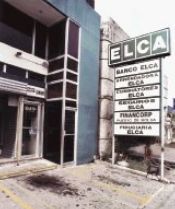
Good news for small depositors
of Banco Elca. The president of
la Asociación Bancaria
Costarricense (ABC), Jorge Monge,
confirmed that the 2.056
depositors with less that ¢4.4
million colones (US$10.000) may
be able to make withdrawls as
early as next week. ABC has ¢900
million colones on hand to
support small and medium
depositors at private banks.
|
Did you
Know?
Did you know that Costa Rica is
the #1 destination in the world
for adventure honeymooners?
Costa Rica has been ranked #1
Best Adventure destiny, and #7
best value destiny around the
world by Modern Bride Magazine.
With a national territory of
50,895 square kilometers, Costa
Rica is slightly larger than
Switzerland and it is the second
smallest Central American
country.
But within the borders of this
small country, you can find vast
areas of jungle, countless
streams and rivers, incredible
diversity of wildlife and flora,
amazing volcanoes and beautiful
beaches.
|
Alvarado, who is currently in
preventive detention in the San
Sebastian jail since July 23,
has sent Lester a
counterproposal last week, a
week after the banking
regulator, Superintendencia
General de Entidades Financieras
(SUGEF), presented it's first
report that is calling for the
bank to be closed.
Little is known about Lester,
however, it is possibly the last
hope for Banco Elca before it is
closed for good, due to
irregularities found in the
bank's credit portfolio and
other administrative
irregularities that placed the
bank in solvency problems.
Lester is well known in real
estate circles in the Naples,
Florida area.
Alvarado and Lester began their
negotiations days before the
SUGEF intervened on June 29.
El Financiero reports that,
notwithstanding the
intervention, Lester continued
to negotiate with Alvarado and
with Alvarado's detention,
intermediaries have been hired
to continue the negotiations.
The last offer made by Alvarado
was a counterproposal sent to
Lester on August 22.
Sources close to the
negotiations says that Lester is
heading a group of foreign
investors who want to establish
themselves in Costa Rica.
SUGEF and the Consejo Nacional
de Supervisión del Sistema
Financiero (Conassif) are not
fully convinced that the group
as sufficient banking
experience.
Rules governing bank ownership
are stipulated in the Ley de
Constitución de Bancos Privados,
de 1986, in which article 6
clearly spells out that anyone
wanting to be a partner in a
bank must provide the government
authority with a curriculum,
criminal record reports,
authority that the SUGEF can
fully investigate the
individual, three personal
references and a statement of
financial stability.
No matter what Lester's motives
for wanting to buy the Banco
Elca, for sure, the 2.500 or so
investors and depositors will
need not go through the long and
torturous closing and
liquidation of the bank and
recover their savings almost
immediately.
Basic Telephone Service Cost to
Increase; Long Distance Lower
The cost of telephone
service is going up. The
Autoridad Reguladora de los
Servicios Públicos (Aresep) held
a public meeting where no one
showed up to oppose the 12% hike
requested by the Instituto
Costarricense de Electricidad
(ICE). Both, cellular and fixed
line telephone service is
affected by the increase.
The cost of cellular service
with 60 minutes of call time
will increase from ¢2.900to
¢3.250 colones per month and the
per minute cost after the
initial 60 minutes will increase
from ¢30 to ¢34 colones at peak
times (7am to 7pm) and from ¢23
to ¢26 colones at other times.
Fixed line telephone service
will go from ¢1.650 to ¢1.850
colones per month for
residential service and ¢2.000
to ¢2.240 for business
customers. The per minute call
cost will go from ¢3.25 to ¢3.75
colones.
In addition, ICE requested a
decrease in the cost of long
distance calls by 33% for all
calls made to the U.S., Canada
and Mexico and 8% to Europe. In
contrast, calls to Central
America will increase by 25% for
calls made between 10pm and 7am.
More Foreigners Rejected
Immigration officials
have vowed not to let their
guard down and are continuing
their operatives to expose and
expel all foreigners who are
illegally in Costa Rica.
A report by immigration
officials says some 30.000
foreigners rejected at all
border points, mainly in Peñas
Blancas and Los Chiles on the
northern frontier with
Nicaragua.
That number is higher than
rejections registered in 2002
and 2003. In 2002 there were
21.570 rejections, while in
2003, 26.862 rejections
were recorded.
Most of the rejected foreigners
were Nicaraguans Also,
Colombians, and
Panamanians were rejected as
they tried to enter Costa Rican
territory.
In total 29.461 Nicaraguans, 294
Panamanians, 172 Colombians, 89
Americans, 69 Peruvians, 39
Ecuadorians, 30 Dominicans, 15
Indians, 10 Cubans, 10
Canadians, 9 Bolivians, 5
Argentines, 5 Venezuelans, 4
Chileans, 5 South Africans and 5
Guatemalans, bringing the total
to 30.223 rejections to date for
this year.
In addition, there were 730
deportations to date.
Demolition Threat to Coastal
Bars, Restaurants
Some
of the Guanacaste Coast’s more
popular bars and restaurants may
disappear as part of an order by
the Municipality of Santa Cruz
to seize back land within the
so-called 50-meter maritime
zone.
Seafood restaurants in Brasilito,
a popular bar in Potrero, beach
houses in Playas Tamarindo and
Penca and a group of at least
nine, local, family houses are
all targeted in a 30-page report
issued by the State Comptroller
General’s office.
The report, scathing in its
criticism of the Municipality,
alleges 59 buildings, most of
them in Brasilito, Tamarindo and
Potrero, are illegal under Law
6043, which in essence states
that the first 50 meters of
coastline above the high tide
mark is considered public zone
and no construction is allowed.
In most cases, the next 150
meters is a restricted zone,
which can be given in concession
by local Municipalities.
The Comptroller General’s
report, which includes
photographs, points to a beach
house construction near
mangroves in Playa Penca, a
stone wall for a private home in
Potrero, a wooden bridge it says
was constructed by owners of a
hotel over mangroves in Playa
Avellanas, a beach house and
hotel in Tamarindo, various
illegal drains and sewers, and a
bar in Potrero.
Municipal Engineer, Miguel
Torres, stressed last week the
issue was a complicated one, and
each example would be studied on
a case by case basis.
“Some of these cases date back
before the maritime law was
established,” he said. “There
are others that are protected
under different articles of
laws, and of course there are
some who have violated the law.”
Whole families are affected by
the Comptroller’s Office report,
which instructs the mayor of the
Municipality of Santa Cruz to
take immediate action over what
it terms “the illegal occupation
of the restricted zone of
Brasilito Beach” in the area
known as El Precario"
The President of the
Municipality, Marlene López
Obando said that before the
Comptroller General’s report,
the council had been working on
the problem.
Ten million colones had been set
aside in last year’s budget to
relocate families who occupied
the land before the law was
passed in 1977.
“This money will not be for
everyone,” Ms López Obando said.
“People who can prove they have
been there since before the law
was passed, will be considered.”
Ms López Obando said it was up
to the mayor and his
administration to find the land
upon which to relocate people.
“It is sad, and sometimes the
law is unjust, but we have to
comply,” she said. “It hurts us
that our people have to be
turned out but they are within
the 50-meter zone and we have
the responsibility to relocate
them.”
Mayor Pastor Góimez Ruiz said
the Municipality was working on
a plan that would detail how the
demolitions will be handled.
“We have to study the cases of
those people who may have
acquired rights, who lived in
the area, before the maritime
law came into existence,” he
said. “I expect we will put this
plan in action in September.”
British Cloning Call Divides
Scientific World
Britain's leading
scientific institution is urging
countries to back a campaign to
stop a possible ban on stem cell
research.
The stem cell research ban would
be part of a UN treaty outlawing
human cloning.
Yesterday's call by the
London-based Royal Society has
split the scientific world.
The society wants the UN to ban
the cloning of babies, or
reproductive cloning, but to
make no ruling on using the
technology for medical research,
or therapeutic cloning, at its
59th General Session in October.
The General Assembly is divided
over whether to allow
therapeutic cloning to continue
or to adopt a broad cloning ban
championed by the Bush
administration and Costa Rica
with strong backing from the US
anti-abortion movement and many
predominantly Roman Catholic
nations.
The Royal Society says cloning
to produce full-grown babies
should be outlawed but argues
that therapeutic cloning should
continue.
In therapeutic cloning, cloned
embryos are allowed to grow for
two weeks. While still smaller
than the head of a pin, their
stem cells can be harvested for
use as "spare part" tissues,
scientists hope.
Britain banned reproductive
cloning in 2001, but became the
first nation to endorse
therapeutic cloning.
|


