General Strike Reduces Traffic
to Crawl
Taxi drivers and
truckers crippled major arteries
in Costa Rica, in a day of
protest, which was mainly
against the government police of
maintaining the vehicle
inspection monopoly given to the
Spanish firm Riteve SyA.
Today's Stories:
 General
Strike Reduces Traffic to Crawl General
Strike Reduces Traffic to Crawl
Foreign
Ministry Denies South Korea's
Financial Aid in Exchange for
Vote
"Chucky"
Behind Bars
Still
No Response About Illegal Shark
Fin Landings
Taximeters
Altered
Did
you Know?
|
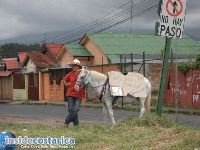
This protestor said he cannot
afford the strict measures
imposed by Riteve to have his
car certified. He and his horse
were the closest the protestors
got to Casa Presidencial.
Click
here for all the fotos of the
national strike.

Taximeters Altered
According to figures released by
Riteve, the vehicle inspection
company, 23% of all taxis that
come for inspection are rejected
for having their taximeters or "maria"
altered.
There are 7.500 "official" taxis
licenses by the Ministerio de
Obras Públicas y Transportes (MOPT),
of which 1.725 are suspected of
charging customers 20% or more
than the set rate by the MOPT.
That means a trip that would
normally cost ¢1.000 colones can
cost ¢1.200 or more for the same
ride in a taxi with al altered
maria. How do you know when you
are being overcharged? You
don't, unless you take the same
route often and know the average
cost of the ride, using
different taxis.
|
Did you
Know?
San José was the
third city in the world having
electricity in the 1800's.
One hundred percent of the
electricity produced in Costa
Rica is from natural renewable
resources , such as hydro,
thermal, geothermal ( Miravalles
and Rincón de la Vieja
Volcanoes), and wind power (
Lake Arenal).
According to the 2000 year
census, approximately 95 percent
of the population of Costa Rica
has access to electricity.
|
Traffic in Central Valley was
reduced to a snail's pace - "tortugismo"
as it was being called by locals
- as different groups on all the
highways and major roads
continue their stop and go
driving, causing traffic to
stall and back.
At the end of the day, the
government finally agreed to sit
down with representatives of the
movement to iron out some type
of settlement.
The government had said it would
not negotiate, while
representatives of the various
unions had vowed to continue the
national strike until the
government would talk to them.
The area around the airport was
just one example of the action.
Around 10am, a wave of tractor
trailers and taxi drivers
descended upon the intersection
east of the airport, and started
their stop and go action, along
the General Cañas highway that
leads into San José.
At the same time, a different
group, with the same tactic,
commenced their slow paced
movement on the Florencio de
Castillo highway that connects
Cartago to San José.
On Avenida Segunda in downtown
San José a group of taxi drivers
stopped in front of the
Cathedral, completely blocking
traffic movement, while Transit
police stood by.
Their objective was to let the
government know their
displeasure over the Riteve
issue, as well as the recent
increase in public salaries and
the Free Trade Agreement.
Groups gathered in front of the
Legislative Assembly, using loud
speakers to make speeches so
that they could be heard by
legislators inside the building,
while a movement was headed for
Casa Presidencial to do the
same.
The area around Casa
Presidencial was completed
blocked off by Transit police
and heavily guarded by members
of the Fuerza Publica.
Authorities were anticipating a
blockade around the President's
office and ensured that no
vehicular traffic got through.
Some members of the Fuerza
Publica had gas masks handy,
while others nearby and out of
sight were dressed in riot gear.
The Fuerza Publica command had
at all times a riot squad ready
to deploy, but were kept some
distance from all the
manifestations, not to incite
the protestors. Visitors first
impression of Costa Rica
yesterday were a squad of riot
geared police, as police made
camp immediately east of the
airport, where normally Transit
police position themselves for
spot checks.
Manifestations by protestors
were spread out all over the
country. Reports by Transit
officials had all major points
outside the Central Valley
reporting some type of blockage
by trucks and taxis.
Did the action have an effect?
Other than impeding roadways and
stopping traffic for hours,
which also affected bus routes
and those taking public
transportation, who had to wait
hours for a bus or in a bus,
business at public offices and
schools was normal.
Most public employees showed up
for work as usual and classrooms
filled with students and their
teachers.
Paying utility bills, customer
were surprised at the short
lines. Monday are typically very
busy places for the Aya (water),
CNFL (light) and ICE
(telephones).
The final result of the meeting
between the government and
organizers was unclear and some
organizers said disappointing.
They expect that the movement
will continue into today
(Tuesday) and vow not to stop
until they meet face-to-face to
president Pacheco.
Foreign Ministry Denies South
Korea's Financial Aid in
Exchange for Vote
The Costa Rican Foreign Ministry
is denying any agreement that
Costa Rica has with the
government of South Korea for a
favourable vote at the united
Nations Security Council in
return for financial aid.
Marco Vargas, Vice Minister of
Foreign Affairs, said that South
Korea's offer to give Costa Rica
a $28 million dollar credit to
improve infrastructure does not
have a condition for a vote
attached to it.
The announcement of South Korea
making the generous contribution
to Costa Rica was announced last
week when President Pacheco met
with the South Korea's minister,
Chang-Hyun Cho, while attending
the presidential inauguration in
the Dominican Republic.
South Korea is aspiring to
become part of the UN Security
Council for the 2007-2008
period, which is made up of five
permanent members - the United
States, China, France, the
United Kingdom and Russia and
ten selected countries for up to
two years each.
The UN Security Council
dedicates itself to finding
peaceful solutions to conflicts
between member states.
Vargas said that the support for
South Korea was formally given
earlier this year, when a Costa
Rican delegation visited New
York and that in exchange, South
Korea would support Costa Rica's
aspirations to the Security
Council for the 2008-2009
session.
"Chucky" Behind Bars
Chucky, the 14 year old boy who
was arrested on Saturday for
being involved in a robbery at a
downtown store, accused of
stealing more than ¢1.900.000
colones this year from three San
José banks and with 29 criminal
accusations in his belt, will be
behind bars for the next 60
days.
The minor is being kept at the
Centro de Menores Zurquí
following an order the Juvenile
criminal courts.
The Patronato Nacional de la
Infancia (PANI) and the
Ministerio de Seguridad Pública
have their hands tied when it
comes to the boy, who has
escaped institutions on numerous
occasions.
According to PANI records, Chuky
has been following the boy since
he was six years old. In 1989,
PANI first intervened on behalf
of the boy due domestic
violence. In 1999 reports of the
boy assaulting other children
were being investigated. And at
the age of eleven, the minor
became the leader of the youth
gang known as "teletubbies".
Chuky has been in and out of
many different institutions
operated by PANI, youth jail and
at the Hospital Nacional
Psiquiátrico.
Authorities say that they have
tried to help the boy, the help
coming from high ranking
officials, but has had no
effect.
Still No Response About Illegal
Shark Fin Landings
On July 29 and August 7 of 2003,
PRETOMA filed two official
denouncements regarding illegal
landings of shark fins at
private docks in Costa Rica.
Now, more than a year later no
results or status reports on
investigations into the cases
have been provided, and the
illegal landings continue.
The denouncements were filed
against Customs for allowing
foreign vessels to land tens of
tons of shark fins at
unauthorized, unsupervised
private docks where Taiwanese
vessels evade paying the 15%
import taxes on highly lucrative
shark fins.
In both denouncements PRETOMA
urged the Customs Police to
perform investigations into the
illegal landings and why such
activity is permitted.
After receiving the
denouncements, Customs Police
confirmed that investigations
would be conducted.
"We are extremely concerned
because the Costa Rican
government is promoting shark
finning by allowing
international vessels to
illegally land tons of shark
fins in Costa Rica," says
Randall Arauz, President of
PRETOMA.
Because the docks are private,
the owner of the dock can deny
access to any government
official, even the Director of
Customs.
"In 2003 Costa Rica officially
reported 533 tons of shark fins,
but since all shark fins are
landed at unauthorized,
unsupervised private docks that
number could easily be 3 times
as high," says Jorge Ballestero,
Vice President of PRETOMA. "And
the tax revenues lost could
easily be in the millions of
dollars."
"In spite of full knowledge of
the situation, Customs has done
nothing to stop the illegal
landings for over a year," notes
Arauz.
PRETOMA is a Costa Rican
non-profit, non-governmental,
marine conservation organization
that works to promote
responsible fisheries and
protect sea turtles, sharks and
marine biodiversity.
Contact:
[email protected],
www.tortugamarina.org
|


