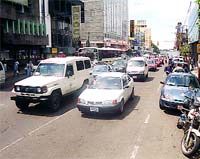
Rising Cost of Gasoline May
Force Rationing
The rising cost of gasoline
prices in Costa Rica is leaving
some car owners no option but to
abandon their cars in trade for
a motorcycle or scooter.
This year, gasoline prices
have risen a total of 11 times,
bringing the current price for a
litre of super gasoline to
¢326.90 colones (that's pennies
shy of US$3 a U.S. gallon).
If the price increases continue
at the same pace, the price
could reach ¢470 colones by the
end of the year or a $1 a litre,
given the declining pace of the
colon.
According to figures by the
Ministerio de Energía y Minas de
Guatemala, Costa Rica has the
highest gasoline prices in
Central America.
A gallon of super gasoline in
Guatemala is about $2.30 and in
neighbouring Nicaragua only
$2.20.
What makes gasoline so expensive
in Costa Rica? Officials say
that for every ¢326 colones paid
at the gas pump, ¢112 goes to
taxes.
And while government officials
are looking for ways to reduce
the cost of gasoline, the
marketplace is looking for new
alternatives like electrical
vehicles or motorcycles.
If the spiraling prices
continue, some say that Costa
Ricans may have to return to the
bicycle as their primary form of
transportation.
The Refinadora Costarricense de
Petróleo (RECOPE) - the national
refinery and monopoly on
gasoline products in Costa Rica,
blames the rising price of crude
for the increasing gasoline
prices. Officials at RECOPE
claim that they are concerned
about the level of gasoline
prices, but it is not within
their control.
The government is studying
various options that include
limiting the hours of gasoline
stations, using electric trains
(uh?), limiting vehicular
circulation to even and odd days
depending on the last number of
the license plate and using
Cortel (post office) vehicles to
deliver government mail.
Venezuelan Ortega Asylum Revoked
Costa Rica revoked
political asylum to Venezuelan
union activist Ortega Carvajal,
saying that Ortega did not
complete with the terms of his
political asylum granted him
some 17 months ago.
Roberto Tovar, Exterior
Minister, said Ortega violated
the terms of the asylum,
returning to Venezuela two weeks
ago, the country he left because
he was being politically
persecuted by the government of
Hugo Chávez.
Ortega was granted political
asylum in Costa Rica in March of
2003. His claim was that he was
being persecuted in Venezuela
for taking part in a general
strike that presumably
destabilized the country at the
end of 2002.
In March of this year, the Costa
Rican government had asked
Ortega to leave Costa Rica when
it was learned that he had
participated at a political
rally in Miami, in which he gave
a speech against the Venezuelan
President, accusing him of being
a dictator and of sinking the
country into an economic crisis.
During the speech, Ortega vowed
to go back to Venezuela and work
clandestinely to oust Chavez.
Costa Rica’s Ministry of Foreign
Relations, cited Ortega’s speech
at the rally a a violation his
asylum agreement.
As president of the
Confederación de Trabajadores
Venezolanos (CTV), Ortega has
the support of 58% of the
population to oust president
Chávez.
Canadian Faces 15 Years for Drug
Trafficking
The Juzgado Penal de
San José has asked 15 years in
prison for Canadian, James
Trimbles, who was found to be
transporting 1.360 kilos of
cocaine.
According to the prosecutor in
the case, Trimbles has shown no
remorse. The case could have
been tried in Canada, however,
the Canadian government has not
shown any interest in having the
man returned and tried in
Canada.
Trimbles, 52 years of age, is
accused of international drug
trafficking and was arrested
last October 12. The drugs were
found in a sail ship in
international waters near the
Galápagos. A joint effort by the
U.S., Canada and Costa Rican
authorities was successful in
making the arrest following an
11 month investigation.
Trimbles is believed to have
lived in Paquera, in the Nicoya
Peninsula and part of an
international drug trafficking
network.
Trimbles is believed to be
responsible to transport the
drugs from Galápagos to Canada.
American Airlines to Begin
Nonstop Service From Los Angeles
American Airlines
will begin daily nonstop service
between Los Angeles and San
José, on Dec. 16.
The new flight is the latest in
a series of additions the
airline has made this year to
its international schedule in
Los Angeles.
American will fly the Los
Angeles - San José route using
Boeing 757 aircraft configured
with 22 First-Class seats and
166 Main-Cabin seats.
American's flight 927 will
leaver Los Angeles at 11:30pm
and arrives in San José at
7:24am. Flight 934 departs San José
at 5:00pm and arrives in Los
Angeles at 9:01pm.
San José is the third
international destination to be
added to American's
Los Angeles schedule this year.
In April, the airline began
daily service to
Tokyo, and in June nonstop
service was added to San
Salvador, El Salvador.
Also this year, American
increased its existing schedule
of flights from Los
Angeles to London and Toronto.
For San José, the flight to Los
Angeles represents its fourth
nonstop
destination in the American
Airlines network, joining
Dallas/Fort Worth, Miami
and New York Kennedy.
San José is one of two
destinations the airline serves
in Costa Rica. Earlier this
year, American began nonstop
flights to Guanacaste Liberia in
northwest Costa Rica from its
Miami hub. That service will
grow from three times weekly to
five times weekly beginning Nov.
1.
911 Screening Callers
Some Costa Ricans are
complaining that a call to the
911 service takes too much of
their time, as 911 operators
take a few seconds to ask more
questions than in the past, in
effect, screening the emergency
calls received.
The high number of ill
intentioned calls to the 911
system have led officials to ask
operators to take a little more
time to verify that the
emergency call is real before
dispatching an ambulance, fire
truck or police.
911 officials say that a call to
the 911 system now takes no more
than a minute and a half. The
change was made following a
recent report that showed that
82% of all calls to 911 were
false.
Officials use the morning of 16
August as an example, where of
the 11.000 calls received, only
2.000 were real. The rest of the
calls were made to insult the
operators with vulgarities or
just plain pranks.
911 officials are quick to
remind that a law in place
allows the caller or owner of
the telephone where the call
originated tol be fined. The
fine is added to the telephone
bill and if not paid, telephone
service will be cut.
|