Carter urges Venezuelans to vote
with calm, confidence
Former US President
Jimmy Carter on Saturday called
on Venezuelans to vote with calm
and confidence in Sunday's
recall referendum against
President Hugo Chavez.
"The voting of Sunday is
another expression of
democracy," Carter said at a
press conference with Cesar
Gaviria, outgoing Secretary
General of the Organization of
American States (OAS).
Carter said the referendum is
the culmination of the dialogues
headed by Gaviria and a year of
legal and peaceful work by
opposition coalition the
Democratic Coordination. It is
"a vigorous and violent-free
electoral campaign."
The 2002 Nobel Price winner
asked representatives of Chavez'
supporters and opponents to be
ready for a meeting after the
referendum, in which the two
sides can define the ways to
work together and solve urgent
problems in Venezuela.
Gaviria also noted that they
look forward to having a result
respected by both parties, and
it can be a beginning of
Venezuela's new era rather than
division or confrontation.
In May 2003, the OAS and the
Carter Center backed up a
democratic solution to the
severe political crisis in
Venezuela. They urged the
government and the opposition to
resort to a referendum to decide
whether or not Chavez will
remain in office till January
2007.
Amid their calls, Venezuelans
were waiting for the referendum
calmly on Saturday.
Under the law, both Chavez's
backers and foes wrapped up
their demonstrations ahead of
the referendum.
According to the National
Election Council (CNE), the
referendum will take place from
local time 6 a.m. (1000GMT) to 6
p.m. (2200GMT), with about 14
million people expected to cast
their votes. First results will
be given by the CNE three hours
after the closing of voting
stations.
Venezuela will use for the first
time electronic voting machines
which can register fingerprints
of voters to prevent them from
casting ballots repeatedly.
The government has deployed
118,000 soldiers to guard voting
centers. Fire fighters and
policemen were also on alert at
their headquarters.
Hundreds of international
observers, including those from
the OAS and the Carter Center,
will monitor the process.
Chavez, who was accused by his
opponents of wrecking the
country's economy, has to face
the referendum as they have
collected 2.5 million signatures
against him, more than the 2.4
million required to call a
recall vote.
Under the Venezuelan
constitution, in order to oust
Chavez, the opposition has to
collect a number of votes equal
to or higher than that obtained
by the president in the 2000
election, which is at least 3.7
million votes.
The opposition has said it will
only accept the recall
referendum results if
international organizations
acting as observers approve
them.
Chile refuses to discuss
maritime-demarcation dispute
with Peru
Chilean President Ricardo Lagos
ruled out the possibility
Saturday to discuss the
sea-territorial demarcation
dispute with Peru, saying the
matter was already solved.
The maritime demarcation with
Peru in the Pacific Ocean "is a
problem for Peru," but Chile
will maintain its position that
this issue is solved, Lagos said
during an interview with local
radio station Radio Bio Bio.
He said that the maritime
question "is not what matters
the most in our relations" with
Peru and he had discussed with
Peruvian President Alejandro
Toledo about the issue.
Lagos reiterated that the
maritime demarcation of Chile
and Peru was initially
established in 1947 and then
reaffirmed in 1952after the two
countries, plus Ecuador and
Bolivia, held talks on the
issue.
He insisted that Peru could take
the case to the International
Court of Justice but anticipated
"I will take the necessary steps
to protect" the interests of
Chile. The country "knows that
when it is necessary to talk
hard, I do it; when steps have
to be taken, I do so," he added.
On Aug. 6, when meeting his
Chilean counterpart Soledad
Alvear, Peruvian Foreign
Minister Manuel Rodriguez
defused tensions between his
country and Chile by saying that
the 1929 Treaty that has set
borders between Chile, Peru and
Bolivia is "perpetual."
Terror threats may be from
political rivals: Salvadorian
president
Salvadorian President Antonio
Saca said Saturday the so-called
threats by Islamic groups agains
this country may be from the
hands of political rivals,
according to reports from San
Salvador, capital of the Central
American country.
The security authorities have
not proved yet the veracity of
the threats, Saca told radio
station YSKL.
"It rather seems the threats are
ill attempts from certain
individuals in El Salvador to
cause instability and
confusion," and "some of them
have terms" that sound quite
local, he said.
Saca added that neither the
existence of such groups that
supposedly launched the threats
nor the veracity of the messages
has been confirmed. But the
alleged threats have made him
order the authorities to
intensify security in strategic
sectors, including harbors and
diplomatic buildings.
Supposed Islamic groups have
said on the Internet that they
will stage attacks against El
Salvador for keeping its
military troops in Iraq.
The Salvadorian National
Security Council has undertaken
a thorough investigation and
contacted world intelligence
organizations. Until now the
veracity of these threats has
not been confirmed.
El Salvador sent its first
contingent of 360 soldiers to
Iraq in August 2003. A third
contingent of 380 Salvadorian
soldiers will be sent to the
Iraq on Aug. 17.
El Salvador is now the only
Latin American country which
still has troops in Iraq.
Nicaragua, Honduras and the
Dominican Republic have
withdrawn their troops.
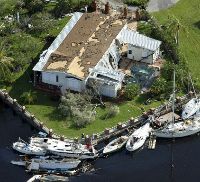
Hurricane Charley kills four in
Cuba
Four people were
killed and five others injured
as Hurricane Charley tore across
Cuba, leaving 200,000 homeless,
local authorities said Saturday.
Hurricane Charley crossed the
coast just after midnight and
took over two hours to sweep
Cuba. It destroyed 16,000 houses
and cut powers in several areas.
Violent winds battered the
capital Havana, damaging
buildings and bringing down 500
electricity cables. Technicians
were trying to resume the supply
of electricity and gas, the
National Electricity Regulation
chief, Victor Puentes, said.
The hurricane struck Mariel port
and destroyed tens of vessels
and school buildings.
The province of Pinar del Rio in
the western Caribbean country
was not directly affected by the
hurricane, but suffered a power
blackout.
The hurricane damaged fruit
plantations, including banana
and sugarcane, and vegetable
production.
Authorities sent brigades to
assist the areas affected by
Charley.
|