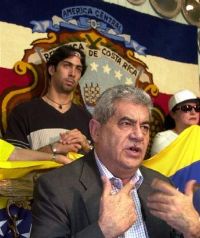
Exiled Union Leader Returns to Venezuela
Leaders of the Venezuelan Workers Confederation say union
president Carlos Ortega has returned to the country more than a year
after seeking exile in Costa Rica.
Union officials say Mr. Ortega returned over the weekend, but could
not confirm his location.
Mr. Ortega told the Associated Press in a telephone interview that
he planned to join opposition efforts to oust President Hugo Chavez.
He said he returned to support democratic groups in the nation and
was willing to fight the Chavez regime by any means necessary.
Last year, the union boss fled to Costa Rica to escape a trial over
his role in a two-month general strike.
Earlier this year, Costa Rica asked Mr. Ortega to leave the country
due to his plans to work against Mr. Chavez's government.
CNE slams false signature collection for referendum in Venezuela
The Venezuelan National Election Council (CNE) denounced
Wednesday, less than two weeks ahead of the Aug. 15 referendum, a
fraud in some signatures collected to support the recall referendum
against Venezuelan President Hugo Chavez.
CNE President Jorge Rodriguez indicated, without mentioning numbers,
that there are clear evidences that several names share the same
fingerprint.
The CNE had validated 1.9 million anti-Chavez signatures out of3.4
million collected by the Venezuelan opposition to seek a recall
referendum against Chavez,as some names and identifications were
similar.
In the reconfirmation process, the fingerprints of two individuals
appear in 32 identification cards and signature-collected notebooks
with different names in different states of Venezuela.
There was no change in calling for a recall referendum against
Chavez, he emphasized, as the constitutional requirements had been
met.
Rodriguez said the CNE would not allow this type of problems appear
in the Aug. 15 referendum with technical support.
Under the Venezuelan constitution, in order to oust Chavez, the
opposition has to collect votes equal or higher than that obtained
by the president in the 2000 election, which is at least 3.7 million
votes.
Chavez, who was elected in 1998 and re-elected to a six-year term in
2000, has been accused by his opponents of wrecking Venezuela's
economy.
On June 8, the National Election Council announced that the
opposition had collected 2.5 million signatures against Chavez, more
than the 2.4 million required to call a recall vote.
Paraguay rules out terror attack in supermarket blaze
The Paraguayan government on Wednesday ruled out a terrorist attack
as the cause of the supermarket blaze that killed more than 500
people on Sunday on the outskirts of Asuncion, Paraguay's capital.
"There is no evidence or signs of sabotage. The investigations
clearly point toward a gas leak and the rapid combustion of the
merchandise," said Paraguay's Interior Minister Orlando Fiorotto,
according to reports from Asuncion.
But according to Paraguayan newspaper Diario Noticias, Paraguayan
Attorney General Rafael Sanchez said the possible cause of the
explosion was a refrigerator located in a bakery of the commercial
center.
"There are sectors in the supermarket where it is noticed that the
fire was most intense. In the bakery, located in the second floor,
there is a refrigerator that was completely melted, and the
situation makes us believe that that is the origin of the fire," the
attorney general said.
The fire broke out when the supermarket was crowded with Sunday
midday shoppers. Reports said nearly 1,000 people had been inside
the shopping center, which is part of the complex that also houses
offices and an underground parking lot.
The supermarket owner Juan Pio Paiva and his son Victor Daniel Paiva,
accused of manslaughter, were held in preventive detention on
Tuesday, as eyewitnesses said the son ordered supermarket guards to
close doors to prevent people from leaving without paying.
Forensic experts from the United States, Colombia, Argentina and
Spain, have started investigations into the accident, which killed
at least 504 people and injured 512, with several of them in serious
condition, according to Paraguayan Attorney General's office on
Wednesday.
So far, 426 victims have been identified, but dozens of scorched
bodies were hard to identify. Forensic experts have taken DNA
samples and odontograms from the bodies.
"The chances of identifying the bodies were slim, as we do not have
odontological records," said Attorney General Oscar Latorre.
Interior Minister Orlando Fiorotto said there are still areas where
no one has checked yet for the existence of human remains, because
the temperature is still high and there are risks of collapse of the
structure.
The death toll may rise further as firemen, rescue worker and police
agents are working to remove the debris.
Colombian police seize four tons
of explosives
The Colombian
Anti-Narcotics Police found 4
tons of explosives aboard two
planes that were utilized to
carry drugs, in an operation in
the northern Colombian
department of Bolivar, police
sources said Wednesday.
Colombian Police Director,
general Jorge Castro, revealed
that in the action two persons
were captured and the explosives
seemingly belonged to the United
Self-Defense Forces of Colombia
(AUC), operating in the area.
The planes were immobilized at
Santodomingo, San Pablo
municipality, where there is
also a presence of the
Revolutionary Armed Forces of
Colombia (FARC) and the National
Liberation Army (ELN).
In recent weeks, the authorities
have seized large quantities of
explosives in various parts of
the country. There have been
alerts on possible terrorist
attacks all over the country, as
President Alvaro Uribe will
complete his second year in
office on Aug. 7.
The AUC, mainly funded by
landowners and drug dealers, was
founded in April 1997 to fight
left-wing guerrillas who also
tried to control plantations and
sales of coca leaves, the raw
material for cocaine.
Colombia has been bogged down in
a four-decade-old civil war, in
which leftist rebels, far-right
paramilitary and government
troops fight one another, with
an average of 3,500 people being
killed every year.
|