US travel curbs force Cuba
exodus
Hundreds of Cuban Americans have
been returning to the US, as
tough new curbs on travel to
Cuba imposed by Washington come
into effect on Sunday.
Cuban Americans will only be
allowed to go back to the island
once every three years instead
of once a year.
President George W Bush says the new policy is
designed to restrict the flow of money to what he describes as Fidel
Castro's repressive regime.
But Havana says the new rules will merely keep families apart.
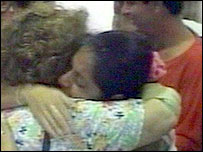
Havana airport departure lounge was packed with tearful Cuban
families getting together for a long, emotional farewell.
Parents, grandparents, brothers, sisters and cousins all wanted to
say goodbye to their relatives.
Cuban Americans had been told by the US authorities they had to
leave the island by the end of July or face heavy fines.
According to the new Bush administration rules, they cannot now come
back for at least three years and then only for two weeks.
The restrictions have proved highly controversial.
Many Cuban Americans, who as a group have traditionally backed a
hardline approach against Fidel Castro, have said they cannot
support a policy which stops them seeing their families.
In Cuba, mass rallies have been organized against the new measures.
The Cuban government, which itself prevents its people travelling
unless with special permission, says President Bush's policy is
brutal and cruel.
Pinochet's son released from detention, banned from leaving Chile
The son of former Chilean dictator Augusto Pinochet was
released Saturday after two days in detention, but he was banned
from leaving the country when the authorities were continuing to
investigate whether he was involved in an illegal sale of vehicles.
Prosecutor Vinko Fodic said Augusto Pinochet Hiriart was released
after he was formally accused of forging license plates, illegally
receiving vehicles and bearing arms in an illegal way.
Appearing in court Saturday, Pinochet Hiriart said he is "convinced
that I will be able to prove that I am innocent. I am a man of
honor."
He was detained Thursday at the Infirmary of the Penitentiary of
Curico, 180 km south of Santiago, where he will have to check in
every 15 days at the local court.
Pinochet Hiriart and two others were accused of using forged license
plates and receiving a stolen car. But none of them has been
indicted.
Pinochet Hiriart was also accused by Fodic of illegal possession of
a gun, after a revolver was found at his residence. The Colt
32-caliber revolver was registered in the name of his father, and it
was illegal to keep a gun in the home of someone other than the
official owner.
The legal problem for Pinochet Hiriart came after his father was
being investigated for his 8 million US dollars in secret accounts
at Riggs Bank in the United States.
Pinochet, 88, was implicated in a drawn-out legal battle over
charges of human rights abuses during his 17-year rule from 1973 to
1990.
The trial for Pinochet was cut short in 2001 when he was diagnosed
as mentally incompetent
Chavez to
prevent "destabilization" attempt
Venezuelan President Hugo Chavez said here Saturday that he will
prevent any attempt from the opposition to destabilize the country
during the Aug. 15 recall referendum.
Chavez said that the US government has intensified its offensive
against Venezuela and the Venezuelan opposition is "pupils" of
Washington seeking to produce violence during the referendum.
According to Chavez, intelligence reports show that the opposition
is analyzing the possibility of cheating the electronic voting
system during the referendum.
He added that the supposed electronic fraud would be supported by
the local telecommunications network CANTV, which will broadcast the
data from the voting machines.
Chavez promised to intervene in the plot if the CANTV really decides
to cheat the nation.
Earlier, the company rebuffed Chavez's accusation during a meeting
with Vice President Jose Rangel.
Finally, Chavez said that although "we are going to win this battle,
no one should lower his vigilance because we haven't won yet,"
Chavez said.
Under the Venezuelan constitution, in order to oust Chavez, the
opposition has to collect votes equal or higher than that obtained
by the president in the 2000 election, which is at least 3.7 million
votes.
Chavez, who was elected in 1998 and re-elected to a six-year term in
2000, has been accused by his opponents of wrecking Venezuela's
economy.
On June 8, the National Electoral Council announced that the
opposition had collected 2.5 million signatures against Chavez, more
than the 2.4 million required to call a recall vote.
Chavez experienced two general strikes, a 48-hour military coup in
April 2002 and a strike at the beginning of last year.
|