Astronaut takes space
industry to Costa Rica
By Blake Schmidt,
Houston Chronicle
LIBERIA, COSTA RICA —
All he ever wanted was
to be an astronaut. So
the Costa Rican teenager
wrote NASA, asking how
he could join the space
corps.
He couldn't, the
devastating response
said. Only Americans
were accepted.
But Franklin Chang-Diaz
didn't give up. Instead,
he decided to move to
the United States.
Four decades later —
after obtaining U.S.
citizenship, a doctorate
in applied physics from
the Massachusetts
Institute of Technology
and a seat aboard seven
space shuttle flights —
the 57-year-old
astronaut has retired
from NASA and returned
home.
He's brought rocket
science and yet another
dream with him.
Chang-Diaz has built
Costa Rica's first
rocket lab and launched
a private venture to
build a plasma-powered
rocket engine to send a
spaceship to Mars faster
and cheaper than by
conventional fuels.
He has become a
celebrity in Costa Rica,
where science education
is light-years behind
the United States.
Reporters seek him out
for interviews.
Politicians ask his
advice. Costa Rica's
postal service has even
issued stamps honoring
him and his lab, called
Ad Astra Rocket.
Chang-Diaz touts Costa
Rica as a land of
opportunity.
"I think this is a
country small enough
that it can be changed,"
he said. "It's not as
difficult as changing
the United States or the
Soviet Union."
'A place of wonder'
After graduating from
high school in Costa
Rica in 1967,
Chang-Diaz, grandson of
a Chinese immigrant and
son of Costa Rican
parents, worked at a
bank until he saved
enough money for a plane
ticket to Connecticut,
where relatives lived.
He picked up English at
a prep school and
enrolled in college,
first at the University
of Connecticut, then at
MIT for graduate
studies. In 1977, he
received a doctorate
from MIT and became a
naturalized American
citizen.
He was selected for the
space program three
years later and in 1986
made his first voyage
into space, a six-day
shuttle mission,
returning to Earth just
10 days before the
Challenger disaster. By
the time he retired in
July 2005, he shared
with fellow NASA
astronaut Jerry Ross the
record for most trips
into space.
"I love space. It's a
place of wonder," he
said from his Costa
Rican office overlooking
a lab where engineers
toil over plans for his
brainchild, an engine
for space flight
propelled by a cloud of
plasma.
They're fine-tuning a
model that will be
tested at the end of
this year at Houston's
Johnson Space Center.
The idea for plasma
propulsion came to
Chang-Diaz nearly three
decades ago while he was
studying at MIT.
"The rockets we are
using right now to send
people to space were the
same thing invented by
the Chinese 2,000 years
ago with a few
embellishments," he
said.
Future of rockets
A plasma-powered craft
would launch from the
Earth with conventional
rockets, then its
engines, which operate
only in a vacuum, would
activate for
interplanetary travel.
A plasma engine relies
on heat generated by a
nuclear reactor. The
heat expands a gas —
hydrogen or argon are
among possibilities —
into plasma, essentially
a hot cloud of subatomic
particles, protons and
electrons. An electrical
field and magnets would
accelerate the chemical
reaction and direct the
plasma as a nozzle
directs thrust from a
conventional rocket
engine.
Such an engine,
Chang-Diaz said, will
make today's chemically
powered rockets "a thing
of the past."
The technology could be
put to many uses in
space and on Earth,
including breaking down
toxic waste into
harmless molecules.
Faster and healthier
NASA successfully
flight-tested a
solar-powered version of
a plasma propulsion
engine in 1998. Called
Deep Space-1, the probe
used xenon rather than
hydrogen fuel to fly by
a comet and an asteroid
to gather close-up
images over three-years.
NASA's Dawn mission,
scheduled for launch in
September, also will
rely on a similar
propulsion technology to
study the large
asteroids Vesta and
Ceres.
The much-more capable
Vasimr plasma engine
proposed by Chang-Diaz
could reduce the travel
time for a human mission
to Mars to four months.
Traditional chemical
rockets would take from
6 to 10 months.
"Anything we could do to
cut the travel time to a
distant destination like
Mars would be very
important," said Kelly
Humphries, a spokesman
for NASA's exploration
systems directorate.
The more rapid travel
would lower the health
threat to astronauts
from exposure to cosmic
and solar radiation.
While weightless,
astronauts also
experience muscle and
bone loss. A faster
journey could lessen the
need for lengthy
in-flight exercise
sessions or even a
centrifuge to introduce
artificial gravity.
A boost for the country
The space agency plans
to return American
astronauts to the moon
by 2020 using
traditional chemical
rockets. NASA also plans
to establish a base on
the moon that would
become a proving ground
for a Mars mission
decades later.
Chang-Diaz hopes to put
plasma-powered rockets
into space by 2010 and
see them fly to Mars by
2025.
He has built his $3.5
million lab, funded
mostly by Costa Rican
investors, in the middle
of rolling green
farmland in Guanacaste,
a traditionally
agricultural region.
Throughout the area,
there's ample evidence
of the gap between rich
and poor despite a boom
in foreign tourism.The
average weekly income
here is still less than
$100, and more than
one-third of households
are below the poverty
line.
Inside the lab,
engineers wearing white
gloves and goggles work
on the model plasma
engine, a cylindric hunk
of steel and magnets the
size of a family van.
When operating, the
engine turns a neon
purple from the argon
gas that fuels it.
The rest of the lab is
sterile and bare, save
for a poster dangling on
one wall. It reads "En
Ruta a la Conquista" or
"En Route to the
Conquest."
Chang-Diaz said he hopes
the lab will be the
vanguard of a high-tech
research center — the
Silicon Valley of Costa
Rica — that will bring
jobs to the area.
It may seem far-fetched
to some and a dream to
others, but it's a
down-to-earth thought to
Chang-Diaz.
"There's a whole
universe out there," he
said.
|
|
|
|
|
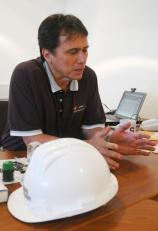
Franklin Chang-Diaz founded Ad Astra
Rocket Company to make shuttles more
efficient.
|
|
|
|
|
|

