|
Why Amphibians Matter
By Moises Velasquez-Manoff
| Contributor to The
Christian Science
Monitor
Monteverde Cloud Forest
Preserve, Costa Rica -
Since the 1970s, three
frog species have
disappeared from Puerto
Rico's mountain forests,
all after unusually warm
years. Between 1987 and
1988, the hottest year
on record until then,
the golden toad and
Monteverde harlequin
frog disappeared from
the Monteverde Cloud
Forest Preserve in Costa
Rica.
That same year, the
jambato toad vanished
from the highlands of
Ecuador, which was also
unusually hot and dry.
"We have a tendency for
species to disappear
after warm years," says
Alan Pounds,
scientist-in-residence
at Monteverde.
Scientists consider
these extinctions part
of an ongoing worldwide
amphibian die-off. The
World Conservation Union
(IUCN) estimates that 32
percent of all
amphibians are in danger
of going extinct. Of
5,918 known species –
and new species are
constantly being
discovered – 165 may
have already
disappeared. Two-thirds
of all harlequin frogs,
which range throughout
New World tropics, are
already gone, Dr. Pounds
says. Scientists have
blamed habitat loss,
increased ultraviolet
radiation, pollution,
and chytrid, a fungus
that humans may have
inadvertently
transported around the
globe.
To that list of
suspects, Dr. Pounds and
many other scientists
now add climate change.
Scientists rarely expect
animals to drop dead
from heat exhaustion.
Instead, they anticipate
warming will do away
with food sources and
habitats or trigger
outbreaks of disease –
and not always in
obvious ways. Pounds
thinks that this is what
happened at Monteverde.
Warming helped the
chytrid fungus kill off
the golden toad.
The fungus, which grows
on the skin of
amphibians and is lethal
to many of them, thrives
in the relatively cool
conditions found in
tropical highlands. So
how could global warming
enable it? What if
warming pushed average
temperatures at
Monteverde up into the
fungus's optimal range,
between 63 and 77
degrees F.? Rather than
suppressing the
cool-weather fungus,
rising temperatures may
have led to ideal
growing conditions.
"It's the opposite of
what you would expect,"
Pounds says.
Disease isn't the only
threat from warming.
Steven Whitfield, a PhD
candidate at Florida
International University
in Miami, analyzed 35
years of amphibian and
lizard population data
at La Selva Biological
Field Station on Costa
Rica's Caribbean plain.
To his surprise, he
found that researchers
today catch one-quarter
of the number of frogs
and lizards they caught
then.
"These declines were not
subtle," he says. And
Pounds's chytrid
hypothesis doesn't
explain them: The fungus
doesn't grow well in the
hot lowlands, and
lizards don't get
chytrid. That suggested
something else. Mr.
Whitfield guesses it is
the leaves rotting on
the jungle floor.
In those same 35 years,
average temperatures at
La Selva have risen.
Higher temperatures,
especially at night,
perhaps make trees put
out fewer leaves. But
they also increase the
decomposition rate of
fallen leaves on the
jungle floor, where
frogs and lizards feed,
lay eggs, and take
shelter.
"If there's less leaf
litter on the ground,
then frogs and lizards
have [fewer] hiding
places," Whitfield says.
Both these hypotheses
underscore global
warming's indirect
effect on wildlife. "I
don't think that a
single factor is going
to explain all of the
trends that we're seeing
worldwide," Whitfield
says. But "interaction
between these factors is
going to be hugely
important." |
|
|
|
|
|
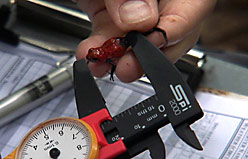
Sizing it
up: Researcher Steven Whitfield uses
calipers to measure a poison dart frog
at La Selva Biological Research Station
in Costa Rica.
|
|
|
|
|
|

