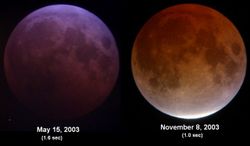
What is a Lunar Eclipse?
From Wikipedia
A lunar eclipse occurs
whenever the Moon passes
through some portion of
the Earth's shadow. This
can occur only when the
Sun, Earth, and Moon are
aligned exactly, or very
closely so, with the
Earth in the middle.
Hence, the Moon is
always full during a
lunar eclipse. The type
and length of an eclipse
depend upon the Moon's
location relative to its
orbital nodes. The most
recent total lunar
eclipse was on 3 and 4
March 2007.
The next one will occur
on 28 August 2007.
A lunar eclipse occurs
at least two times a
year, whenever some
portion of the Earth's
shadow falls upon the
Moon. The Moon will
always be full during a
lunar eclipse; that is,
from the perspective of
the Sun, the Moon will
be directly behind the
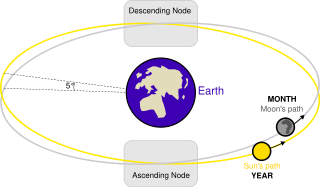
Earth. However, since
the orbital plane of the
Moon is inclined by
about 5° with respect to
the orbital plane of the
Earth (the ecliptic),
most full moons occur
when the Moon is either
north or south of
Earth's shadow. Thus in
order to be eclipsed,
the Moon must be near
one of the two
intersection points its
orbit makes with the
ecliptic, which are
referred to as the
Moon's ascending and
descending nodes.
The shadow of the Earth
can be divided into two
distinctive parts: the
umbra and penumbra.
Within the umbra, there
is no direct solar
radiation. However, as a
result of the Sun's
large angular size,
solar illumination is
only partially blocked
in the outer portion of
the Earth's shadow,
which is given the name
penumbra.
A penumbral eclipse
occurs when the Moon
passes through the
Earth's penumbra. The
penumbra does not cause
any noticeable darkening
of the Moon's surface,
though some may argue it
turns a little yellow. A
special type of
penumbral eclipse is a
total penumbral eclipse,
during which the Moon
lies exclusively within
the Earth's penumbra.
Total penumbral eclipses
are rare, and when these
occur, that portion of
the Moon which is
closest to the umbra can
appear somewhat darker
than the rest of the
Moon.
A partial lunar eclipse
occurs when only a
portion of the Moon
enters the umbra. When
the Moon travels
completely into the
Earth's umbra, one
observes a total lunar
eclipse. The Moon's
speed through the shadow
is about one kilometer
per second (2300 mph),
and totality may last up
to nearly 107 minutes.
Nevertheless, the total
time between the Moon's
first and last contact
with the shadow is much
longer, and could last
up to more than 6 hours.
The longest total lunar
eclipse between 1000 BCE
and 3000 ACE had a
duration of 1h47m14s,
and took place on May
31, 318. The relative
distance of the Moon
from the Earth at the
time of an eclipse can
affect the eclipse's
duration. In particular,
when the Moon is near
its apogee (that is, the
farthest point from the
Earth in its orbit) its
orbital speed is the
slowest. The diameter of
the umbra does not
decrease much with
distance. Thus, a
totally-eclipsed Moon
occurring near apogee
will lengthen the
duration of totality.
A selenelion or
selenehelion is a type
of lunar eclipse when,
due to the moon's
proximity to the
ecliptic, both the sun
and the eclipsed moon
can be observed at the
same time. This
particular arrangement
has led to the
phenomenon being
referred to as a
horizontal eclipse. It
can only be observed
just prior to sunset or
just after sunrise. The
specific arrangement is
not common, and last
occurred on May 16, 2003
over Europe.

The 3rd March 2007 total
eclipse as seen from
Leeds, England. |