Breathtaking Costa Rica
By BETSY CROSBY
For the Atlanta Journal-Constitution
There is nothing worse than traveling with people whose mere existence irritates. Ask our teenage son, Sam. He's had just about as many trips with his parents -- to museums, educational displays and historical re-enactments -- as he can take.
Then, again, there's just so much sighing and rolling of the eyes that we, his parents, can take. So, last spring we planned a trip from a teenager's perspective, to Costa Rica. To reduce the irritant factor all around, we brought along Sam's easy-going friend Gordon Smith.
The key to traveling with two 15-year-old boys is adventure. Costa Rica proved to be just the ticket, offering surfing, an active volcano and a zip line through the rain forest. It also served up activities for doddering middle-aged parents: golf, bird-watching and, my personal favorite, soaking in thermal hot springs. And we were able to check out the Hacienda Pinilla, a resort under development by an
Atlantan.
A bonus was the scenery, dramatic enough to impress teenagers and parents alike: breathtaking mountain views, unspoiled beaches and lush tropical landscapes offering a kaleidoscope of birds and butterflies. We kept wondering, is this what Hawaii was like in the 1950s? Or Florida in the 1930s?
In San José, the capital, we got our first inkling of just how adventurous a trip this would be: Our rental car company asked us to agree in writing not to drive our four-wheel drive through rivers. We cheerfully complied, little guessing that this trip would test our road skills and our patience.
We had been told to fly to Liberia, a small town in northwest Costa Rica, whose airport is about an hour's drive to the Pacific beach resorts in the Guanacaste region. Because all direct Delta flights from Atlanta to Liberia were booked, we opted to fly into San José and drive to the coast.
Though there were small commuter flights between San José and
Tamarindo, the surf town that was our ultimate destination, we wanted the flexibility of a rental car. We also were carrying golf clubs, which sometimes can exceed the weight limits of small planes.
'Go with the non-flow'
What looked on the map to be an easy three-hour drive stretched into an excruciating six as we navigated the potholes on the two-lane Pan-American "highway" alongside uniformed schoolgirls on bicycles. Exiting the San José area, my husband tried to make up time by passing the lumbering trucks on the shoulderless switchbacks. I closed my eyes to survive the experience, diminishing my appreciation of the stupendous mountain scenery. And as darkness descended we got lost, happily near a service station where we received accurate directions in English.
"You've got to be able to go with the non-flow," said Dorothy
MacKinnon, an American we met that night at the Hacienda Pinilla near
Tamarindo. She and her traveling companion, Kristin Jolly, a recent graduate of the University of Georgia, were working on an update of a Tico Times guidebook to Costa Rica. Relaxing over goblets of planter's punch, the two women cheerfully recounted their experiences of the previous few days. They had flipped their rental car once and had two flat tires. Their attitude seemed to suggest it was all in a day's work.
Relax, chill
Incredibly, the angst of our first day's adventures melted away in the subdued beauty of Hacienda Pinilla, a resort that offers 24 rooms. This 4,500-acre former cattle ranch beside the Pacific Ocean is being transformed into an exclusive eco-resort of boutique hotels and private homes. A tropical rain forest marks its northern boundaries; its isolated beaches at the southern border are inhabited only by the occasional surfers who cross the mangrove swamp at low tide. |
|
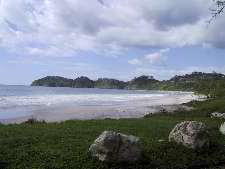
Playa
Junquillillal, Guanacaste
|
|
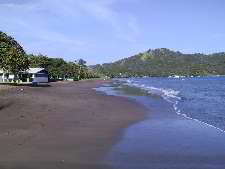
Playa
del Coco, Guanacaste
|
|
Playa
del Coco, Guanacaste
|
| If
you go |
| Getting
there: Driving
in Costa Rica is
time consuming
because of the
uneven condition
of the roads. A
thorough
exploration of the
many wonderful
tourist areas is
best conducted on
several small
trips rather than
one that is sure
to include several
frustrating days
in the car. If the
beautiful beaches
of the northwest
Guanacaste
province are your
primary
destination, fly
to Liberia, rather
than San José,
the capital. Aside
from the many
water and beach
activities, there
are hot springs,
mud baths, rain
forest canopy
tours and aerial
trails throughout
the region. The
quaint surfing
town of Tamarindo
is known as the
place to watch
nesting
leatherback
turtles.
A
separate trip to
San José and
central Costa Rica
offers an equal
number of
attractions; Volcán
Arenal, the hot
springs of Tabacón
and the Monteverde
Cloud Forest
Reserve are an
afternoon's drive
from the capital.
Continental,
Delta, United and
American all offer
service to Costa
Rica. Delta flies
directly from
Atlanta to Liberia
on Wednesdays,
Saturdays and
Sundays. Grupo
TACA (Free
Airfare Quote),
a Central American
airline, offers
direct flights
from New Orleans,
Dallas and
Houston. SANSA,
the domestic
branch of Grupo
TACA, offers
commuter flights
between Liberia,
San José,
Tamarindo and
other Costa Rica
destinations.
Car
rental
• Economy
Rent a Car,
National and Alamo
operate in Costa
Rica.
|
|
|
Though many of the hacienda's attractions are in the planning stages, its championship golf course is open and has been drawing international golfers for three years. We were traveling in March, the dry season, and a textured vista of brown grassland, spreading Guanacaste trees and green fairways evoked a spaciousness suggestive of Africa. The course has been certified by the Audubon Society as a bird sanctuary, a source of pride for the hacienda's Atlanta-based owner, H.G. Pattillo, who asked golf course designer Mike Young, of Athens to preserve the trees.
Our boys submitted to a round of golf, but then were ready for greater adventure. The hacienda's friendly marketing director, Cynthia Duran, arranged for Sam and Gordon to take surfing lessons in Tamarindo. Two hours later, they were hanging ten -- but at a cost. Gordon had chipped his two front teeth, putting a temporary damper on his pursuit of the perfect wave. But he was soon paddling back to catch the next swell, and by the end of the day, we had accomplished our purpose: For once, both boys were worn out.
Back at the hacienda, Duran assured us that the Costa Rican dentists were very good and very cheap, a sentiment echoed by helpful Costa Ricans the rest of our trip. But Gordon opted to wait for dental relief in the States.
As the days passed, lulled by our surroundings and the graciousness of our hosts, we became de-Americanized. Quirky inefficiencies amused rather than annoyed us. We shrugged our shoulders when the telephone faded out in midsentence. We laughed when the Tamarindo ATM machine whirred obediently but failed to spit out money into waiting hands. We had developed the "benevolent attitude" that travel guidebooks suggest Americans bring with them to Costa Rica.
Our next segment of the trip, a visit to the must-see Volcán Arenal, required traversing the Pan American highway once more toward San José. This time we were able to exit the highway early to take the new, fairly smooth road north around stunning Lake Arenal, a man-made lake at the foot of this active volcano. As our travel-writing acquaintances had told us, it's not the distance that matters in Costa Rica, but the condition of the roads.
But as we approached our destination, the Arenal Observatory Lodge, the road became impossible -- and nearly impassable -- once more. We traveled so slowly that a family of coati, pointy-nosed raccoonlike animals with long curling tails, were able to climb up and peer into our car.
As we bounced our way up the steep face of the volcano, my husband, Bob, shot me a "this better be worth it" look. I had my own doubts when we crossed a low bridge over a river that in the rainy season might have voided our car rental contract.
Volcán Arenal last erupted in 1968, killing 78. The Observatory Lodge, built by the Smithsonian Institution as a research station for its scientists, is on a "safe" ridge across a deep valley from the volcano. Today it is open to the public, most of whom, outfitted in hiking boots and rugged gear, come to hike to the base of the volcano for a closeup look at the lava flow.
Zip line doubts
Because we had insufficient footwear (we had on slippery tennis shoes), we settled for the view. We peered out the plate glass windows of the observatory's restaurant, expecting an incendiary show of spewing rocks and fiery lava. The volcano refused to cooperate during our visit and we were forced to entertain ourselves with a lively game of Spanish Scrabble.
Howler monkeys were more obliging. We awoke in the morning to their haunting wail. Shrouded in wisps of cloud, the Arenal volcano seemed close enough to touch. At breakfast, we watched the stately Montezuma Oropendola, a yellow-tailed bird the size of a toucan, feasting on slices of watermelon and banana on a feeding post, while hummingbirds flitted among the bushes beneath our windows.
We were fascinated, but the wildlife we'd brought with us was getting restless. So we set off for the Canopy Tour by zip line through the rain forest.
Sam and Gordon were eagerly anticipating this adventure. My husband and I were less enthusiastic. In fact, I was feeling certain dread.
An appropriate emotion, I was soon to find out. A half-hour horseback ride into the jungle (my least favorite mode of locomotion) brought us to the launching deck, where our guides outfitted us in helmets and harnesses and gave us a sobering talk about safety and possible death and dismemberment.
A glance around the platform at the other members of our group did little to reassure me. They were all attractive, athletic American and Canadian women in their mid-20s, obviously better suited to the challenge before us. Nevertheless, our local male guides seemed determined to give them extra care and attention. While they quickly memorized the first names of the comely Canadians -- Jessica, Julia, Karen, Pamela, Kori -- they resorted to calling me "Mom."
Gordon and Sam proved the most fearless ones in the group, gleefully zipping from tree platform to tree platform, hooked to a wire that stretched 150 feet above the jungle floor. As the morning progressed, one young woman confessed that she hated the narrow treetop landing platforms. Another continued to brake so much that her zip was more of a creep. And a third didn't stop shaking until we reached solid ground.
But I found that with each successful traverse by zip line (there were eight), my smile was getting broader and broader. A glance over my shoulder showed me that my husband felt the same way.
Our enthusiasm apparently impressed Kori Hollend, one of the young Canadians. I distinctly overheard her say, "Gee Sam, you have the coolest parents." If only we had gotten that on tape.
Click
here a FREE quote on the lowest Air Tickets Prices
to and from Costa Rica!
 Email
this page to a Friend
Email
this page to a Friend
|


