Teacher to Help Study Monkeys
in Costa Rica
BY Vincent Todaro, East
Brunswick Sentinel
EAST BRUNSWICK - A two-week
expedition in Costa Rica next
month will have special meaning
for Donna Hamer.
Hamer, who teaches physical
education at Hammarskjold Middle
School and Churchill Junior High
School, was recently awarded an
Earthwatch Fellowship Award from
the Geraldine R. Dodge
Foundation to study monkeys in
the Central American nation.
And as meaningful as the trip
will be on a scientific level,
the trip will also have some
emotional significance. As fate
would have it, Costa Rica is
home to the 9-year-old boy whom
Hamer sponsors, and the trip
will provide the first
opportunity for the two to meet,
once the study portion is
complete.
Through the fellowship award,
Hamer will be part of a team
studying the impact of increased
human contact on troops of
mantled howler monkeys and
white-faced capuchin monkeys in
the western part of the country.
Hamer and the other five team
members will study monkeys in
the lowlands, where monkeys have
had more contact with humans, as
well as in the northern
highlands. The monkeys in the
lowlands are on a working farm
and are viewed by tourists,
interacting daily with humans,
Hamer said. The monkeys in the
highlands do not come into
nearly as much contact with
humans because of their location
in the forests and mountains.
Hamer, whose work is part of her
Ph.D. thesis for Ohio State
University, said it is
reasonable to assume that the
monkeys with more human contact
have different dietary and
travel patterns, among other
things, than their northern
neighbors.
"Monkeys are genetically close
to humans, so it will be
interesting to see how they
adapt to a human presence," she
said. "We're looking at the
differences between disturbed
and undisturbed monkey
populations."
The contact with humans could,
for example, mean the monkeys
are less aggressive and more
flexible, Hamer said. This would
result from the fact that the
monkeys have an easier time
gathering food when humans are
around. The more readily
accessible food could make them
less competitive, as well.
"We're collecting behavioral
data," she said.
It is hoped that the data
generated from the Earthwatch
expedition will be useful to
people throughout the world as
they try to keep habitats as
natural as possible.
She said humans have a certain
notion of monkeys as being
huggable and taking food.
"Humans are really forcing
themselves on monkeys," she
said.
Hamer said that for years her
supervisor has recommended
applying for an award because of
her interest in the outdoors.
She applied in February and was
notified of her selection a
month later.
She said the adventure really
began as soon as she filled out
the application, because the
foundation picks the
destination. She had some
leverage because the foundation
does ask applicants for
information on phobias, health
problems and other issues that
help determine where the person
is sent.
"You figure they will try to
pick a place that is
compatible," Hamer said.
Their choice of Costa Rica came
as a thrill to Hamer. After two
weeks of study, she will have
six days to travel and visit her
sponsor child, who lives in
poverty and whom Hamer has
assisted for two years through
World Vision, a Christian
humanitarian organization that
works to help children, families
and their communities worldwide
by addressing the causes of
poverty and injustice.
|
|
|
|
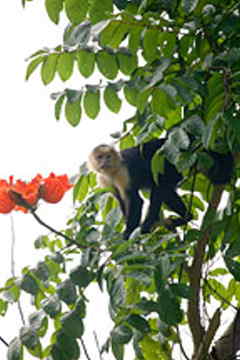
White-Faced Monkey |
|
|
|
|
|


