Birds of the tropics toucans,
motmots and more a feast for the
eyes
Closeups
By Diana Churchill
Whether we are dining, shopping
or bird-watching, as humans we
have a tendency to be lured by
the attraction of eating, buying
or seeing something new. And
while we may wait for those new
things to come to us, we also
can satisfy our thirst for
newness by traveling to parts
unknown.
In late July, I embarked on a
group birding adventure to the
rain forests and mountains of
Costa Rica. While I visited
Costa Rica last summer, I was
mostly studying Spanish with a
little birding on the side. This
trip was 12 days of non-stop
birding led by the expert
naturalist guides of Costa Rica
Expeditions.
In spite of its small size
(think West Virginia or
Scotland), Costa Rica ranks 15th
on the biodiversity list, with
12,000 species of plants, 1,239
species of butterflies, 850
species of birds, 440 species of
reptiles and amphibians and 232
species of mammals. Much of this
diversity is because Costa Rica
has rain forest, which while it
covers only two percent of the
earth's surface, accounts for
about 50 percent of all life on
our planet.
In addition to rain forest,
Costa Rica also has coastline on
the Caribbean and the Pacific,
as well as mountains and cloud
forests. While many of our
familiar bird friends - the
neo-tropical warblers, vireos,
tanagers, buntings and orioles -
spend the winter in Costa Rica,
a host of other species find
that the tropical profusion of
nectar, fruit and insects makes
for easy living.
I just love the challenge of
encountering a whole new set of
birds and matching them to their
habitats. While most of us are
familiar with toucans (think
Fruit Loops), Costa Rica also
has guans, tinamous, cotingas,
motmots, antbirds, and
woodcreepers. Nearly 50 species
of hummingbird flit from flower
to flower, sipping nectar and
distributing pollen, while more
than 40 species of tanager feast
on fruit and bugs. Some 75
different species of flycatchers
present serious identification
challenges to novice birders.
Our trip began in the central
province of Heredia - at the
Hotel Bougainvillea. I dropped
off my luggage and headed for
the gardens, undeterred by the
overcast skies and rain
(anything from a downpour to a
drizzle) that I came to
understand was the norm for
afternoon in Costa Rica. Many
members of our group were
already assembled in the
bird-watching tower, scanning
the compost piles of rotting
fruit for the elusive Prevost's
ground sparrow.
I noticed first the unfamiliar
sounds. There was a whistled
"drink your tea," reminiscent of
a towhee, which turned out to be
a grayish saltator. A loud,
ringing, bubbly call could be
traced to a pair of plain wrens
going back and forth to a nest.
Occasionally, a series of
raucous squawks would alert us
to a fly-by flock of parrots or
parakeets. Frustratingly, most
of these birds flew high and
fast, making it difficult to
discern sulphur wings, orange
chins or red lores.
Strolling about the grounds, I
picked up a damp feather. It was
iridescent bluish-green and
probably belonged, according to
Barbara Drummond, to a
blue-crowned motmot. Half an
hour later we found its owner,
perched at eye level in a low
tree not six feet from where we
were standing. Motmots are
colorful forest birds with long
racquet-tipped tails, which they
often swing like pendulums. They
tend to perch motionless for
long intervals, scanning for
invertebrates, small reptiles
and amphibians. Motmots also
plan ahead. They dig long
tunnels during the wet season
while the mud is soft, and
return to them to nest during
the dry season.
Our journey continued to the
highlands around the Savegre
Mountain Lodge, where at one
stop we found not one but six
resplendent quetzals. We watched
the slaty flowerpiercer piercing
the blossoms of the mallow bush,
while nearby in the rushing
waters of a mountain stream, a
tiny torrent tyrannulet chased
the insects that hovered above
the water.
Black guans came to the feeders
at Bosque de Paz, a private
reserve in the central
highlands, while emerald
toucanets fed on fruit in the
canopy, and the familiar
American dipper worked a nearby
rocky stream.
At Carrara National Park, we
were treated to the spectacle of
a family of scarlet macaws
returning to their nest cavity,
and at La Selva Biological
Reserve, we managed to get looks
at both the 36-inch great
curassow and the three-inch,
black-capped pygmy tyrant.
If you're into numbers, my final
tally for the trip was 285 bird
species seen, 188 of which were
new to me. That might just
satisfy my thirst for newness -
at least until next year! Good
birding. |
|
|
|
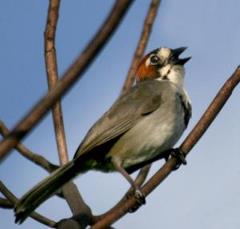
Prevost's ground sparrow was sought after (and found) at
Hotel Bougainvillea. |
|
|
|
|
|


