Costa Rican families adopt
Mohawk students
By Jill Gosche
A teacher says people can be
reluctant to travel to Costa
Rica, a different country,
because they’re gone for three
weeks. Once they get there,
though, they overcome the
culture shock.
Victor Parlier, the Spanish
teacher at Mohawk High School,
said a lot of the same
reservations return later — but
the emotions re-emerge because
people are saying farewell to
the country, not preparing to
visit it.
Parlier keeps in contact with
Costa Ricans he recently left
behind.
“It’s not a world away,” he
said. “It’s just a phone call
away or an e-mail away or a
seven-hour plane trip away.”
Juniors Kaleb Luidhardt and Nick
Norwood, and Steve Curlis, a
senior, traveled with Parlier to
Cartago, Costa Rica, June
16-July 7, as part of a Spanish
Club trip.
Parlier said he travels with
students every other summer, and
this marks the sixth time he’s
taken them on a trip.
Norwood said the excursion
sounded fun, and he went because
he could experience another
country and learn Spanish; he
knew a little before he left.
“For a while, (immersion is)
kind of hard, but after a little
bit, you pick it up,” he said.
Parlier said students started to
get used to speaking the
language and could talk back by
the end of the first week.
“The first couple days are
always a whirlwind,” he said.
The four men all lived with
different host families, and
each had his own parents and
siblings. Curlis said Costa
Ricans are a lot friendlier than
people in the United States and
are accepting. He said he felt
like he was part of his host
family by the end of the trip.
“My mom treated me as her own
son,” he said. “I had to do
chores.”
Parlier said Costa Ricans are
inviting, loving and warm.
“They’re a lot nicer than
Americans,” he said. “It’s a
cultural thing. … They want to
love you.”
Parlier said his host family
lives on a farm in the
mountains, and the area offered
an incredible view.
“You stand up there, and you see
mountains and volcanoes,” he
said. “You can see the mist
coming over the mountaintops.”
The men visited Manuel Antonio
National Park, an amusement
park, museum and rain forest,
and also went shopping.
“We did get a chance to go to
school when we were there,”
Parlier said.
Parlier said school in Costa
Rica is different than in the
U.S and resembles a college
atmosphere. Curlis said students
attend classes on varying
schedules.
“You can just come and go
through classes,” he said. “I
think school’s more of a place
to hang out than it is to
learn.”
Parlier said students have a lot
of respect for their teachers.
They stand when instructors
enter a room, much like people
do when a judge enters a
courtroom, he said.
“It’s not informal, but it’s
relaxed,” he said.
The three students all play
soccer for Mohawk and got a
chance to show off their skills
in Costa Rica.
“Soccer down there is just as
big as football is up here —
even bigger,”
Norwood said.
He said soccer fields could be
in rain forests and would be
mowed every day, and Parlier
said they’re manicured like
American golf courses.
“There’s always somebody on
them,” he said.
Parlier said a soccer game can
get as much hype as an Ohio
State-Michigan game.
“It’s crazy,” he said.
Norwood said he could find
someone who knew how to speak
English everywhere he went.
Parlier said people tend to
think Central Americans live in
a Third-World country, but the
area is well-developed.
“They have computers,” he said.
“Everybody has cell phones.”
Parlier said he hopes his
students gain a different
perspective and learn about the
Spanish language. He also said
he hopes they learn the world
isn’t just Mohawk, Tiffin, Ohio
or the U.S.
“It is a world, and it’s closer
than what we think it is,” he
said. “It’s family.”
|
|
|
|
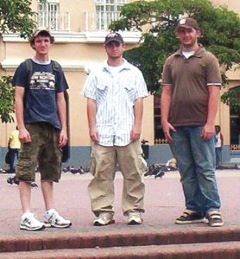
Steve Curlis, Kaleb Luidhardt and Nick Norwood, all
Mohawk High School students, stand in a plaza outside
National Theater in San José. Photo courtest Victor
Parler |
|
|
|
|
|


