Dengue
Fever
Perspectives
 |
|
Image:
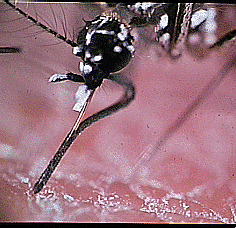
The stylets (needle-like
structures) and proboscis
(elongated mouth) of an Aedes
aegypti feeding. Dengue
viruses are transmitted during
the feeding process.
|
Dengue
and dengue hemorrhagic fever (DHF) are
caused by one of four closely related,
but antigenically distinct, virus
serotypes (DEN-1, DEN-2, DEN-3, and
DEN-4), of the genus Flavivirus.
Infection with one of these serotypes
does not provide cross-protective
immunity, so persons living in a
dengue-endemic area can have four
dengue infections during their
lifetimes. Dengue is primarily a
disease of the tropics, and the
viruses that cause it are maintained
in a cycle that involves humans and Aedes
aegypti, a domestic,
day-biting mosquito that prefers to
feed on humans. Infection with dengue
viruses produces a spectrum of
clinical illness ranging from a
nonspecific viral syndrome to severe
and fatal hemorrhagic disease.
Important risk factors for DHF include
the strain and serotype of the
infecting virus, as well as the age,
immune status, and genetic
predisposition of the patient.
History
of Dengue
The
first reported epidemics of dengue
fever occurred in 1779-1780 in Asia,
Africa, and North America; the near
simultaneous occurrence of outbreaks
on three continents indicates that
these viruses and their mosquito
vector have had a worldwide
distribution in the tropics for more
than 200 years. During most of this
time, dengue fever was considered a
benign, nonfatal disease of visitors
to the tropics. Generally, there were
long intervals (10-40 years) between
major epidemics, mainly because the
viruses and their mosquito vector
could only be transported between
population centers by sailing vessels.
A
global pandemic of dengue began in
Southeast Asia after World War II and
has intensified during the last 15
years. Epidemics caused by multiple
serotypes (hyperendemicity) are more
frequent, the geographic distribution
of dengue viruses and their mosquito
vectors has expanded, and DHF has
emerged in the Pacific region and the
Americas. In Southeast Asia, epidemic
DHF first appeared in the 1950s, but
by 1975 it had become a leading cause
of hospitalization and death among
children in many countries in that
region.
Current
Trends
In
the 1980s, DHF began a second
expansion into Asia when Sri Lanka,
India, and the Maldive Islands had
their first major DHF epidemics;
Pakistan first reported an epidemic of
dengue fever in 1994. The recent
epidemics in Sri Lanka and India were
associated with multiple dengue virus
serotypes, but DEN-3 was predominant
and was genetically distinct from
DEN-3 viruses previously isolated from
infected persons in those countries.
After an absence of 35 years, epidemic
dengue fever occurred in both Taiwan
and the People's Republic of China in
the 1980s. The People's Republic of
China had a series of epidemics caused
by all four serotypes, and its first
major epidemic of DHF, caused by
DEN-2, was reported on Hainan Island
in 1985. Singapore also had a
resurgence of dengue/DHF from 1990 to
1994 after a successful control
program had prevented significant
transmission for over 20 years. In
other countries of Asia where DHF is
endemic, the epidemics have become
progressively larger in the last 15
years.
In
the Pacific, dengue viruses were
reintroduced in the early 1970s after
an absence of more than 25 years.
Epidemic activity caused by all four
serotypes has intensified in recent
years with major epidemics of DHF on
several islands.
Despite
poor surveillance for dengue in
Africa, epidemic dengue fever caused
by all four serotypes has increased
dramatically since 1980. Most activity
has occurred in East Africa, and major
epidemics were reported for the first
time in the Seychelles (1977), Kenya
(1982, DEN-2), Mozambique (1985,
DEN-3), Djibouti (1991-92, DEN-2),
Somalia (1982, 1993, DEN-2), and Saudi
Arabia (1994, DEN-2). Epidemic DHF has
been reported in neither Africa nor
the Middle East, but sporadic cases
clinically compatible with DHF have
been reported from Mozambique,
Djibouti, and Saudi Arabia.
The
emergence of dengue/DHF as a major
public health problem has been most
dramatic in the American region. In an
effort to prevent urban yellow fever,
which is also transmitted by Ae.
aegypti, the Pan American Health
Organization organized a campaign that
eradicated Ae. aegypti from
most Central and South American
countries in the 1950s and 1960s. As a
result, epidemic dengue occurred only
sporadically in some Caribbean islands
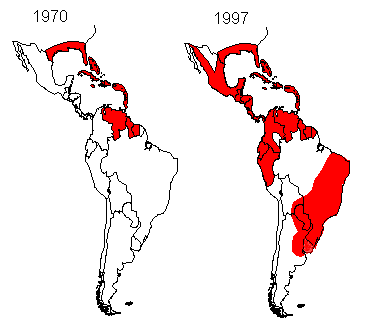
during this period. The Ae. aegypti
eradication program, which was
officially discontinued in the United
States in 1970, gradually eroded
elsewhere, and this species began to
reinfest countries from which it had
been eradicated. In 1997, the
geographic distribution of Ae.
aegypti is wider than its
distribution before the eradication
program.
In
1970, only DEN-2 virus was present in
the Americas, although DEN-3 may have
had a focal distribution in Colombia
and Puerto Rico. In 1977, DEN-1 was
introduced and caused major epidemics
throughout the region over a 16-year
period. DEN-4 was introduced in 1981
and caused similar widespread
epidemics. Also in 1981, a new strain
of DEN-2 from Southeast Asia caused
the first major DHF epidemic in the
Americas (Cuba). This strain has
spread rapidly throughout the region
and has caused outbreaks of DHF in
Venezuela, Colombia, Brazil, French
Guiana, Suriname, and Puerto Rico. By
1997, 18 countries in the American
region had reported confirmed DHF
cases, and DHF is now endemic in many
of these countries.
shaded areas), prior to 1981 and from
1981 to 1997.
DEN-3
virus recently reappeared in the
Americas after an absence of 16 years.
This serotype was first detected in
association with a 1994 dengue/DHF
epidemic in Nicaragua. Almost
simultaneously, DEN-3 was confirmed in
Panama and, in early 1995, in Costa
Rica. In Nicaragua, considerable
numbers of DHF cases were associated
with the epidemic, which was
apparently caused by DEN-3. In Panama
and Costa Rica, the cases were classic
dengue fever.
Viral
envelope gene sequence data from the
DEN-3 strains isolated from Panama and
Nicaragua have shown that this new
American DEN-3 virus strain was likely
a recent introduction from Asia since
it is genetically distinct from the
DEN-3 strain found previously in the
Americas, but is identical to the
DEN-3 virus serotype that caused major
DHF epidemics in Sri Lanka and India
in the 1980s. As suggested by the
finding of a new DEN-3 strain, and the
susceptibility of the population in
the American tropics to it DEN-3
spread rapidly throughout the region
caused major epidemics of dengue/DHF
in Central America in 1995.
In
1997, dengue is the most important
mosquito-borne viral disease affecting
humans; its global distribution is
comparable to that of malaria, and an
estimated 2.5 billion people live in
areas at risk for epidemic
transmission. Each year, tens of
millions of cases of dengue fever
occur and, depending on the year, up
to hundreds of thousands of cases of
DHF. The case-fatality rate of DHF in
most countries is about 5%; most fatal
cases are among children and young
adults.
There is a small, but significant,
risk for dengue outbreaks in the
continental United States. Two
competent mosquito vectors, Ae.
aegypti and Aedes albopictus,
are present and, under certain
circumstances, each could transmit
dengue viruses. This type of
transmission has been detected three
in the last 16 years in south Texas
(1980, 1986, and 1995) and has been
associated with dengue epidemics in
northern Mexico. Moreover, numerous
viruses are introduced annually by
travelers returning from tropical
areas where dengue viruses are
endemic. From 1977 to 1994, a total of
2,248 suspected cases of imported
dengue were reported in the United
States. Although some specimens
collected were not adequate for
laboratory diagnosis, 481(21%) cases
were confirmed as dengue. Many more
cases probably go unreported each year
because surveillance in the United
States is passive and relies on
physicians to recognize the disease,
inquire about the patient's travel
history, obtain proper diagnostic
samples, and report the case. These
data suggest that southern Texas and
the southeastern United States, where Ae.
aegypti is found, are at risk for
dengue transmission and sporadic
outbreaks.
The
reasons for this dramatic global
emergence of dengue/DHF as a major
public health problem are complex and
not well understood. However, several
important factors can be identified.
First, effective mosquito control is
virtually nonexistent in most
dengue-endemic countries. Considerable
emphasis for the past 20 years has
been placed on ultra-low-volume
insecticide space sprays for adult
mosquito control, a relatively
ineffective approach for controlling Ae.
aegypti. Second, major global
demographic changes have occurred, the
most important of which have been
uncontrolled urbanization and
concurrent population growth. These
demographic changes have resulted in
substandard housing and inadequate
water, sewer, and waste management
systems, all of which increase Ae.
aegypti population densities and
facilitate transmission of Ae.
aegypti-borne disease. Third,
increased travel by airplane provides
the ideal mechanism for transporting
dengue viruses between population
centers of the tropics, resulting in a
constant exchange of dengue viruses
and other pathogens. Lastly, in most
countries the public health
infrastructure has deteriorated.
Limited financial and human resources
and competing priorities have resulted
in a "crisis mentality" with
emphasis on implementing so-called
emergency control methods in response
to epidemics rather than on developing
programs to prevent epidemic
transmission. This approach has been
particularly detrimental to dengue
control because, in most countries,
surveillance is (just as in the U.S.)
very inadequate; the system to detect
increased transmission normally relies
on reports by local physicians who
often do not consider dengue in their
differential diagnoses. As a result,
an epidemic has often reached or
passed transmission before it is
detected.
Future
Outlook
No
dengue vaccine is available. Recently,
however, attenuated candidate vaccine
viruses have been developed in
Thailand. These vaccines are safe and
immunogenic when given in various
formulations, including a quadrivalent
vaccine for all four dengue virus
serotypes. Efficacy trials in human
volunteers have yet to be initiated.
Research is also being conducted to
develop second-generation recombinant
vaccine viruses; the Thailand
attenuated viruses are used as a
template. Therefore, an effective
dengue vaccine for public use will not
be available for 5 to 10 years.
Prospects
for reversing the recent trend of
increased epidemic activity and
geographic expansion of dengue are not
promising. New dengue virus strains
and serotypes will likely continue to
be introduced into many areas where
the population densities of Ae.
aegypti are at high levels. With
no new mosquito control technology
available, in recent years public
health authorities have emphasized
disease prevention and mosquito
control through community efforts to
reduce larval breeding sources.
Although this approach will probably
be effective in the long run, it is
unlikely to impact disease
transmission in the near future. We
must, therefore, develop improved,
proactive, laboratory-based
surveillance systems that can provide
early warning of an impending dengue
epidemic. At the very least,
surveillance results can alert the
public to take action and physicians
to diagnose and properly treat dengue/DHF
cases.
 Email
this page to a Friend
Email
this page to a Friend
|


