CUBA:
Ecomaterials for
Low-Cost,
Hurricane-Proof Housing
By Patricia Grogg
.SANTA CLARA, Cuba,
(IPS) - Low-income Cuban
families now have a
greater chance of having
a home of their own
thanks to a
prize-winning
construction method that
uses strong,
locally-produced
alternative materials.
"The hurricane destroyed
my house, but the one I
have now is better and
safer, and was built in
around three months,"
Marilú Figueredo, a
mother of three who
lives in Manicaragua, a
rural district in the
central Cuban province
of Villa Clara, told IPS.
She is one of the
beneficiaries of a plan
for repairing and
building homes that were
damaged or destroyed in
2005 by Hurricane
Dennis, which caused
damages to 120,000 homes
in Cuba, 15,000 of which
were completely levelled.
"I think that if another
hurricane comes, I won't
have any problems," she
said optimistically.
The same confidence is
shared by pensioners
María Trujillo and
Felicia Armenteros, and
by Iluminada Rivero, who
is divorced. The three
women live in Quemado de
Guines, a Villa Clara
town that has been hit
hard by hurricanes over
the years.
The women’s new homes
have replaced the
precarious housing units
they were living in two
years ago. The new
buildings are made of
environmentally-friendly
materials manufactured
in their own towns at a
low-cost, known as
ecomaterials because
they are both ecological
and economic.
The concept covers a
broad range of building
materials, whose common
denominator is the use
of local raw materials
or the recycling of
waste products like
sugar cane bagasse.
Strong results have been
obtained locally with
micro-concrete roofing
tiles, pozzolana (CP-40)
cement -- named for the
volcanic ash of the
Pozzuoli volcano in
Italy -- made with the
ashes of sugar cane
straw, pre-cast hollow
concrete blocks in which
Portland cement has been
partially replaced by
CP-40, and low-energy
fired clay bricks using
bio-waste products as
fuel.
CP-40 is an alternative
binder that requires
less energy than
traditional Portland
cement and therefore
reduces climate changing
carbon dioxide
emissions.
"The key is that we have
returned to our roots,"
Professor Fernando
Martirena told IPS. "In
the past 5,000 years of
human civilisation, the
most widely-used and
sustainable materials
are red bricks, wood and
roman cement. We are now
using them again, but in
conjunction with the
advances made by modern
science and technology."
Ecomaterials provide
alternatives not only
for solving Cuba’s
current housing
shortage, but also for
the problems that will
plague many countries in
the future, when oil and
modern materials "like
glass and titanium" will
be unsustainable and
unaffordable, he said.
Several times more earth
must be removed to
produce a ton of
titanium -- an extremely
strong and versatile
rare metal that is
stronger than steel yet
can be as light as
aluminium -- than to
produce a ton of cement.
"Ecomaterials have shown
to be long-lasting and
attractive, and they
strike a balance with
the environment. By
using them, we are
reducing the size of our
ecological footprint,"
said the expert.
Martirena heads a team
of academics from the
CIDEM research and
development institute at
the Central University
of Las Villas who for
several years have been
seeking low-cost ways to
reduce the vulnerability
of buildings to
hurricanes while coming
up with solutions to
Cuba’s chronic shortage
of decent housing.
This year, their "ecomaterials
in social housing
project" won the World
Habitat Award, bestowed
annually by the Building
and Social Housing
Foundation (BSHF), an
independent research
organisation that
promotes sustainable
development and
innovation in housing.
The prize includes
10,000 pounds sterling
(over 23,000 dollars),
but the most important
aspect is that "the idea
is awarded, and it is a
good way of
disseminating the
techniques, to get
people to learn about
and use them," said
Martirena.
According to the BSHF
web site, the Cuban
project "has developed
and transferred a range
of innovative and
environmentally
sustainable building
materials which can be
manufactured locally in
small workshops and are
suitable for both rural
and urban areas."
The CIDEM project sets
up workshops that train
people how to produce
ecomaterials in their
own communities, as part
of a local production
system designed to be
self-sustaining.
Local residents, and
especially low-income
families, have access to
loans for producing the
ecomaterials for their
own houses from the
Banco Popular de Ahorro
(BPA) (popular savings
bank), explained Belkis
Delgado, a housing
official in Manicaragua.
Although the
technologies using
ecomaterials are geared
toward small-scale,
decentralised
production, to bolster
the local economy by
generating job
opportunities, the
project includes a
strict quality control
system, says CIDEM,
which also provides
ongoing technical
assistance.
"The project has been
successful because we
have not imposed
anything on people.
Flexibility has been our
motto, and we never
aspired to taking over
the role of existing
institutions, but
instead have sought to
forge alliances around a
common goal, while
boosting local
capacities and adapting
ourselves to different
local contexts," said
Martirena.
Omaida Cruz, in charge
of cooperation in the
non-governmental
National Association of
Small Farmers (ANAP) in
Villa Clara, said the
initiative has bolstered
local possibilities for
development.
Around 20 Cuban
municipalities are now
using the alternative
building techniques. In
the northern part of
Villa Clara alone, some
3,000 houses were built,
repaired or renovated
with ecomaterials
between 2000 and 2006.
But "our production has
alleviated, rather than
fully met, demand, which
is high," said Lázaro
Bermúdez, director of a
workshop in Manicaragua.
In this district of
74,500 people, 60
percent of the 27,000
housing units are in
poor or mediocre
condition. According to
officials, the biggest
housing problems in this
mainly farming area are
in rural zones.
This year, the project
will be extended to
provinces in eastern
Cuba.
"At this rate, by 2010
we could have between 40
and 50 workshops
operating throughout the
country. This, together
with government plans
for producing building
materials, could resolve
the current housing
emergency within 10
years," Martirena
predicted.
The CIDEM project has
received funding from
foreign agencies like
the Swiss Agency for
Development and
Cooperation (SDC) and
the European Commission,
and the second phase of
the initiative will also
be supported by the
Canadian International
Development Agency (CIDA).
"Government support for
these projects is also
very important," said
Martirena. "For each
dollar that we invest,
the Cuban state provides
seven, eight, or even 10
dollars. That is what
marks the contrast with
other countries, and
increases the social
impact."
CIDEM began its work in
Villa Clara in the wake
of Hurricane Lili, in
1996. In 1998, after
Hurricane Mitch caused
unprecedented
devastation in Nicaragua
and Honduras, it helped
organise projects for
the relocation of local
communities living in
areas prone to flooding
in those countries.
There are currently 19
ecomaterials workshops
operating in Cuba, and
another 15 worldwide,
including Nicaragua,
Honduras, Panama,
Guatemala, Colombia and
Ecuador in Latin
America, and Namibia,
Nigeria and Mozambique
in Africa. In those
countries, a large part
of the equipment used to
manufacture ecomaterials
was exported from Cuba.
The aim is to expand the
initiative to Venezuela
by means of a one
million-dollar
investment to install
and equip ecomaterial
workshops.
Cuba, a country of 11.2
million, officially has
a housing shortage of
500,000 dwellings. But
of the existing housing
units, 15 percent in
urban areas and 38
percent in rural areas
are substandard,
according to the 2002
census.
A government plan
designed in 2005 for the
construction of 100,000
units a year has been
held up by red tape,
which has slowed down
the delivery of building
materials to the
families selected to
build their own homes,
as well as the lack of
adequate plots of land
to build on. |
|
|
|
|
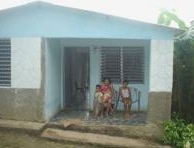
Marilú Figueredo in her
house made of ecomaterials in Manicaragua, Cuba
Foto credit: IPS Cuba.
|
|
|
| |
|


